
The cut-in and cut-out speeds are the wind speeds below and above which the turbine is turned on and off. The cut-in speed (3 to 4 m/s) is the minimum breeze to start producing energy, while the rated speed is when the production peaks. Automated safety mechanisms stop the blades if wind speeds exceed the harmful cut-out speed (25m/s) to prevent structural damage.
In Pakistan, these constraints regulate how projects can use the 50,000 MW Gharo-Jhimpir wind corridor located in Sindh. Local commercial turbines have low cut-in thresholds to catch weak winter breezes, but depend on good cut-out protection during heavy summer monsoons.
Cut-In, Rated and Cut-Out Speed at a Glance
Many buyers type what is cut in and cut out speed in wind turbine into Google after seeing these numbers on a datasheet. The table puts all three speeds side by side. To change m/s to km/h, multiply by 3.6. So 10 m/s is 36 km/h.
| Speed | Meaning | Large (utility-scale) turbine | Small wind turbine | Large turbine in km/h | What the turbine does |
| Cut-in | Lowest wind speed that gives power | 3 to 4 m/s | 2.7 to 4 m/s | 11 to 14 km/h | Starts sending power out |
| Rated | Wind speed that gives full rated power | 11 to 14 m/s | 11 to 14 m/s | 40 to 50 km/h | Holds output at its maximum |
| Cut-out | Highest safe wind speed | 20 to 25 m/s | 18 to 29 m/s | 72 to 90 km/h | Stops the rotor to avoid damage |
These are typical ranges. Every model differs, so check the datasheet before you buy.
What Is Cut-In Speed of a Wind Turbine?

The cut in speed of wind turbine models is the lowest wind speed at which the turbine sends power out. Most large turbines cut in at 3 to 4 m/s. The Vestas V90-1.8 MW cuts in at 3.5 m/s, and the Vestas V164-8.0 MW cuts in at 4 m/s.
Why not start at zero? Wind carries kinetic energy, which is the energy of motion. Light wind has very little of it. The rotor must use that energy to beat three forces:
- Rotor inertia: the effort needed to move heavy blades from rest.
- Bearing friction: the drag inside the moving parts.
- Cogging torque: a magnetic pull inside the generator that resists the first turn.
Wind below 3 m/s cannot beat all three.
Start-up speed is not the same as cut-in speed. Start-up speed is when the rotor begins to turn. Cut-in speed is when the generator connects and power flows. A rotor may turn slowly for a while before that point.
Output at cut-in is tiny. A large turbine gives only a small slice of its rated power at 3 m/s. Real output builds as the wind gets faster.
What Is Cut-Out Speed of a Wind Turbine?
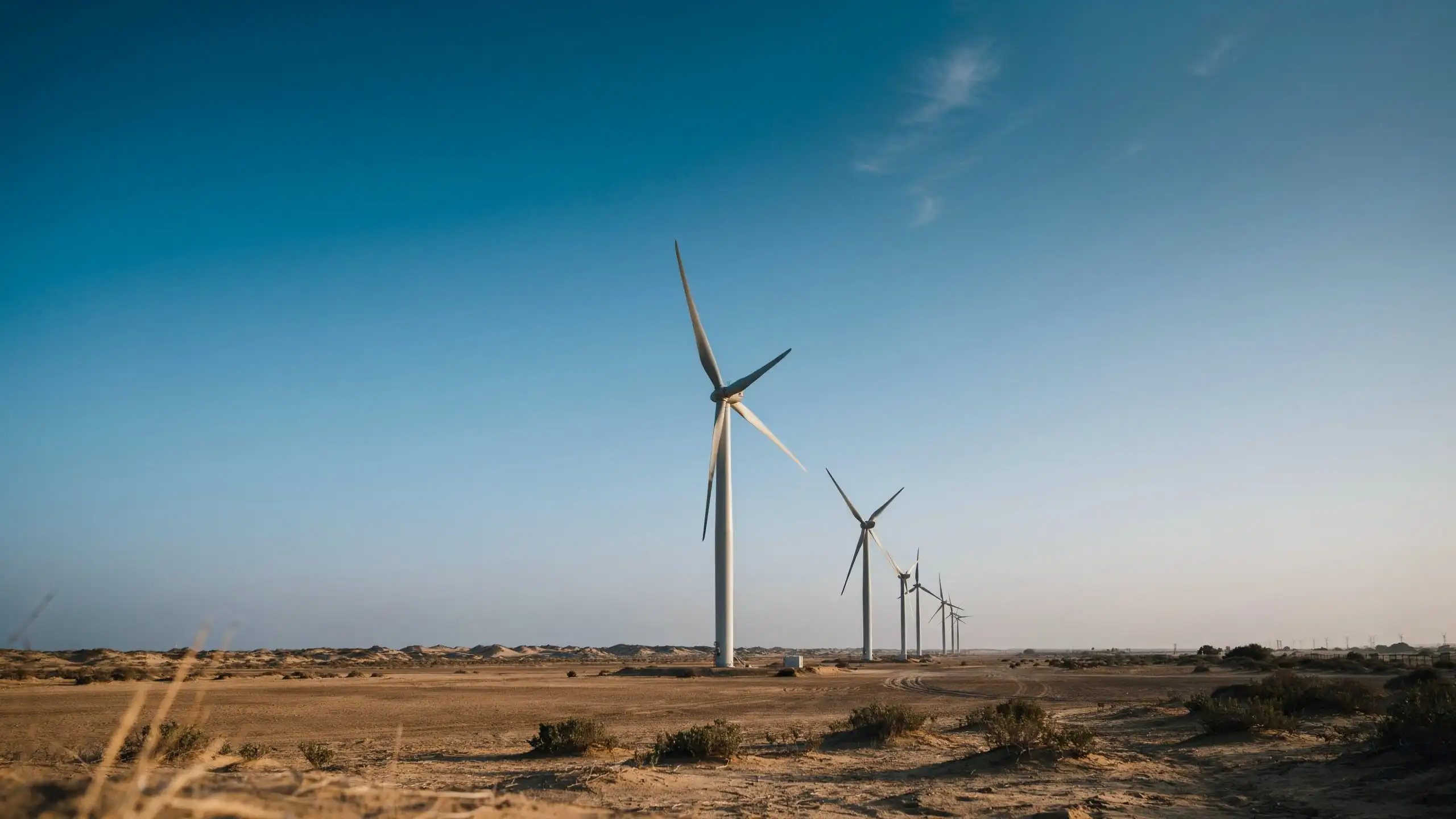
The cut out speed of wind turbine models is the highest wind speed at which the turbine keeps running. Most large turbines cut out between 20 and 25 m/s. The Vestas V100-1.8 MW stops at 20 m/s, while the Envision EN-182 8 MW stops at 25 m/s.
Why stop at all? Storm wind pushes hard on the blades, tower and drivetrain. Loads rise sharply as wind speed climbs. Repeated heavy loads cause structural fatigue, which is slow damage that builds up in metal and blade material. One severe gust can also break parts.
A shutdown follows a clear order:
- The anemometer, a sensor that measures wind speed, reads the wind.
- The SCADA system, which is the control and monitoring software, checks the data.
- The controller pitches the blades to feather. Feathering turns each blade edge-on to the wind, so it stops catching force.
- The mechanical brake holds the rotor still.
- The yaw system can turn the nacelle to cut the load further.
A turbine does not react to one gust. It uses a 10-minute average wind speed, plus gust limits set by the maker. After the wind falls and stays low for a set time, the turbine restarts by itself.
Some newer turbines use a soft cut-out. They lower power step by step as wind nears the limit, instead of stopping at once. This keeps some output during strong wind.
To see how all the parts work together, read our guide on the Wind Energy Working Principle. For a plain overview of turbine parts.
What Is Rated Wind Speed?
The rated wind speed of wind turbine models is the wind speed at which the turbine first reaches its rated power. For many large turbines this is about 11 to 14 m/s. Rated power is the most the generator is built to deliver.
Above rated speed, output stays flat. The turbine uses pitch control, which turns the blades to catch less wind. Some designs use stall control instead, where the blade shape spills extra wind on its own. Both methods keep the machine within its generator limit.
Why not take more power? The generator, gearbox and tower are built for one maximum load. Extra power would overheat parts and cut their life. Turbines give up a little output to run safely for many years.
Wind Turbine Power Curve: How the Three Speeds Fit Together
A wind turbine power curve is a simple graph. Wind speed runs along the bottom. Power output runs up the side. Each model has its own curve, and it shows all three speeds at once.
The curve has four regions:
- Below cut-in: no output.
- Ramp-up: output climbs steeply.
- Rated plateau: output stays flat at rated power.
- Above cut-out: the turbine is stopped and output is zero.
How to read it: find the wind speed on the bottom line. Go up to the curve, then across to read the power.
Take a real example. Zorlu’s Jhimpir wind farm uses Vestas 1.8 MW turbines. It starts at 3 m/s, has 1.8 MW rated power, and stops at 20 m/s. So its curve reads zero below 3 m/s, climbs, stays flat at 1.8 MW, then drops to zero above 20 m/s.
Why does the curve climb so fast? Wind power follows the cube law. Double the wind speed and power rises eight times. A 10 m/s wind carries eight times the power of a 5 m/s wind. The Betz limit also caps what any rotor can take. No turbine can capture more than about 59% of the wind’s energy.
A headline kW number tells you little by itself. A 2 MW label means less if the turbine only hits full power at a wind speed your site rarely sees. Capacity factor, the share of its maximum a turbine delivers over a year, depends on how your wind matches the curve. Always ask the supplier for the manufacturer datasheet curve of the exact model.
See our post on how much electricity one wind turbine can generate for output examples.
Large Wind Farm Turbines vs Small Turbines
Buyers often mix up what is cut in and cut out speed in wind turbine specs for large and small models. The numbers and the rules differ.
| Feature | Large wind farm turbine | Small turbine |
| Cut-in | 3 to 4 m/s | 2.7 to 4 m/s |
| Rated speed | 11 to 14 m/s | 11 to 14 m/s (check datasheet) |
| Cut-out | 20 to 25 m/s | 18 to 29 m/s, varies widely |
| Hub height (tower) | About 70 to 100 m | About 10 to 40 m |
| Typical use | Wind farms feeding the grid | Farms, homes, telecom towers, remote sites |
| Design standard | IEC 61400-1 | IEC 61400-2 |
IEC 61400-1 sets design rules for large turbines. IEC 61400-2 does the same for small ones. Small wind certification means a third party tested the turbine. Ask for the report. Independent tests have found that some small turbines start later than the seller claims.
Cut-out speed and survival speed are different. Survival speed is the extreme wind a parked turbine can sit through without breaking. It is much higher than cut-out speed. The Envision EN-182 has a 25 m/s cut-out speed but a 57 m/s survival speed. Some budget sellers quote only survival speed. That turbine may still shut down at a far lower wind speed.
A lower cut-in speed is not always better. A turbine tuned to start early may give less power in strong wind. Turbulence from buildings and trees can also raise the wind you really need. Vertical-axis turbines (VAWT) often list a low cut-in that only means the rotor starts to spin. Horizontal-axis turbines (HAWT), the common three-blade type, usually list the speed where useful power begins. Compare the full power curve, not one number.
For budget numbers, read how much wind energy costs in Pakistan.
Cut-In and Cut-Out Speed in Pakistan
Wind farms in Gharo-Jhimpir
Pakistan’s best wind sits in the Gharo-Jhimpir corridor in Thatta district, Sindh. It is seen as the most promising site for wind plants, with average speeds above 7 m/s. Zorlu’s Jhimpir site averages 7.8 m/s. That is more than double a 3 m/s cut-in speed, so turbines there have plenty of usable wind. Pakistan had about 2.29 GW of wind capacity in early 2026. Wind power in Pakistan +2
Several makers already run turbines here. Zorlu uses Vestas. Tricon’s project near Jhimpir uses GE 1.7 MW turbines, and Foundation Wind Energy at Gharo uses Nordex. The CPEC Dawood project near Bhanbore uses 33 Goldwind 1.5 MW turbines. Wind data for these sites comes from the Pakistan Meteorological Department (PMD). PMD fitted wind sensors at 10 and 30 metres to record it.
The US National Renewable Energy Laboratory (NREL) also mapped the corridor in 2013. The Alternative Energy Development Board (AEDB) has identified the corridors, and NEPRA grants generation licences to wind plants. The IFC project disclosure for Zorlu is a good public source.
Here, cut-out speed matters mainly in storms. Summer monsoon winds are strong on the Sindh coast. Arabian Sea cyclones can also bring rare storm winds. In those hours a turbine may reach its cut-out speed and pause.
Small turbines for farms, remote sites and telecom towers
Inland and northern areas usually have lower average winds than the Sindh coast. For a small turbine, cut-in speed matters more here. Picture a farm where wind stays under 3 m/s for most of the day. Even a turbine with a 3 m/s cut-in would only make power in the gusty hours.
Do not rely on average wind speed. Averages hide long calm spells. Measure wind at hub height with an anemometer and data logger for several months. Then compare your readings with the turbine’s power curve. Our guide on wind turbine installation explains the steps.
Many off-grid sites in Pakistan use a hybrid wind-solar setup. Wind and sun often fill each other’s gaps, so the site has power in more hours. Solar has limits too. People often ask why do solar panels lose efficiency. The main causes are heat, dust, shade and age. These factors that reduce solar panel efficiency are easy to manage with cleaning and a smart layout.
What affects solar panel efficiency most in a Pakistani summer is panel heat. Solar panel efficiency degradation is slow, a small share each year.
At Progressive Ventures, we plan the wind and solar parts together, using your site’s real wind data. We also handle Solar Energy Installation from design to setup.
Wind Turbine Not Spinning? It May Not Be Cut-In or Cut-Out
A stopped turbine does not always mean a cut-in or cut-out problem. Use this table first.
| Symptom | Likely cause | What to check |
| Slow or stopped in light wind | Wind is below cut-in | Compare anemometer reading with the datasheet cut-in speed |
| Stopped during a storm | Cut-out | Look for a high-wind stop in the SCADA log and wait for the restart |
| Stopped in good wind | Curtailment, controller fault, maintenance or yaw misalignment | Check grid notices, fault codes, the service plan and nacelle direction |
| Starts and stops again and again | Wind is hovering near cut-in | Watch the wind trend. It settles once wind rises |
Wind farms in Pakistan can sit idle in strong wind. NTDC has had to curb wind output because grid capacity between Jhimpir and Gharo is limited. That is curtailment, not cut-out. Grid constraints are outside the turbine’s control. A controller fault can also stop a turbine. So can yaw misalignment, where the rotor does not face the wind. Planned maintenance does the same.
Conclusion
Now you know what is cut in and cut out speed in wind turbine design. Cut-in speed is where power starts, about 3 to 4 m/s. Rated speed is where output hits its maximum. Cut-out speed, about 20 to 25 m/s, is where the turbine stops to stay safe. The wind turbine power curve shows all three on one graph. In Pakistan, measure the real wind at your site before you pick a model.
Planning a wind project? Progressive Ventures offers Wind Energy Installation Services with site checks and expert support. Reach out our team today.
FAQs
What is the typical cut-in speed of a wind turbine?
Most large wind turbines cut in at 3 to 4 m/s, which is 11 to 14 km/h. Small turbines cut in at about 2.7 to 4 m/s. The exact value depends on the model, so check the datasheet.
Why do wind turbines shut down in high wind?
Strong wind puts heavy loads on the blades, tower and gearbox. Running through a storm can cause damage and fatigue. The controller stops the rotor at the cut-out speed, often 20 to 25 m/s, to protect the machine.
Is cut-in speed the same as start-up speed?
No. Start-up speed is when the rotor begins to turn. Cut-in speed is when the turbine starts sending power out. Cut-in is usually a little higher than start-up.
What is the difference between cut-out speed and survival speed?
Cut-out speed is where the turbine stops running to stay safe. Survival speed is the extreme wind a parked turbine can take without breaking. Survival speed is far higher. One example is 25 m/s cut-out against 57 m/s survival.
Can cut-in or cut-out speed be changed?
Only within set limits, and only by the maker or an approved service team. Owners should not change controller settings. It can void the warranty and risk damage. A better fix is to pick a turbine that suits your site.