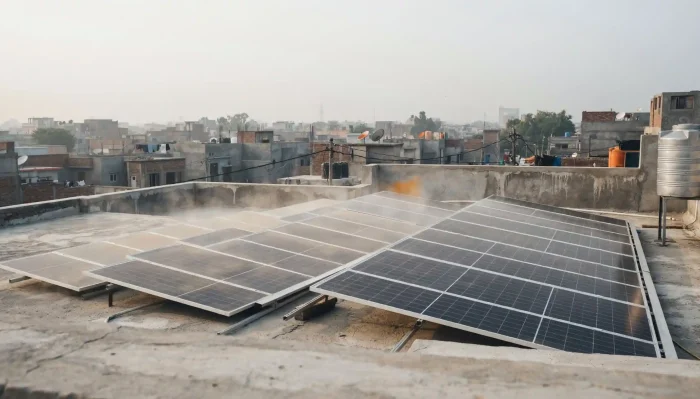
Is solar an AC or DC system? Solar panels generate DC (direct current), and an inverter converts it to AC (alternating current) for your home and the grid. So the answer is both, depending on where in the system you look. Here, “AC” means alternating current, not air conditioning.
That mix confuses many first-time buyers, and we hear the question often at Progressive Ventures. This guide follows the power from your roof to your wall socket, so you know what each part does and what to ask your installer.
Quick Answer: Which Part of a Solar System Is AC or DC?
| Part of the system | Current type |
| Solar panel output | DC |
| Battery storage | DC |
| Inverter output | AC |
| Home appliances and the grid | AC |
Power starts as DC on your roof and ends as AC at your plug.
Why Do Solar Panels Produce DC?
Solar cells are made from layers of silicon. When sunlight hits them, it knocks electrons loose, and the cell’s internal electric field pushes those electrons in one direction. Electrons moving one way is direct current.
The difference between the two types is about direction, not voltage. DC flows steadily one way, like water in a pipe. AC reverses direction many times every second.
For the full science behind the cell, read How Solar Energy is Converted into Electricity?.
Why Do Homes and the Grid Use AC?
Is solar power AC or DC by the time it reaches your sockets? It is AC. Power stations send AC over long distances with lower losses, and transformers can step the voltage up or down easily. Higher voltage means lower current for the same power, and lower current wastes less energy as heat in the cables.
Pakistan’s grid supplies 230 V at 50 Hz, and your fans, fridge, and television are built for it. Edison backed DC and Tesla backed AC in the 1880s, and AC won the grid.
How Does DC Become AC? The Role of the Inverter
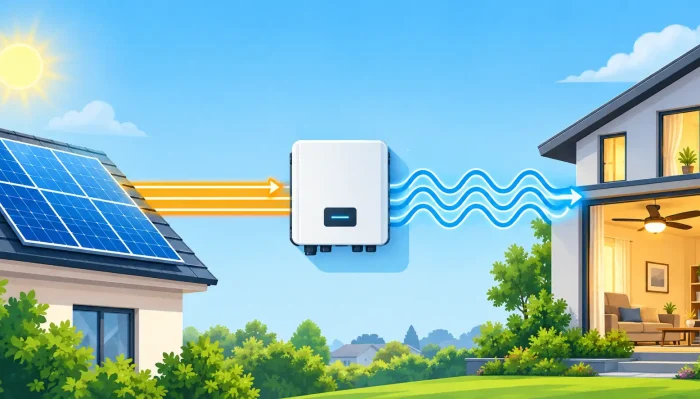
Here is the path your power takes:
- Panels collect sunlight and produce DC.
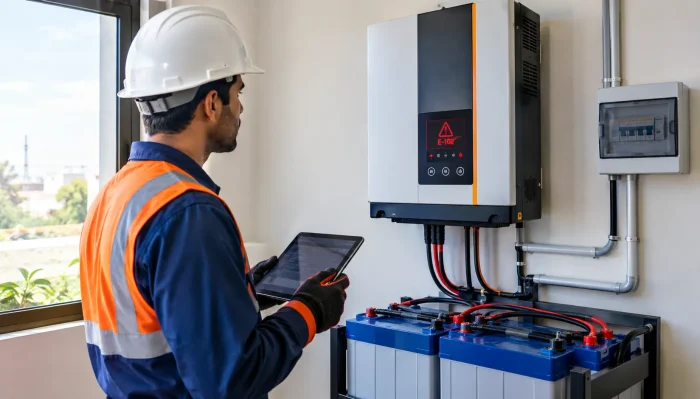
- DC cables carry that power through a DC isolator to the inverter.
- The inverter converts it to AC.
- The AC flows to your distribution board.
- The distribution board feeds your lights, fans, and appliances.
DC to AC in solar happens through fast electronic switching. The inverter flips the DC on and off in a precise pattern and shapes the result into a smooth AC wave at the right voltage.
Frequency matters too. Pakistan’s grid runs at 50 Hz, so the current reverses 50 times a second, and your inverter must match it. A grid-tied inverter syncs with the grid. An off-grid inverter creates its own 50 Hz supply. Most modern inverters also adjust how much power they draw from the panels as sunlight changes, so you get the most from every hour of daylight.
Learn more in What is a Solar Inverter System?
What About “AC Solar Panels”?
They are still DC panels. The only difference is a small microinverter fixed to the back, which converts power to AC right at the panel. AC vs DC solar panels is really a question of where the inverter sits.
| Feature | Standard DC panel with string or hybrid inverter | AC panel with microinverter |
| Installation | One central inverter, simple wiring | An inverter on every panel |
| Cost | Usually lower for home systems | Usually higher |
| Shading | One shaded panel can drag down its string | Each panel works on its own |
| Repair | Inverter is easy to reach | A fault means roof access |
Most Pakistani homes use standard panels with a string or hybrid inverter.
Are Solar Batteries AC or DC?
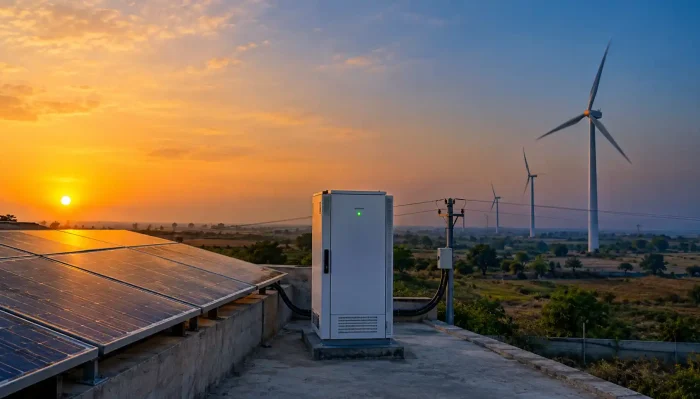
Batteries store DC. In a DC-coupled system, panel power goes straight into the battery through a hybrid inverter without turning into AC first.
In an AC-coupled system, the battery has its own inverter. Power converts from DC to AC, back to DC for storage, then to AC again. Every conversion wastes a little energy.
For sizing and battery types, see Solar Batteries for Solar Panels.
Where Is DC Used Directly in Solar?
Some equipment skips the inverter entirely:
- DC solar water pumps: Panels feed the pump controller directly. Farmers use them for irrigation and tube wells.
- DC fans and LED lighting: Common in off-grid cabins and remote sites.
- DC refrigerators: Built for off-grid and battery-based setups.
Using DC directly removes conversion loss and one part that can fail. These are specialist uses, though. Most homes still run AC appliances.
How Can You Check AC and DC in Your Own Solar System?
You can read the answer off your own equipment:
- Panel label and junction box: These show DC values such as Voc (open-circuit voltage) and Isc (short-circuit current).
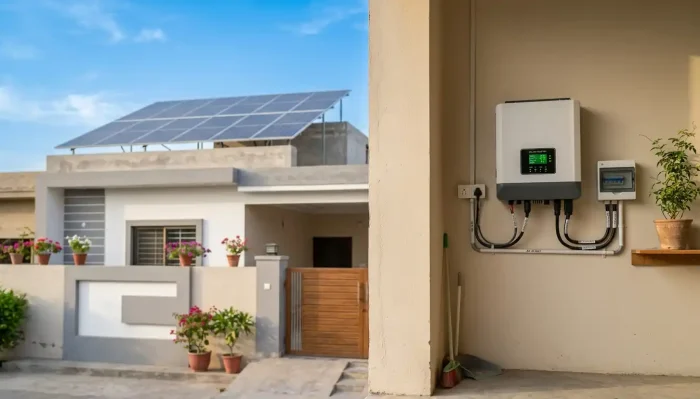
- Inverter label: Look for “DC input” and “AC output” ratings.
- Cables and protection: DC cables usually carry red and black markings, and the system has separate DC isolators and AC breakers.
Ask your installer if something is unclear. Never open DC wiring yourself.
What Are the Safety Differences Between DC and AC in Solar?
DC arcs are harder to put out. AC current drops to zero many times a second, which helps an arc die. DC never does, so you need DC-rated fuses, breakers, and isolators. Standard AC breakers are not a substitute.
Panels also keep producing DC whenever there is daylight, even if you switch the system off. Wires on the DC side can stay live. Always use a qualified installer.
What Does This Mean for Your Solar System in Pakistan?
Pick an inverter with enough capacity for your AC load, meaning everything you run at the same time. Then check that your DC cables, DC protection, and AC wiring are all rated correctly. If you plan to add batteries later, ask whether your inverter is hybrid-ready, so you avoid replacing it.
Progressive Ventures brings 16 years of experience to every system we design. Our Solar Panel Installation service helps make your solar installation more accurate.
Final Thoughts
So, is solar an AC or DC? It is DC at the panel and the battery, and AC at the inverter output and throughout your home. Knowing where the switch happens helps you size your inverter, spot problems, and stay safe around the wiring.
Progressive Ventures can help you plan a system that fits your load. Contact us today for any renewable energy need.
FAQs
Do solar panels produce AC or DC power?
Solar panels produce DC power. An inverter then converts it to AC for your home.
Can solar panels run appliances without an inverter?
Yes, but only DC appliances such as DC pumps and fans. Standard home appliances need AC.
Is a solar battery AC or DC?
A solar battery stores DC power. A hybrid or battery inverter converts it to AC when you need it.
Why can’t we use DC directly in homes?
Most home appliances and the grid are built for AC. Switching would mean replacing nearly every device.
Do AC solar panels need a separate inverter?
No, each AC panel has a microinverter built in. The panel itself still generates DC.