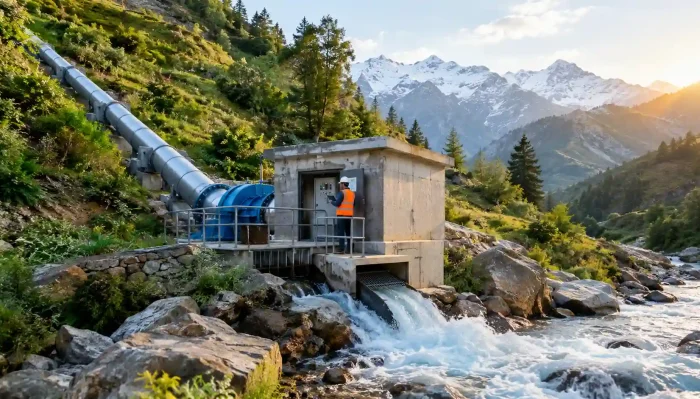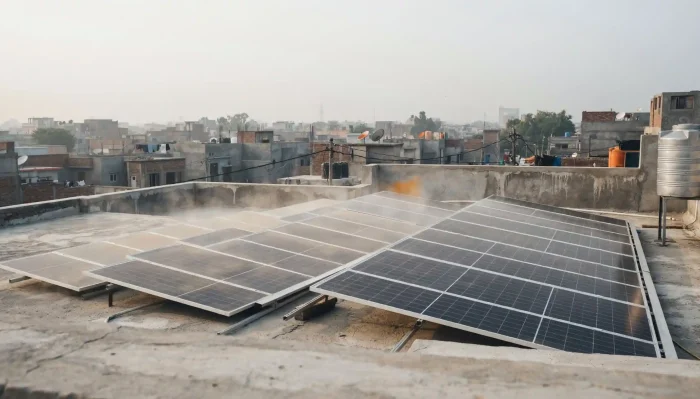
Micro hydropower is a renewable energy system that generates electricity from flowing water on a small scale. It uses the natural height difference and flow of a stream or river to turn a turbine connected to a generator. Unlike solar panels, it can produce electricity day and night when water flow remains steady.
For homes, farms, remote communities, and commercial sites in Pakistan, what is micro hydro power and how does it work is an important question when exploring reliable renewable energy options. Progressive Ventures helps businesses and project owners explore renewable energy solutions based on their site conditions and energy needs.
What Is Micro Hydro Power?
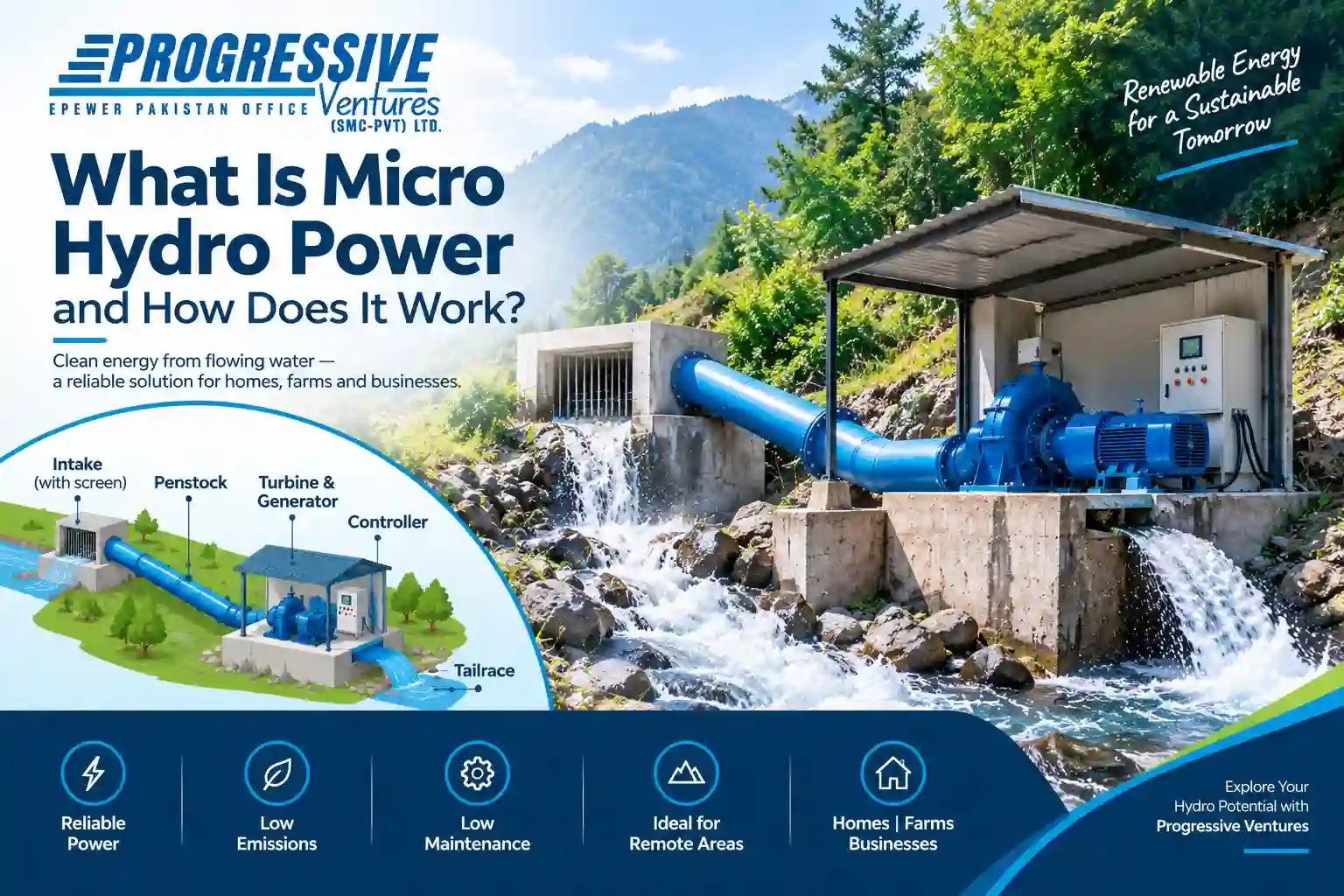
Micro hydropower is a small-scale electricity generation method that converts the energy of moving or falling water into electrical power. Most systems divert part of a stream through a pipe, called a penstock, and direct it towards a turbine.
The turbine spins a generator, which produces electricity for local use, battery storage, or a suitable grid connection. These systems can work without building a large dam, making run-of-river designs useful for suitable mountain streams and water channels.
Pico vs Micro vs Mini vs Small Hydro: What Is the Difference?
Hydropower categories depend on generating capacity. However, there is no single classification used by every country or organization.
| Type | Common capacity range | Typical application |
| Pico hydro | Below 5 kW | Small homes and individual loads |
| Micro hydro | Around 5 kW to 100 kW | Homes, farms and small communities |
| Mini hydro | Around 100 kW to 1 MW | Villages and small commercial projects |
| Small hydro | Around 1 MW to 10 MW | Local grids and larger developments |
These ranges are common working classifications, not universal legal limits. Always check the definition used by the relevant authority before planning a project.
How Does Micro Hydro Power Work Step by Step?
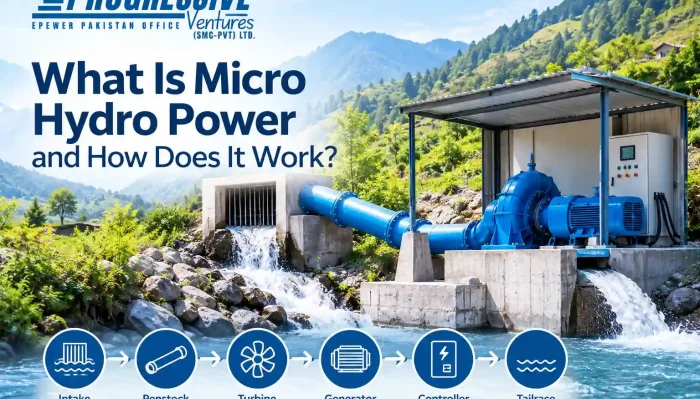
A typical system follows a simple process: it collects flowing water, directs it through a pipe, and uses its force to generate electricity.
System flow:
Intake → Penstock → Turbine → Generator → Controller → Electrical Load
The remaining water exits through a tailrace and returns to the stream.
How Does a Micro Hydro System Work?
Here is how each stage works:
- Intake: A screened opening collects water from a stream or channel while blocking leaves, stones, and other debris.
- Penstock: A closed pipe carries water downhill towards the turbine. Its height difference creates pressure.
- Turbine: Moving water strikes or passes through turbine blades, causing them to rotate.
- Generator: The rotating turbine drives a generator, converting mechanical energy into electricity.
- Controller: Electrical controls regulate the system and protect equipment from unsafe operating conditions.
- Tailrace: Water leaves the turbine and returns to the natural watercourse.
Think of a garden hose with a nozzle. When you narrow the opening, water exits with greater speed. A hydro system uses controlled water flow and pressure to spin its turbine. However, actual power depends on both water volume and available height.
Head and Flow: Which Two Measurements Determine Power?
Two measurements decide whether a water source can generate useful electricity: head and flow.
- Head: The vertical height difference between the water intake and turbine. It is measured in metres.
- Flow: The volume of water available per second. It is measured in litres per second or cubic metres per second.
How Do You Measure Head and Flow?
You can begin with simple site measurements:
- Head measurement: Use a level, measuring equipment, or a professional survey to determine the vertical difference between the intake and turbine.
- Flow measurement: For a small stream, use a bucket and stopwatch where practical. Collect water for a measured time and calculate its flow.
- Seasonal assessment: Repeat measurements during dry months because the lowest water flow often determines reliable system capacity.
For larger streams, engineers may use flow meters, current meters, or other hydrological survey methods.
How Much Power Can a Stream Generate?
A commonly used theoretical power formula is:
Power (kW) = 9.81 × Flow (m³/s) × Net Head (m) × Efficiency
Consider a stream with:
- Flow: 0.02 m³/s
- Net head: 20 metres
- Overall efficiency: 60%
Estimated output:
9.81 × 0.02 × 20 × 0.60 = 2.35 kW
This is an approximate electrical output. Actual performance depends on pipe losses, turbine selection, generator efficiency, and operating conditions.
A fast-moving stream is not automatically suitable. If it has little vertical drop, it may have plenty of flow but insufficient head to generate useful power economically.
What Equipment Does a Micro Hydro System Need?
A complete installation includes several connected components.
| Component | Main function | Cost importance |
| Intake and screen | Collects and filters water | Moderate |
| Penstock | Carries pressurised water | Often high |
| Turbine | Converts water energy into rotation | High |
| Generator | Produces electricity | High |
| Controller and dump load | Regulates electrical output | Moderate |
| Batteries or grid-tie inverter | Stores or supplies electricity | Depends on design |
| Powerhouse | Protects generation equipment | Site-dependent |
The penstock can become one of the largest expenses, especially when the turbine is far from the intake. Pipe length, diameter, material, terrain, and pressure rating all affect its cost.
Which Turbine Type Is Suitable for Your Site?
The right turbine depends mainly on available head and flow. Choosing the wrong design can reduce output and increase maintenance.
| Turbine type | Suitable conditions | Common use |
| Pelton | High head, low flow | Mountain streams |
| Turgo | Medium to high head | Small hydro installations |
| Crossflow | Low to medium head, moderate flow | Community and farm systems |
| Francis | Medium head and flow | Larger, engineered installations |
| Propeller/Kaplan | Low head, high flow | Rivers and water channels |
How Do You Choose a Turbine?
Use these general guidelines:
- High head with low flow: Consider Pelton or Turgo.
- Low to medium head with moderate flow: Consider crossflow.
- Medium head and substantial flow: Assess Francis.
- Low head with high flow: Assess propeller or Kaplan designs.
An engineer should confirm the final selection using measured head, minimum seasonal flow, operating speed, and required electrical output.
How Much Does Micro Hydro Power Cost?
The cost of a micro hydel power plant depends on its location, generating capacity, water conditions, and construction requirements. There is no reliable single price for every project in Pakistan.
The main cost factors include:
- Penstock length, diameter, and material.
- Intake, water channels, and civil construction.
- Turbine and generator capacity.
- Electrical controls, protection, and wiring.
- Battery storage or grid connection.
- Transport, installation, labour, and maintenance access.
Example of a Project Cost Assessment
Consider a proposed 2.35 kW installation using the head and flow from the earlier example. Its budget should include the intake, penstock, turbine-generator, controls, powerhouse, and installation.
A genuine PKR quotation requires local supplier prices and a site survey. Published international project costs vary considerably, so applying an old foreign price directly to a Pakistani installation would be misleading.
Research on micro-hydro installations also identifies the penstock as a major cost factor. A longer pipe can increase material costs and reduce available pressure through friction losses.
How Do You Calculate Electricity Cost?
Use this basic formula:
Cost per kWh = Total lifetime project cost ÷ Total lifetime electricity generation
Include installation, financing, maintenance, replacement parts, and expected operating years. A site producing more electricity throughout the year can have a lower cost per unit.
Well-maintained civil structures can serve for decades, while turbines, bearings, generators, and electrical controls need periodic servicing or replacement.
How Much Electricity Can a Micro Hydro System Generate?
Electricity production depends on rated capacity and capacity factor. Capacity factor tells you how much electricity a system actually produces compared with running at full power all the time.
A 1 kW system could theoretically generate 720 kWh in a 30-day month if it operates continuously at full output.
However, actual production is lower when water flow changes or equipment requires maintenance.
| Capacity factor | Approximate monthly generation |
| 40% | 288 kWh |
| 50% | 360 kWh |
| 60% | 432 kWh |
| 80% | 576 kWh |
These are examples, not guaranteed production figures.
How Does Seasonal Water Flow Affect Generation?
In Pakistan’s northern regions, stream flow can change with rainfall, snowmelt, and seasonal conditions. Some locations receive stronger flows during particular months and much less water during dry periods.
This affects system design in several ways:
- Measure water availability during the driest month.
- Avoid selecting a turbine based only on peak-season flow.
- Consider battery storage for short-term changes and backup generation for extended shortages.
- Protect the intake against sediment, leaves, and seasonal debris.
Micro Hydro vs Solar vs Wind: Which Is Better?
Each renewable energy source has different operating conditions.
| Factor | Micro hydro | Solar | Wind |
| Output pattern | Can operate continuously | Daylight-dependent | Wind-dependent |
| Site requirement | Suitable head and water flow | Adequate sunlight and space | Suitable wind speed |
| Maintenance | Mechanical and water-system checks | Relatively low | Mechanical inspections |
| Battery requirement | Depends on system design | Depends on system design | Depends on system design |
| Main limitation | Water availability | Sunlight and shading | Variable wind |
Hydro is attractive when a site has steady water flow throughout the year. Solar is usually more practical where suitable sunlight is available but flowing water is not.
Combining hydro and solar can improve supply because their generation patterns may complement each other. The final design should consider seasonal production, storage needs, and total project cost.
Permits, Water Rights, and Environmental Impact
Run-of-river hydropower generally diverts part of a stream through a turbine and returns it downstream. It usually requires less water storage than a conventional dam, but it still affects the local watercourse.
Responsible planning should include:
- Maintaining sufficient downstream flow for aquatic life and other water users.
- Assessing fish movement and providing suitable passage where required.
- Controlling soil erosion and sediment around construction areas.
- Consulting local communities and downstream water users.
- Obtaining the necessary water-use permissions and environmental approvals.
In Pakistan, requirements depend on the province, water source, project type, and connection arrangement. For example, a KP Environmental Protection Agency approval document for a mini/micro hydropower project requires coordination with the Irrigation Department.
Check the relevant provincial Irrigation Department, Environmental Protection Agency, and energy authorities before construction. Grid-connected projects may also need additional technical and regulatory approvals.
Is Your Site Suitable for Micro Hydro? Follow These 5 Steps
Before investing in equipment, assess the site carefully.
- Measure the head: Find the vertical distance between the water intake and proposed turbine location.
- Measure minimum flow: Check the stream during its driest period to establish dependable water availability.
- Estimate the pipe route: Measure the penstock distance and identify difficult terrain or installation points.
- Check water rights: Confirm that water use will not affect existing users, irrigation, or environmental requirements.
- Request a technical quotation: Ask an experienced engineering team to assess the site and prepare a complete system design.
A useful site checklist should record head, seasonal flow, pipe length, estimated output, water permissions, and installation costs. Keep these measurements together before comparing supplier quotations.
Common Micro Hydro Installation Mistakes
Even a promising water source can produce poor results if the system is not designed correctly.
Avoid these common mistakes:
- Oversizing the turbine: Selecting equipment for more water than the stream can reliably supply.
- Ignoring dry-season flow: Designing around rainy-season measurements instead of dependable minimum flow.
- Using an unsuitable penstock: Long or narrow pipes can cause pressure losses and reduce output.
- Skipping the dump load: Some off-grid systems need a properly sized dump load to manage excess electricity and maintain safe operation.
- Ignoring permits: Starting construction before obtaining required approvals can cause delays and legal problems.
A proper feasibility assessment helps identify these problems before major money is spent. If you are exploring a hydropower project, learn more about our team’s proper Hydel Energy Installation services across Pakistan.
Final Thoughts
Micro hydropower can provide dependable renewable electricity when a site has sufficient head and year-round water flow. However, successful installation depends on accurate measurements, suitable turbine selection, proper pipe sizing, and responsible water management.
For homes, farms, remote communities, and commercial developments in Pakistan, the right design starts with a detailed site assessment. Progressive Ventures brings 16 years of experience in renewable energy solutions and supports projects involving solar, wind, and hydel energy. Contact us today to discuss your project requirements and plan a suitable renewable energy system.
FAQs
Can micro hydro power a whole house?
Yes. A properly sized system can power an entire home if its water flow and head meet the household’s electricity demand.
How small a stream can work?
Even a small stream can generate electricity if it provides sufficient flow and vertical drop. A site assessment determines its potential.
Can I connect a micro hydro system to the grid?
Yes. A compatible grid-tie inverter and approved electrical connection are required, along with relevant regulatory approvals.
Is micro hydro worth it compared with solar?
It can be worthwhile where water flows consistently throughout the year. Solar is often more practical where suitable water resources are unavailable.
Does micro hydro work in winter or freezing temperatures?
Yes. It can operate in winter if water continues flowing and the equipment is protected against ice and freezing conditions.