Here’s the short version, since you probably don’t want to scroll through five paragraphs to get it. A typical onshore wind turbine, the 2 to 3 megawatt (MW) size used in most commercial wind farms, produces somewhere between 5 and 10.5 million kilowatt-hours (kWh) of electricity in a year. In Pakistan, where an average household uses far less power than a home in Europe or North America, that’s enough for close to 2,000 homes from one single turbine.
That number changes a lot depending on wind speed, turbine size, and where the turbine sits. So let’s go through it properly. We’ll cover how much electricity can one wind turbine generate per day, what the math actually looks like behind these numbers, and how Pakistan’s own wind corridor in Sindh stacks up against the giant machines being tested in China right now.
Quick answer: How much electricity can one wind turbine generate? A typical 2–3 MW onshore turbine produces about 5 to 10.5 million kWh per year. Using Pakistan’s average household consumption of roughly 300–400 units (kWh) a month, that’s enough to power around 1,500 to 2,000 homes for a full year. Real output depends on wind speed, turbine size, and site conditions.
How Much Power Does a Wind Turbine Produce Per Day?
Take the annual number and divide it by 365, and you get the daily figure. It’s not more complicated than that.
A 2 MW turbine running at a 30% capacity factor produces roughly 14,400 kWh a day. Push that to a 3 MW turbine running at 40% on a strong site, and daily output climbs to around 28,800 kWh. So how much power does a wind turbine produce per day in terms most of us can picture?
A single mid-size turbine, on an average day, generates more electricity than 100 typical Pakistani homes use in that same day, based on daily household use of roughly 10 to 35 units depending on the season.
That said, don’t expect a flat number every day. Wind isn’t consistent. Karachi’s coastal breeze in June behaves nothing like a still January morning in Punjab. A turbine might sit near zero output for hours, then run close to full capacity that same afternoon. This is exactly why capacity factor, the average output across a full year, matters far more than any single day’s reading when you’re sizing a project or comparing turbine models.
How Many Kilowatts Can a Wind Turbine Produce? (By Size)
How much power does one wind turbine produce really comes down to one thing first: how big is it? A rooftop-scale turbine and a 26 MW offshore giant aren’t playing the same game. Here’s the breakdown by size, using capacity factor ranges reported by the U.S. Department of Energy alongside Pakistan-specific figures from the Gharo-Jhimpir wind corridor in Sindh, where capacity factors have historically run between 32% and 35%.
| Turbine Type | Rated Capacity | Typical Capacity Factor | Daily Output | Monthly Output | Annual Output | Homes Powered* |
| Small residential | 10 kW | 20% | ~48 kWh | ~1,460 kWh | ~17,500 kWh | ~4 homes |
| Community/commercial | 100 kW | 25% | ~600 kWh | ~18,250 kWh | ~219,000 kWh | ~55 homes |
| Mid-size onshore (Sindh corridor average) | 2.5 MW | 34% | ~20,400 kWh | ~620,500 kWh | ~7.45 million kWh | ~1,860 homes |
| Large onshore | 5 MW | 38% | ~45,600 kWh | ~1.39 million kWh | ~16.6 million kWh | ~4,160 homes |
| Large offshore (not yet built in Pakistan) | 14 MW | 48% | ~161,300 kWh | ~4.9 million kWh | ~58.9 million kWh | ~14,715 homes |
| Newest mega offshore turbine (China, 2026) | 26 MW | ~44% | ~274,000 kWh | ~8.3 million kWh | ~100 million kWh | ~25,000 homes |
Homes powered here is based on an average Pakistani household using about 300 to 400 units (kWh) a month, which lines up with figures from local solar and load-calculation guides. Bigger homes running two or three ACs will pull much more than that, sometimes over 1,000 units a month.
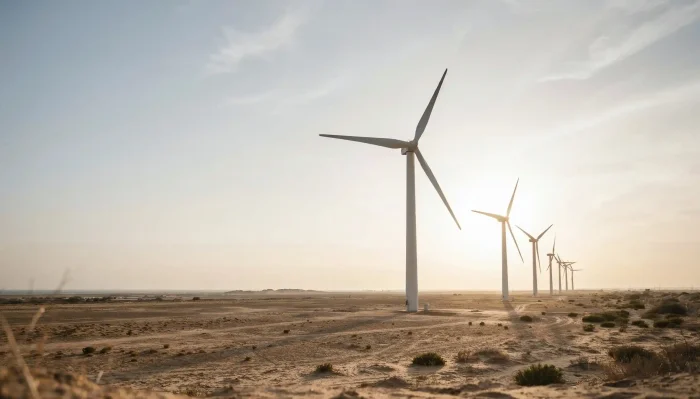
That last row is worth sitting with for a second. One 26 MW turbine, still in testing, could theoretically cover the electricity needs of a small town on its own. Pakistan doesn’t have anything close to that size yet. Most turbines running in the Gharo-Jhimpir corridor today are in the 1.7 to 2.1 MW range, similar to the GE 1.7-103 units used at projects like Artistic Energy and the Hawa Power Project in Jhimpir.
The Formula Behind Wind Turbine Power Output
You don’t need to be an engineer to follow this, though it looks intimidating at first glance:
P = ½ × ρ × A × v³ × Cp
Broken down into plain words:
- P is power output, in watts.
- ρ (rho) is air density, roughly 1.225 kg per cubic meter at sea level. Cooler, denser air packs more punch than hot, thin air, which is one small reason winter wind often produces more than summer wind at the same speed.
- A is the swept area, the size of the circle the spinning blades trace out. Longer blades mean a bigger circle, which means more wind gets caught.
- v is wind speed. This is the part that surprises most people, because it’s cubed.
- Cp is capture efficiency, or how much of the wind’s available energy the turbine actually turns into electricity.
Because wind speed is cubed, small changes in wind matter a huge amount. Double the wind speed and you don’t get double the power, you get eight times the power, since 2³ works out to 8. That’s why coastal sites like Gharo and Jhimpir, with steady 7 to 8 m/s winds off the Arabian Sea, were picked for Pakistan’s wind corridor in the first place. A slightly stronger, steadier wind beats a gusty, unpredictable one by a wide margin, not a small one.
There’s also a ceiling on Cp that no turbine, anywhere, has ever beaten. German physicist Albert Betz proved back in 1919 that a turbine can never capture more than 59.3% of the wind’s kinetic energy. This is known as Betz’s Law. Real turbines land well under that number. Gearbox friction, generator losses, and blade design typically bring real-world Cp down to somewhere between 35% and 45%, according to data compiled by the University of Michigan’s Center for Sustainable Systems.
Worked Example: Calculating One Turbine’s Output
Let’s actually do the math, since most articles on this topic skip it entirely. We’ll use a common turbine spec: a 3 MW onshore turbine, 120-meter rotor diameter, running in an 8 m/s wind, a fairly average breeze and well below its rated wind speed.
Step 1: Find the swept area. Radius = 120 ÷ 2 = 60 meters Swept area (A) = π × 60² ≈ 11,310 square meters
Step 2: Plug in air density. ρ = 1.225 kg/m³
Step 3: Cube the wind speed. v³ = 8³ = 512
Step 4: Apply a realistic capture efficiency. Cp = 0.40, well under the Betz limit of 0.593
Step 5: Multiply it out. P = 0.5 × 1.225 × 11,310 × 512 × 0.40 ≈ 1,418,800 watts, or about 1.42 MW
So at 8 m/s, this 3 MW turbine is only putting out 1.42 MW, less than half of what it’s rated for. That’s completely normal. Turbines run through three thresholds: cut-in speed (around 3 to 4 m/s, when the blades first start turning), rated wind speed (usually 11 to 13 m/s, where the turbine hits its full nameplate output), and cut-out speed (around 25 m/s, where it shuts down to avoid damage in a storm).
This single calculation shows how much electricity can one wind turbine generate at any given moment, and why that answer keeps shifting through the day.
Onshore Wind in Pakistan vs. Global Offshore Wind
Pakistan currently has no offshore wind farms. Every project in the country, from Zorlu’s original 50 MW Jhimpir plant to newer developments like Triconboston’s 150 MW project backed by Sapphire Textile Mills, sits onshore in the Gharo-Jhimpir corridor in Sindh. It’s worth seeing how that compares to what’s happening offshore elsewhere in the world.
| Factor | Onshore (Pakistan) | Offshore (global) |
| Typical turbine size | 1.7–2.5 MW | 8–26 MW |
| Capacity factor | 32–35% (Gharo-Jhimpir average) | 40–55% |
| Wind consistency | Strong sea-land breeze cycle, but variable inland | Steady, less turbulent open-water wind |
| Reported tariff/cost | Historic NEPRA levelized tariff around Rs. 13.69/kWh for early Jhimpir projects | Roughly $75–95 per MWh today, falling toward $35–45 by 2030 |
| Grid limitation | Transmission bottlenecks between Jhimpir and the national grid limit output | Generally fewer local grid constraints in mature markets |
That transmission bottleneck matters more than most people realize. Pakistan’s wind corridor has an estimated exploitable potential of around 11,000 MW, yet the country had only about 1,845 MW of installed wind capacity as of 2025, spread across 36 projects. The main obstacle isn’t wind. It’s the grid’s capacity to carry that power away from Sindh, which sometimes forces NTDC to curtail output even on windy days.
What Affects How Much Electricity a Turbine Actually Generates?
The table numbers above are averages, and real output moves around for a handful of reasons:
- Wind speed changes. The biggest factor by far, since power scales with the cube of wind speed.
- Air density. Turbines in hotter, thinner air capture less energy from the same wind speed than turbines in cooler air.
- Maintenance downtime. Scheduled service, plus the occasional unplanned repair, takes turbines offline for stretches.
- Curtailment. As mentioned above, Pakistan’s grid sometimes can’t absorb everything Jhimpir’s wind farms could produce, so output gets deliberately reduced.
- Seasonality. Wind along Pakistan’s coast tends to be strongest from May through August and weaker in winter, so a turbine’s output isn’t spread evenly across the year.
- Wake effects. Turbines packed too close together block wind from each other, lowering output for the whole farm.
None of this shows up on a spec sheet, but it’s the reason two turbines with the same rated capacity can produce very different amounts of real electricity over twelve months.
The World’s Most Powerful Wind Turbines (2026)
Turbines have grown fast worldwide, even if Pakistan hasn’t caught up to the largest models yet. The Renewables 2025 Global Status Report puts the average turbine installed globally in 2024 at 5.5 MW, up 9% from the year before, with prototypes already past 15 MW onshore and 26 MW offshore.
The current record holder is Dongfang Electric’s DEW-26MW-310, an offshore turbine tested in China in 2025. Its rotor spans over 310 meters, its blades run roughly 153 meters long, and it’s rated to produce up to 100 million kWh a year at average wind speeds of 10 m/s. That’s enough for about 25,000 average Pakistani homes, using the same 4,000 kWh-per-year baseline from our table above.
Not far behind is Siemens Gamesa’s 21.5 MW SG DD-276, installed in Denmark, and Mingyang Smart Energy’s 22 MW concept model aimed at floating offshore sites. Mingyang has also floated a “twin-headed” 50 MW design on paper, which would roughly double the current record if it ever reaches production.
For scale, Guinness World Records notes that the previous record holder, a 16 MW model, generates about 34.2 kWh with one single rotation of its blades, enough to power a typical European home for around five days.
Compare that to Pakistan’s biggest single project, the Sachal Wind Power Project in Jhimpir, which runs 49.5 MW across an entire wind farm and produces about 136.5 GWh a year. One Chinese prototype now nearly matches an entire Pakistani wind farm’s annual output. That gap is exactly why keeping up with global turbine technology matters for future projects here.
Planning a Wind Energy Installation in Pakistan?
Every number in this guide is a general estimate. Your actual site is not. Wind speed in Thatta district looks nothing like wind speed in Balochistan’s coastal belt, and even within the Gharo-Jhimpir corridor, output varies from one plot of land to the next based on terrain, elevation, and how close you are to the coast. A real site assessment, using local wind data from AEDB and tools built on the Global Wind Atlas, is the only way to know what a turbine will actually produce where you plan to build.
At Progressive Ventures, this is the work we do. We assess your site’s wind resource, help you pick a turbine size that matches your budget and your local grid connection, and manage your full wind energy installation from permitting through commissioning. Whether you’re looking at a small commercial turbine for a factory in Sindh or a larger project along the coast, talk to us before you sign a purchase order. Reach out to Progressive Ventures for a free site evaluation, and get a straight answer on what your land can realistically produce.
Conclusion
So, how much electricity can one wind turbine generate? For a typical onshore turbine, it’s 5 to 10.5 million kWh a year, which works out to somewhere between 1,500 and 2,000 average Pakistani homes powered for a full year. For the largest offshore machines now running overseas, that number climbs into the tens of millions of kWh, enough for a small town. The real figure for any specific project depends on wind speed, turbine size, and how steady that wind stays across all twelve months, not just on one good afternoon.
If you’re considering a wind project anywhere in Pakistan, don’t build your budget around averages from this article or any other. Get real wind data for your actual site, compare it against turbine specs from manufacturers, and work with a team that has actually installed this equipment before. Progressive Ventures can walk you through the whole process, from measuring your site’s wind resource to choosing a turbine that fits what your grid connection can handle. Get in touch, and let’s find out what your land can really generate.
FAQs
How much power does one wind turbine produce?
It depends heavily on size. A small 10 kW turbine produces around 17,500 kWh a year. A mid-size 2.5 MW onshore turbine, similar to those running in the Gharo-Jhimpir corridor, produces around 7.4 million kWh a year. A large 14 MW offshore turbine, a size not yet built in Pakistan, would produce close to 59 million kWh a year.
How much electricity does a wind turbine produce per day?
A typical 2 to 3 MW onshore turbine produces roughly 14,000 to 29,000 kWh per day, depending on wind conditions. Larger offshore models can produce 150,000 kWh or more per day.
How many kilowatts can a wind turbine produce?
Most turbines installed in Pakistan’s wind corridor are rated between 1,700 and 2,500 kilowatts. Onshore turbines worldwide now reach up to 5,000 kilowatts, and offshore models have crossed 26,000 kilowatts in testing.
How many homes can one wind turbine power?
Using Pakistan’s average household electricity use of roughly 300 to 400 units a month, a typical 2 to 3 MW turbine can power somewhere between 1,500 and 2,000 homes a year. A large offshore turbine overseas could power over 25,000 homes, though nothing at that scale exists in Pakistan yet.