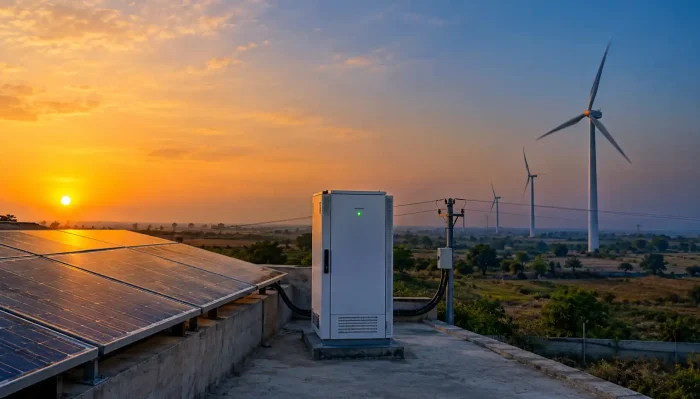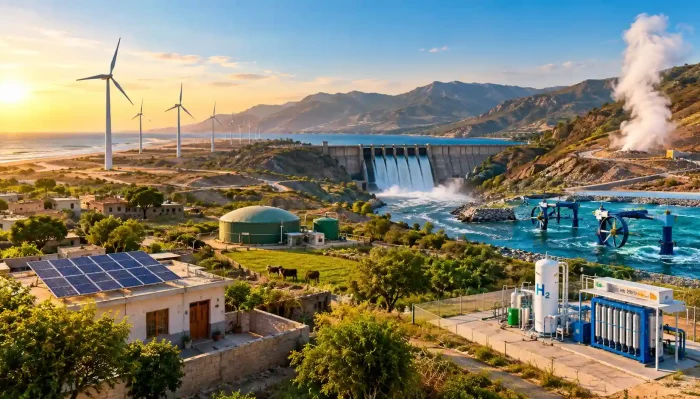
A single 300-watt solar panel makes about 1.2 to 1.5 kWh of electricity per day under normal Pakistani sunlight. A 700-watt panel can produce close to 3 kWh daily.
Your exact numbers depend on wattage, sunlight, and system losses. This guide answers how much energy a solar panel produces, city by city, season by season, so you can plan a system that actually fits your home.
How Much Energy Does a Solar Panel Produce?
The short answer: a panel’s daily output equals its wattage multiplied by peak sun hours, then reduced by system losses.
Here’s the formula solar installers use every day:
Daily kWh = Panel Wattage (kW) x Peak Sun Hours x System Efficiency (75-85%)
So a 400-watt panel getting 5 peak sun hours, at 80% efficiency, makes: 0.4 kW x 5 hours x 0.80 = 1.6 kWh per day
This formula works for any wattage. Peak sun hours are not the same as daylight hours. They measure the time the sun is strong enough to push a panel near its rated output, roughly when sunlight hits 1,000 watts per square meter.
How Many kWh Does a Solar Panel Produce Per Day?
Most home solar panels sold today range from 300 watts to 700 watts. Here’s what typical daily output looks like across that range, using 5 average peak sun hours and 80% system efficiency.
| Panel Wattage | Daily Output (kWh) | Monthly Output (kWh) |
| 300W | 1.2 | 36 |
| 400W | 1.6 | 48 |
| 500W | 2.0 | 60 |
| 600W | 2.4 | 72 |
| 700W | 2.8 | 84 |
These figures shift with your city, roof angle, and the season. Treat them as a starting point, not a guarantee.
Solar Panel Energy Production by Wattage
Solar panel watts tell you the maximum power a panel produces under lab test conditions, not real daily output. One solar panel watt is a rating, not a promise. Real output always runs lower because of clouds, dust, heat, and wiring losses.
A 100-watt panel produces roughly 0.4 to 0.5 kWh a day in Pakistan. A 300-watt panel produces around 1.2 to 1.5 kWh. Scale up from there and the math stays proportional, as long as sun hours and efficiency stay the same.
How Much Electricity Does a 700 Watt Solar Panel Produce?
A 700-watt panel is now common in Pakistani installations because it needs fewer panels to hit the same system size. Under 5 to 5.5 peak sun hours, one 700W panel produces about 2.8 to 3.1 kWh per day. Over a 30-day month, that’s close to 84 to 93 kWh from a single panel.
Ten of these panels, wired into a 7 kW system, could produce 28 to 31 kWh a day. That’s enough to run a small Pakistani household, including a fridge, fans, lights, and a washing machine, on most sunny days.
What Factors Affect How Much Energy a Solar Panel Produces?
Several things push output up or down, even with the same panel wattage:
- Sunlight hours: More peak sun hours mean more kWh, plain and simple.
- Panel angle and direction: South-facing panels tilted near your latitude catch more sun.
- Temperature: Panels lose a bit of efficiency in extreme heat, oddly enough.
- Dust and shading: Dust on the panel or shade from a tree cuts output fast.
- Inverter and wiring losses: Even a good system loses 10 to 20% of raw output.
- Panel age: Panels degrade slowly, usually 0.5 to 0.8% less output each year.
How Much Energy Does a Solar Panel Produce in Pakistan?
Pakistan gets strong, steady sunlight for most of the year, which makes solar a smart choice here. Average peak sun hours across the country run between 4 and 6 hours a day, depending on the region and season.
That means a 400W panel in Pakistan typically makes 1.4 to 2.0 kWh daily, and your solar plate capacity should be sized around this range rather than the panel’s lab rating alone.
Solar Panel Energy Production in Different Pakistani Cities
- Karachi: High sun exposure most of the year, often 5 to 5.8 peak sun hours in summer.
- Lahore: Strong and fairly steady output, generally 5 to 5.2 peak sun hours.
- Islamabad: Slightly lower due to hills and cloud cover, around 4.5 to 5 peak sun hours.
- Multan: One of the sunniest cities, often 5.5 to 6 peak sun hours.
- Peshawar: Solid output most months, close to 4.5 to 5 peak sun hours.
- Quetta: High altitude and clear skies push it to 5.5 to 6 peak sun hours.
These are averages. Your rooftop, panel tilt, and monsoon season will move the number up or down.
How Much Energy Does a Solar Panel Produce Per Month?
Multiply your daily kWh estimate by 30. A 400W panel making 1.6 kWh a day produces about 48 kWh a month. A 700W panel at 2.8 kWh a day adds up to roughly 84 kWh monthly.
Summer months usually beat this average because sun hours run longer. Winter months, especially December and January, often fall 20 to 30% below the yearly average.
How Much Electricity Can Different Solar Systems Produce?
A full solar system scales the same math across many panels.
- 1 kW system: 4 to 5.5 kWh per day
- 3 kW system: 12 to 16.5 kWh per day
- 5 kW system: 20 to 27.5 kWh per day
- 10 kW system: 40 to 55 kWh per day
A 5 kW system, common for mid-size Pakistani homes, can cover most of a household’s daily electricity needs, especially with a battery to store extra power for the evening.
You May Also Read: How Much KwH Required For A House
How to Calculate Solar Panel Energy Production Yourself
You don’t need an engineering degree for this. Follow these steps:
- Find your panel’s wattage rating, printed on the back of the panel.
- Check average peak sun hours for your city (use the numbers above as a guide).
- Multiply wattage (in kW) by sun hours to get raw output.
- Cut that number by 15 to 25% to account for real-world losses.
Example: a 500W panel in Multan with 5.5 sun hours gives 0.5 x 5.5 = 2.75 kWh raw. After a 20% loss, real output lands near 2.2 kWh a day.
How to Increase Solar Panel Output (Practical Tips)
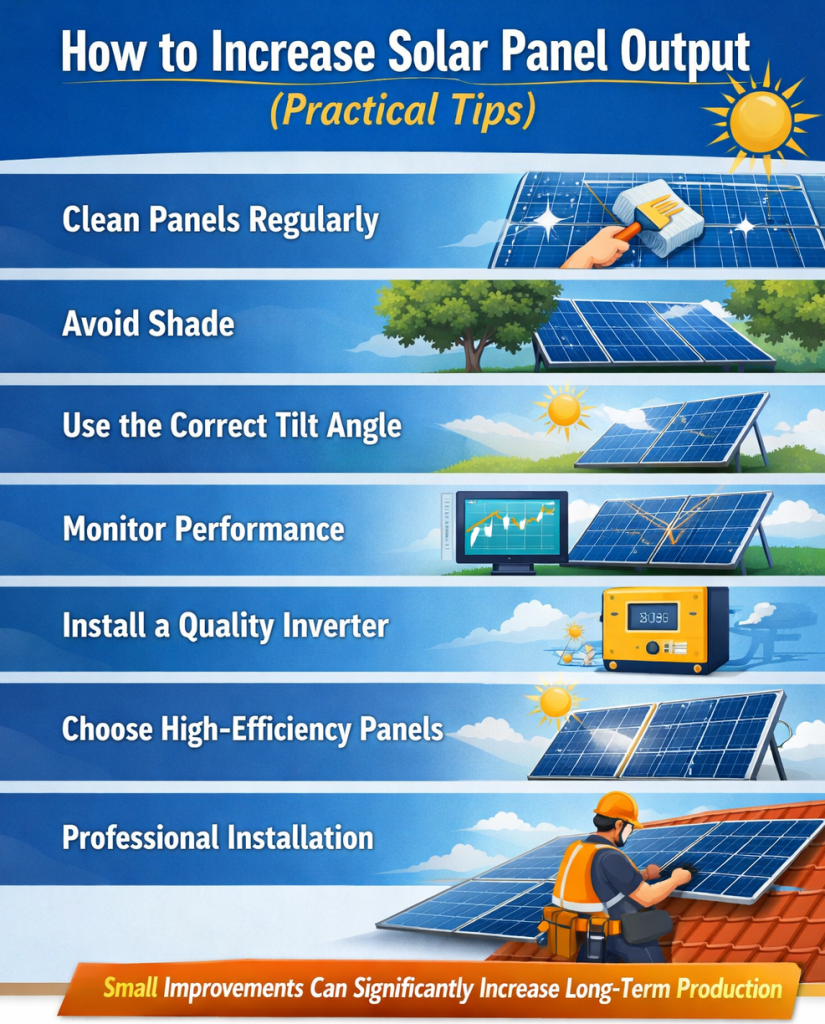
Small changes make a real difference in how much energy a solar panel produces over a full year.
- Clean panels every two to three weeks to clear dust buildup.
- Set the tilt angle close to your city’s latitude for the best year-round exposure.
- Trim trees or remove anything casting shade during peak hours, usually 10 AM to 3 PM.
- Use a quality inverter, since a weak one can waste 10% or more of your output.
- Get your system checked yearly by a professional installer to catch wiring faults early.
If your current setup is underperforming, working with proper solar panel installation services can fix most of these issues in a single visit. Progressive Ventures offers system audits and installation support built around Pakistan’s climate and grid conditions, which helps homeowners get closer to their panel’s real potential.
Solar Panel Production: Theoretical vs. Real-World Output
The wattage printed on a panel is a lab number, measured under perfect lighting and cool temperatures. Real rooftops rarely match that. Expect actual output to run 15 to 25% below the rated number on any given day.
This gap is normal, and every reputable installer accounts for it when sizing your system.
Can a Solar Panel Produce Electricity on a Cloudy Day?
Yes, but at a reduced rate. A panel can still generate 10 to 25% of its rated output on a heavily overcast day, since diffuse sunlight still reaches the cells. Light cloud cover cuts output less, often just 10 to 20%.
Does a Solar Panel Produce Electricity at Night?
No. Solar panels need direct or diffuse sunlight to generate power, so output drops to zero after sunset. This is exactly why solar production time of day matters so much when sizing a system, and why most homes pair panels with batteries or stay connected to the grid for nighttime use.
How Much Energy Does a Solar Panel Produce in Winter?
Winter output drops for two reasons: shorter days and a lower sun angle. In Pakistan, winter peak sun hours often fall to 3.5 to 4.5, compared to 5.5 to 6 in summer.
A 400W panel that makes 1.6 kWh a day in June might only produce 1.1 to 1.3 kWh a day in December. Sizing your system a bit larger than your summer needs helps cover this seasonal dip.
Is a 700 Watt Solar Panel Worth Buying in Pakistan?
For most homes, yes. A 700W panel needs fewer units to reach the same system size, which cuts mounting hardware and wiring costs. It also fits well with Pakistan’s strong average sun hours, since higher wattage panels make the most of longer sunny days.
The trade-off is weight and size. Roofs need to handle larger panels, and older mounting structures may need reinforcement.
Solar Panel Energy Production Example for a Pakistani Home
Take a typical 5-marla home in Lahore running a 5 kW system made up of seven 700W panels.
At 5 peak sun hours and 80% efficiency, that system produces around 20 kWh a day. Over a month, that’s roughly 600 kWh, enough to cover fans, lights, a fridge, a washing machine, and several hours of air conditioning during summer, especially when paired with a battery for evening use.
Also Read: How Often Should Solar Panels Be Cleaned?
Conclusion
The amount of energy a solar panel produces depends on its wattage, available sunlight, panel efficiency, weather conditions, shading, orientation, and system losses. A higher-wattage panel can generate more electricity, but real-world output will always vary depending on installation and local conditions. In Pakistan, good sunlight availability makes solar panels an effective option for reducing electricity costs and meeting residential or commercial energy needs.
Before choosing a solar panel, consider your monthly electricity consumption, available roof space, and expected energy requirements rather than focusing only on panel wattage. Contact Progressive Ventures today for expert guidance, reliable solar products, and professional solar installation services tailored to your energy needs.
FAQs
How much energy does a solar panel produce on average?
A standard 400W panel produces around 1.4 to 2 kWh per day under average Pakistani sun conditions.
How many solar panels do I need to power a house in Pakistan?
Most homes need a 3 kW to 7 kW system, which usually means 8 to 20 panels depending on wattage and household usage.
Does solar panel wattage match real output?
No. Wattage is a lab rating. Real output runs 15 to 25% lower once you account for weather, dust, and system losses.
How long do solar panels keep producing energy?
Most panels stay productive for 25 to 30 years, losing less than 1% output each year.
What’s the best solar panel size for a small Pakistani home?
A 3 kW to 5 kW system, built from 400W to 700W panels, covers most small to mid-size households comfortably.