Picking the appropriate kW value is also worth considering when planning to install solar, upgrade your power connection, or build a backup power system. How much kW is required for a house, and how quickly will this scale? This will also be determined largely by the appliances you have, what is running together, and if your needs are likely to change.
A small house might be ok with 3–5 kW, but a larger house, perhaps with several air conditioners, might require anything from 8–12 kW or more. It is most prudent to calculate your peak load rather than determine capacity based just on the size of the house.
What Size Is Required?
Average home load is usually somewhere between 3 kW and 10 kW. A very small home with only lights, fans, a refrigerator, a TV, and a single AC on might be between 3 and 5kW.
- A typical 2- to 3-bedroom home with 1 or 2 ACs is typically 5 to 8kW.
- Larger 3-, 4-, or more-bedroom homes with several ACs are typically 8-15 kW or more.
The above are planning ranges and not hard and fast rules. Appliances are not all turned on at once; usage patterns vary, and future additions to the home all change the load requirement.
Understanding kW and kWh Before Calculating Your Home Load
What Does kW Mean?
The instantaneous electrical power being required at a particular moment in time. If all the appliances in the house were running at once, they would draw a combined 4,000 W, which equates to 4 kW of instantaneous load.
What Does kWh Mean?
The “kWh” energy term is in the present.
We take an example of a 1 kW load for 3 hours; then the energy consumed will be 3 kW or 3 units of energy.
But this is another thing. It is crucial for solar planning, as the capacity of the inverter mainly depends on the load at present. But the solar panel capacity is tied to the total power consumed per day.
How to Calculate the Required kW for a Home
Step 1: List Appliances and Their Wattage
List any appliances that will be on throughout your busiest time span and note their actual wattages from the nameplate. Planning values for calculations can be around 8–15W for LED lights, 60–80W for a fan, 100–300W for a fridge, 400–1,000W for a pump, and approximately 900–1,400W for a 1.5T inverter AC.
These figures are merely examples. User consumption is measured by model and operating point, so it is advisable to use nameplate ratings whenever possible.
Step 2: Add Loads That Can Run Together
To give a rough estimate, we are using:
- 4 x fans (each 75W)
- 10 x lights (each 10W)
- 1 x refrigerator (200W)
- 1 x television set (100W)
- 1 x water pump (750W)
- 1 x air-conditioning unit (1200W)
The energy consumed by each item could then be worked out as
300 + 100 + 200 + 100 + 750 + 1,200 = 2,650W
On that, we have 2.65 kW of combined running load. The final system should build in appropriate headroom and not run at peak all the time.
Step 3: Add a Safety Margin
A safety margin is a consumption offset to cover variations, starting loads, and incoming appliances. An increase of 20% (2.65K/W) is about 3.18KW.
The size of the final inverter selected is also influenced by the standard sizes available, surge requirements, battery requirements, and what appliances are to be supplied on outage.
Read more Do Solar Panels Increase Home Value
How Much kW Is Required for a House in Pakistan?

The requirement can vary widely in Pakistan; this is due to the fact that hot weather increases cooling loads, especially in air conditioning systems, when they remain in operation for an extended period of time. An off-the-shelf starting point is:
|
Home Type |
Typical Capacity |
Common Loads |
|
Small home |
3–5 kW |
fans, lights, fridge, TV, one AC |
|
Medium home |
5–8 kW |
More appliances, pump, 1–2 ACs |
|
Large home |
8–12 kW |
Multiple ACs, pumps, kitchen appliances |
|
Large villa |
12 kW+ |
Several ACs and heavy appliances |
These are approximations rather than specific connection or solar requirements. The rating of appliances and concurrent demand must be checked prior to investment.
Read more How Many Panels in a 5kW Solar System
How Many kW Inverters to Run a House?
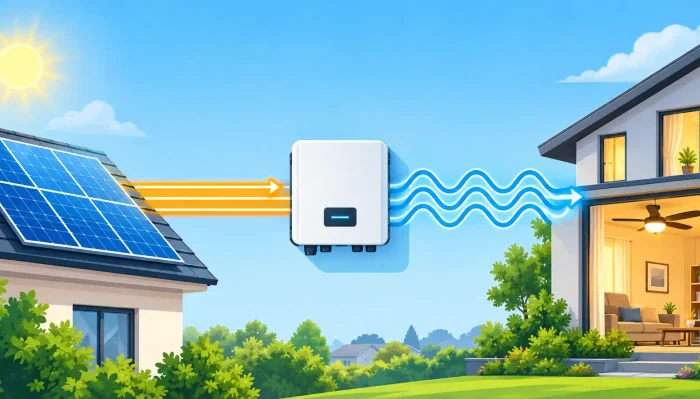
The correct inverter size will be driven by the appliances you plan to run simultaneously, and the size of your house won’t determine it. Pumps, fridges, and appliances with motors can draw more power at startup than they do normally. Always look at both continuous power output and surge requirements to size an inverter correctly. For a backup system, determine the critical appliances first—if you’ll just be running fans, lights, the fridge, internet gear, and a few rooms, the inverter you need could be a fraction of your total connected load.
What Is 1kW Load Capacity for a Home?
A 1 kw load capacity is roughly 1,000 watts in one go. It would be suitable to run some low-wattage appliances, but not likely to be enough to run a large AC along with a few other loads. On the other hand, your lighting, a handful of fans, your TV, and a refrigerator might all be contained within this capacity, assuming the actual watt ratings are equal to or less than this amount.
Electricity Load Calculator in kW for Home
To build an inexpensive electricity load calculator in kW to use at home, make a list of every appliance, note its wattage, multiply by how many you have, and then sum the loads most likely to run simultaneously.
Use this simple calculation:
Kw = Watts / 1000. Daily consumption: Daily kWh=Watts×Hours/1,000. 20.×Q. 20.×Hours/1,000. 20.
The first is the maximum power consumption, and the second is a ballpark figure of how much energy you’re going to use in a day. Both are valuable in a solar power plan, since the inverter needs to support simultaneous loads, and the panels need to generate a particular amount of energy during the day.
How Much Solar Capacity Does a House Need?
Consider the scale of the installation: solar capacity should not necessarily be the same as the peak load of your home. Use your average daily electrical use, then take into account the sunlight, shading, panel angle, etc.
As another example, a house using 20 kWh a day might start with about a 4–5 kW array if a 4–5 peak-sun-hours-a-day assumption is made as a planning assumption. A detailed design might be very different after including actual site details and losses.
Factors That Affect Your Required kW

Air Conditioning and Cooling
ACs can be 20 to 25% of a household load during the summer, and multiple ACs or inverter ACs will have a large impact on your peak load.
Future Expansion
Think of what extra appliances, like an additional AC, electric geyser, pump, and EV charger, you might add in the future.
Reasonable headroom is better than an early upgrade when your household’s electricity load grows.
How to Choose the Right Capacity for Your Home

Begin with your list of appliances, rather than the number of rooms. If your simultaneous load is estimated to be 2-3 kW, then you may end up with something in the 3-5 kW range after looking at the surge load and future needs. If your average daily peak demand is on the order of 5-8 kW, then you will want a bigger inverter or better load management.
Homes with a few ACs and several high-powered appliances will end up being in the 8-12kW or higher design.
And if you plan on installing solar, then look at three numbers: peak load, daily usage, and backup load. That makes sizing the panels, inverter, and battery much simpler.
A proper assessment helps you choose the right system size, avoid unnecessary costs, and maintain consistent energy performance in your home.
In addition, working with a professional solar installation can significantly improve system performance. Experts conduct detailed load analysis, assess your roof and sunlight conditions, and design a system that maximises efficiency and long-term savings.
Final Thoughts
The suitable house size depends on the appliances (type, number, and load), efficiency, and the tasks you want to perform. An estimated daily load figure would be just as good as a single-phase load estimate. Your solar and backup power should account for peak load and everyday power requirements.
Instead of following the size of someone else’s system, refer to the appliance ratings and find out which time of the day you will be using them the most. This way, you can prevent an under-sized system, overspending, and going over your capacity.
If you are planning a solar installation, consult a professional installer for a customized load assessment and system design. Contact us For solar installation, our experts guide you based how much kW is required for a house power usage and provide the most suitable system without confusion. Whether you want solar installation, wind energy or hydropower energy solutions, we deliver the complete package with reliability and trust.
FAQs
What kW solar system does a home need based on its size?
A typical home may need around 3–4 kW for a small home, 5–8 kW for a medium home, and 8–15 kW or more for a larger home, depending on the number of appliances, AC usage, peak load, and daily electricity consumption.
Does AC usage increase my kW requirement?
Yes, ACs significantly increase your kW requirement because they consume high power.
How do I calculate the right solar system size for my home?
You can calculate the right solar system size by checking your daily electricity consumption (kWh), peak load, and the appliances you use at the same time. Your solar installer can then use this information to determine the appropriate panel capacity and inverter size.
Is solar a good choice for reducing home power costs?
Yes, solar reduces monthly bills and provides long-term savings.
Can I expand my solar system later?
Yes, most systems allow expansion if your future power needs increase.
Can load management lower the inverter size?
Yes. If the heavy appliances, like a pump and electric geyser, etc., are operated at different time slots, the load demand is reduced, but the inverter must be able to accommodate the load combination at any instant.
Is there any room for growth?
Yes. 20-30% headroom is a good idea if you plan on adding another AC or other significant electric appliance.