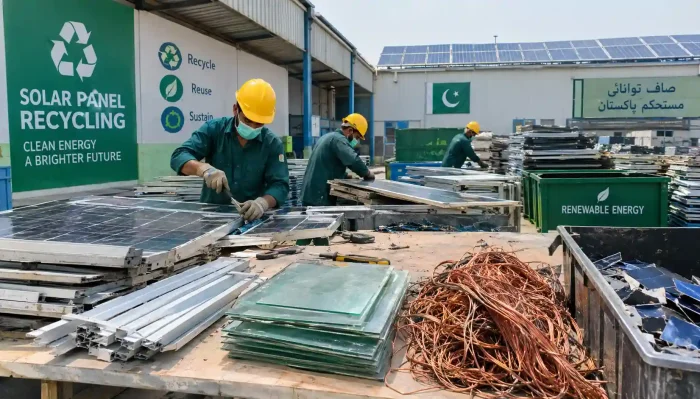
Heat, dust, shade, early-life loss, slow aging, and wiring or inverter faults are what causes solar panels to lose efficiency. In Pakistan, heat and dust cause the biggest losses. Most of that loss is temporary, and you can fix it. Normal permanent loss is small, about 0.5% per year. If your output fell by much more than that, something else is wrong.
This guide explains why do solar panels lose efficiency, how much loss is normal, and what it costs you in rupees. You will also learn how to find the exact cause and fix it.
Efficiency Loss vs Degradation vs System Loss: What’s the Difference?
Most guides mix these three things together. That is why owners get confused. Each one needs a different fix.
| Type | What it means | Examples | Fixable? |
| Temporary loss | Output drops, then returns | Dust, heat, shade | Yes |
| Permanent loss (degradation) | The panel itself wears out | LID, PID, aging | No, but it is slow |
| System loss | The panel is fine, the equipment around it is not | Inverter, cables, mismatch | Yes |
Three terms help here. Efficiency is how much sunlight the panel turns into power. Output is the units your system makes. Performance ratio compares your real output to what the system should make. A healthy system usually sits around 75% to 85%.
Panels are rated at Standard Test Conditions (STC): 1000 W/m² of sunlight and 25°C cell temperature. Your roof is rarely that perfect. So your output will always sit below the nameplate rating on the sticker.
Installers also track specific yield, which is kWh produced per kWp installed. It lets you compare your system with others. Solar panel efficiency degradation is only one part of the story. Many owners blame the panels when the real cause is dust, heat, or a bad connector.
Causes of Solar Panel Efficiency Loss at a Glance
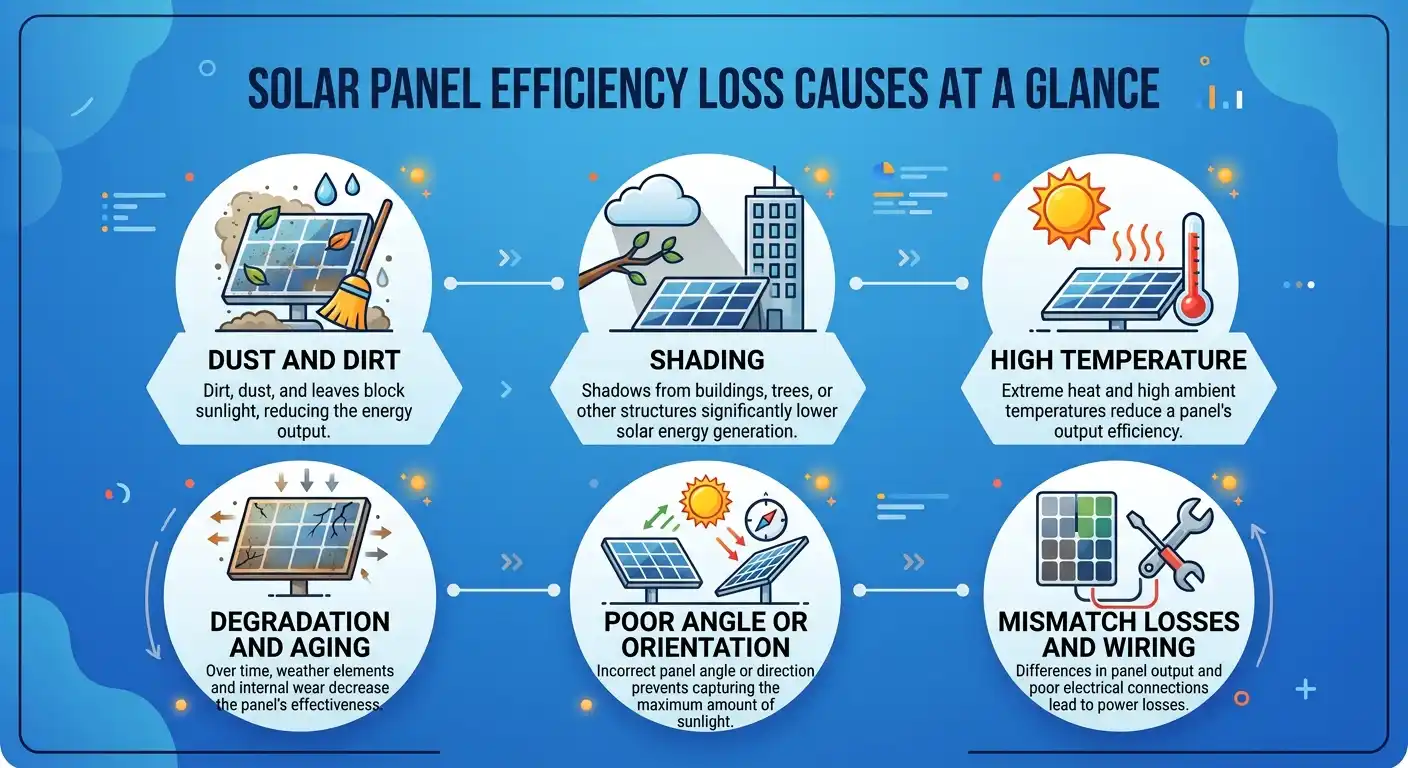
Here is what causes solar panels to lose efficiency, sorted by how easy each one is to fix. These are typical ranges. Your system may differ.
| Cause | Temporary or permanent | Typical loss | Can you fix it? |
| Dust and smog | Temporary | 3% to 10%+ | Yes, clean it |
| Heat | Temporary | Up to about 14% at peak | Reduce it, not remove it |
| Shading | Temporary | 5% to 30%+ | Yes, remove the shade |
| Wrong tilt or direction | Ongoing | 3% to 10% | Hard after install |
| LID and LeTID | Permanent | 1% to 2% in year one | No |
| PID | Permanent | Can be 5% to 30% | Sometimes reversible |
| Cracks and hotspots | Permanent | 1% to 10%+ | Replace the panel |
| Normal aging | Permanent | About 0.5% per year | No |
| Low-quality panels | Permanent | Faster aging | Only by replacing |
| Inverter and cables | Ongoing | 2% to 10% | Yes |
Sources for loss ranges include the NREL degradation study and the Fraunhofer ISE Photovoltaics Report. Test standards come from the IEC.
Temporary Causes You Can Fix
These are the factors that reduce solar panel efficiency most often in Pakistan. They are also the cheapest to fix.
Dust, Smog and Bird Droppings
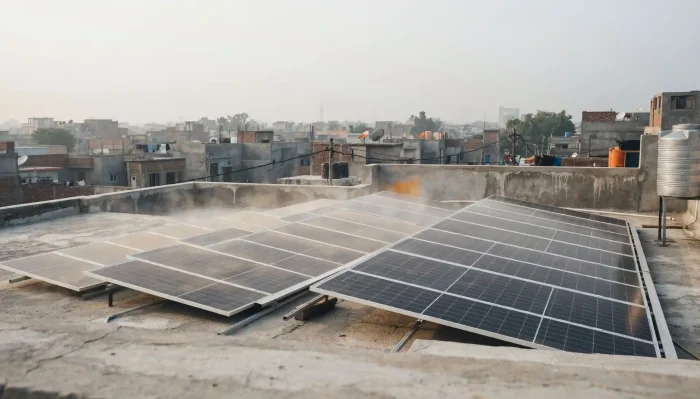
Soiling means dirt on the glass. It blocks light before it reaches the cells. Dust storms, brick kiln emissions, and winter smog in Punjab all add to it. Bird droppings are worse. They block light in one spot and can heat the cell.
Dust loss in dry months often reaches 5% to 10% or more. Rain helps, but a light shower can turn dust into a muddy film. An anti-soiling coating makes dirt wash off easier.
Fix: Clean on this schedule.
| Season | Cleaning frequency |
| Dry summer (April to June) | Every 2 to 3 weeks |
| Monsoon (July to September) | After dust, droppings, or muddy rain |
| Smog season (October to January) | Every 2 weeks in Punjab |
| Dry winter | Every 3 to 4 weeks |
Read our What is the Efficiency of Solar Cell.
Heat
Heat is the biggest loss in Pakistani summers. Solar cells lose power as they get hotter. The temperature coefficient (Pmax) on your datasheet tells you how much. A common value is about 0.35% per °C above 25°C.
Here is a worked example. On a hot afternoon, air may be 40°C. The cell temperature is higher, often 65°C or more. That is 40°C above the test value.
0.35% × 40 = about 14% loss at peak.
On a 10 kW system, that is about 1.4 kW gone at the hottest hour. The loss is temporary. It disappears when the panel cools. NOCT on the datasheet shows how hot a panel runs in normal conditions.
Fix: Pick panels with a lower coefficient. N-type TOPCon and HJT panels usually lose less in heat than older PERC panels. Leave an airflow gap behind the panel. Raise the GI structure height so air can move under it. Flat rooftop heat from concrete makes things worse.
Shading
Shade causes more harm than its size suggests. Common sources in Pakistan are water tanks, parapet walls, neighbouring buildings, trees, and outdoor AC units.
A panel has bypass diodes. They let current skip a shaded section. In a string inverter setup, panels are linked in a line. One shaded panel can pull the whole string down. Half-cut cells handle shade better than full cells.
Fix: Do a shade analysis before install and again every year or two. Move small items such as antennas. Trim trees. If shade is unavoidable, use a DC optimizer or microinverter so each panel works alone.
Wrong Tilt, Orientation or Mounting
Your tilt angle should be close to your city’s latitude. Karachi sits near 25°, Lahore near 31°, and Islamabad near 34°. The best fixed tilt is often a little lower than the latitude. Panels should face south, so azimuth is about 180°.
Strong wind can also shift a loose GI structure. A small change in angle cuts output. Check bolts after storms.
Permanent Causes: Why Panels Degrade
This part answers what affects solar panel efficiency over many years. You cannot undo these losses. You can slow them down by picking good panels.
Early-Life Loss: LID and LeTID
LID means light-induced degradation. It happens in the first weeks of sun. It comes from boron-oxygen pairs in P-type silicon. Loss is usually 1% to 2%. LeTID is a similar effect that needs heat and light and works slower.
N-type cells use phosphorus instead of boron. That is why N-type and TOPCon panels show much lower LID. PERC panels, which are mostly P-type, see more.
PID
PID means potential-induced degradation. Voltage between the cells and the frame leaks away. Power drops. Humid and coastal sites like Karachi face more risk because coastal humidity helps the leak.
High system voltage raises the risk. Good grounding and earthing helps. So do anti-PID panels. Some PID can be reversed with the right equipment, so call a technician early.
Physical Damage
Panels can crack without any visible mark. Microcracks come from hail, rough handling, and walking on panels. Cracked cells can create hotspots, which are small areas that overheat. You may also see snail trails, which are thin dark lines on the surface.
Daily thermal cycling (hot by day, cool by night) widens cracks. Over time, EVA (the plastic layer that holds the cells) can turn yellow or brown. The backsheet can crack and the layers can come apart. That is delamination.
An electroluminescence (EL) test shows cracks you cannot see.
Normal Aging
NREL’s study found a median loss of about 0.5% per year. Many good panels fall near that number. Your degradation rate is on your datasheet.
Here is a 25-year example. At 0.5% per year, a panel keeps about 87.5% of its power after 25 years. A 10 kW system would act like an 8.75 kW system. Most makers back this with a linear performance warranty. Always check your own datasheet.
Low-Quality or B-Grade Panels
Some panels in the Pakistani market are B-grade or have thin frames and weak glass. They age faster. A-grade vs B-grade matters here. A-grade panels pass full quality checks.
How to check: Look for a Tier-1 maker on the BNEF list. Ask for IEC 61215 and IEC 61730 certificates. Match the serial number and datasheet to the maker’s records. A very low price should make you ask questions.
System Losses That Look Like Panel Problems
Sometimes the panels are fine. Check these first.
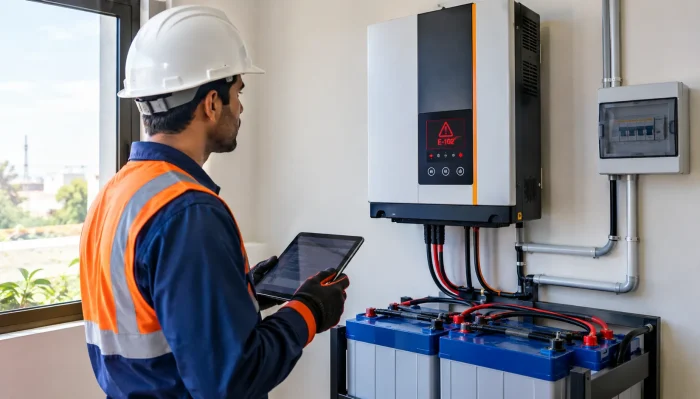
- Inverter derating and clipping. Inverters cut power when they get too hot. Clipping also happens when panel power is higher than the inverter limit. Check your DC/AC ratio and make sure the inverter has shade and airflow.
- Cables and MC4 connectors. Thin DC cables cause voltage drop. Loose MC4 connectors get hot. Look for heat marks or melted plastic.
- Mismatch loss. Mixing old and new panels, or different models, drags down the whole string.
- Grid voltage trips. High grid voltage can make the inverter cut output. This can affect net metering systems on LESCO, K-Electric, IESCO, and MEPCO lines. The MPPT tracker also picks a worse point when conditions swing fast. Rules for net metering come from NEPRA.
Which Cause Hits Hardest in Your City?
These rankings are typical, not measured on your roof.
| City or region | Main driver | Second driver | What to do |
| Karachi | Salt mist, humidity | PID risk, heat | Rinse salt often, use anti-PID panels |
| Lahore and Punjab | Smog and dust | Heat | Clean every 2 weeks in smog season |
| Multan, Jacobabad | Extreme heat | Dust | Low coefficient panels, airflow gap |
| Islamabad, Peshawar, KP | Monsoon, shade | Bird droppings | Shade check, clean after storms |
| Quetta, Balochistan | Dust storms | Temperature swings | Frequent cleaning, check mounts |
How to Find Out Why Your Solar System Is Producing Less
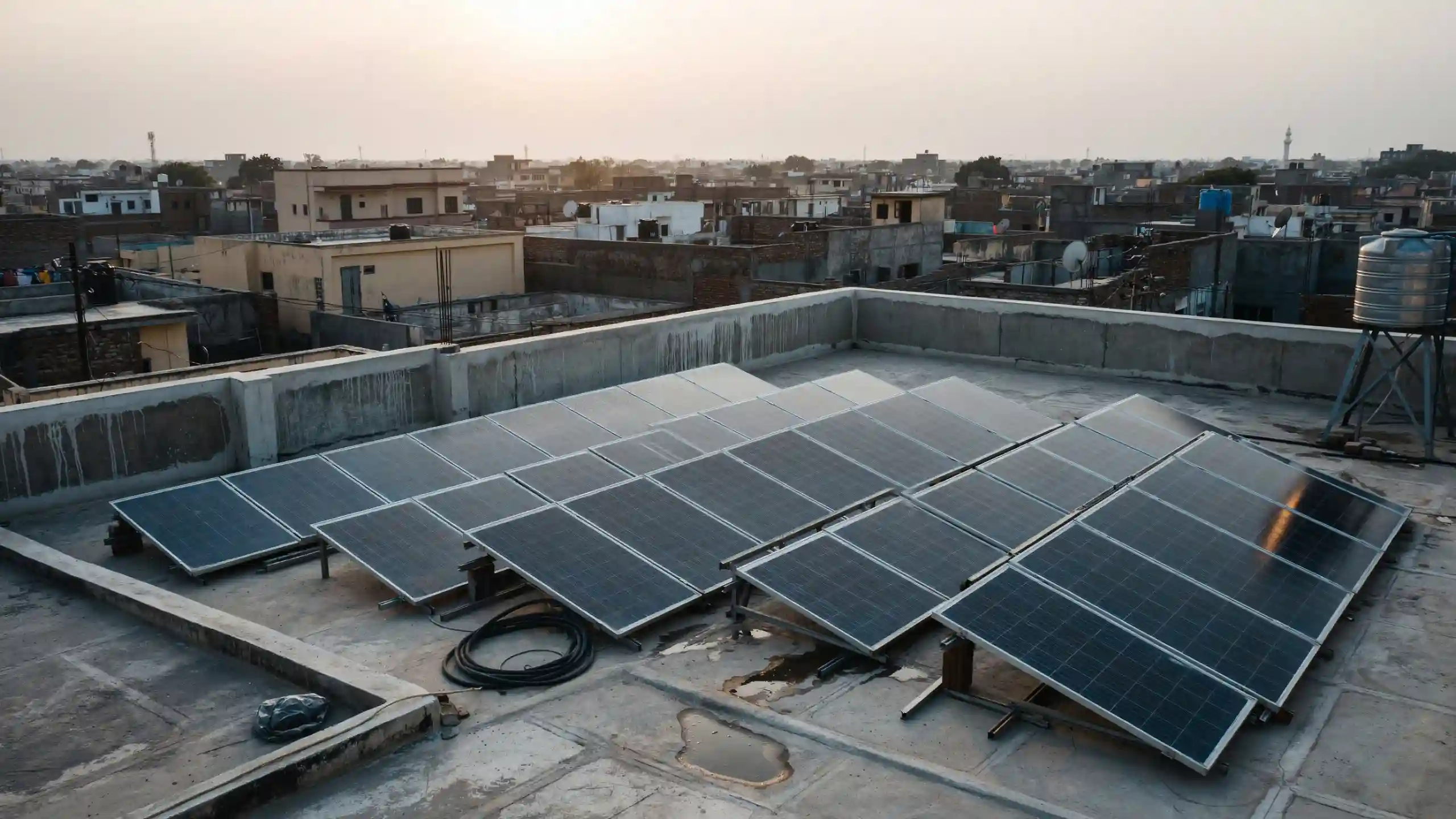
Follow these 5 steps in order.
- Check your monitoring app. Compare the same clear-sky time to last year.
- Read inverter error codes and string data. One weak string points to shade, a bad panel, or a bad connector.
- Clean and measure again. If output rises, soiling was the cause.
- Inspect the system. Look for new shade, hotspots, cracks, and MC4 or cable heat marks.
- Call a PEC-registered engineer. Ask for a thermal (IR) camera scan and an I-V curve tracer test. Add an EL test if you suspect cracks.
How to Reduce Efficiency Loss: Fixes Ranked by Impact and Cost
Costs below are typical estimates in PKR. Prices change with city and system size, so get local quotes.
| Action | Typical cost | Likely gain | Frequency |
| Clean panels (soft brush, soft or deionised water) | DIY: under Rs 1,500 for tools. Professional: about Rs 3,000 to 8,000 per visit | 3% to 10% back in dusty months | Every 2 to 4 weeks in dry season |
| Remove shade (trim trees, move tank or antenna) | Rs 0 to 20,000 | Up to 5% to 20% on shaded systems | Once, review yearly |
| Fix cables and MC4 connectors | Rs 5,000 to 30,000 | 1% to 5%, and lower fire risk | Inspect yearly |
| DC optimizers or microinverters | Medium to high, get a quote | 2% to 10% on shaded roofs | One time |
| Buy N-type with a lower coefficient | Small price gap | About 2% extra energy in hot months | At purchase |
| Monitoring app | Often free with the inverter | Catches faults early | Check weekly |
A simple example shows why cleaning pays. Take a 10 kW system making about 45 units a day. It loses 7% to dust. That is about 3.15 units a day. At an assumed Rs 45 per unit, you lose about Rs 142 a day, or about Rs 4,250 a month. One cleaning visit costs less than that.
Avoid these cleaning mistakes:
- Do not clean at midday. Cold water on hot glass can crack it.
- Do not use rough cloths or harsh chemicals.
- Do not use hard water. It leaves white scale.
- Do not step on panels.
- Do not use a high-pressure jet.
If you are planning a new Solar Panel Installation, ask for a shade report, a loss estimate, and the datasheet temperature coefficient before you sign. At Progressive Ventures, our engineers plan tilt, spacing, cable size, and inverter match for Pakistani heat and dust.
When Is It a Warranty Claim?
There are two warranties. The product warranty covers defects such as cracks, junction box faults, and delamination. It often lasts 10 to 15 years. The performance warranty guarantees power over time. It often lasts 25 to 30 years and follows a linear drop.
Your loss counts only if it is bigger than the warranty curve. Dust and heat are not warranty issues.
Keep this proof:
- Dated production logs from your app
- A test report from a PEC-registered engineer
- Clear photos of damage
- Your invoice and serial numbers
Installer workmanship is usually a separate warranty. It covers wiring, mounting, and connectors. Do not mix the two when you file a claim.
Conclusion
Understanding what causes solar panels to lose efficiency helps you identify performance problems before they become costly. In Pakistan, heat, dust, shading, poor connections, and normal panel degradation can all reduce output, but many of these issues can be managed with proper cleaning, maintenance, and system checks.
If your solar system is producing less power than expected, don’t assume the panels are the problem. Contact at Progressive Ventures for professional solar inspection, maintenance, and support to help identify the cause and restore your system’s performance.
FAQs
How much efficiency do solar panels lose per year?
Good panels lose about 0.5% per year. The first year can lose 1% to 2% because of LID. After 25 years, most panels still make about 85% to 88% of their rated power.
Is a 20% drop normal?
A 20% drop in peak hours is possible from heat, dust, and shade together. A permanent 20% drop in a few years is not normal. Clean the panels, check shade, then test the system.
Why does my output drop in summer even when there is more sun?
Hot cells lose power. A panel can lose about 0.3% to 0.5% for each °C above 25°C. Long days help, but the heat loss cuts into the gain. Your inverter may also derate in heat.
How often should I clean solar panels in Pakistan?
Clean every 2 to 3 weeks in dry months and every 2 weeks in Punjab’s smog season. Clean after dust storms and bird droppings. In monsoon, clean after muddy rain.
Does rain clean panels fully?
No. Heavy rain removes loose dust. Light rain can leave a muddy film. Salt and sticky dirt stay behind. Check the glass after rain and clean if you see marks.
Can degraded panels be restored?
Dust loss, shade loss, and some PID loss can be reversed. LID, aging, cracks, and delamination cannot. Cracked or delaminated panels need to be replaced.
Do smog or cloudy days affect panels?
Yes. Smog and clouds reduce the sunlight that reaches the cells, so output drops. This is not damage to the panel. Output returns when the sky clears. Smog also leaves dirt on the glass.
Are N-type panels better for Pakistan’s heat?
Usually yes. N-type TOPCon panels have a lower temperature coefficient and lower LID. That means more output in hot months. Compare the datasheets of the exact models you plan to buy.