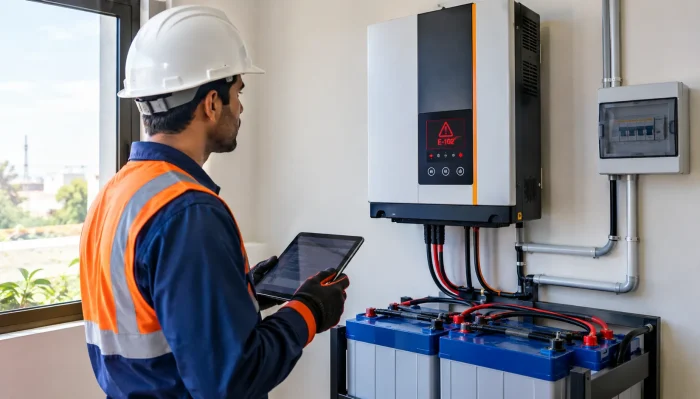
An error code means your solar inverter is protecting itself from issues like grid over-voltage, overheating, or moisture leaks. Before resetting, write down the exact code and inverter model, and check your home’s main switchboard for any tripped breakers. If you see an Isolation Fault, call a licensed technician immediately, as this indicates a dangerous electrical leak usually caused by water ingress.
To safely reset the system, turn OFF the AC solar switch in your fuse box, turn OFF the DC isolator by the inverter, and wait 5 minutes. Restart by turning the DC isolator ON first, followed by the AC switch second, then watch the screen to see if the code clears.
What Does a Solar Inverter Error Code Mean?
A solar inverter error code is a short message that tells you what the inverter sensed. It may show as a number like “F23”, a letter code, or a text message. It may also show as a red light or a beeping pattern.
Brands do not share one code list. Growatt, Solis, Huawei, Voltronic-based inverters (sold under many local names), and others each use their own system. The same number can mean different things on two models. “Error 04” on one unit may be a battery issue, and on another it may be a fan issue.
So always check your manual for your exact model. Use the table below only as a general guide.
Inverters also react at three levels:
- Warning: The inverter still works but tells you something is off. Low battery and high temperature often start here.
- Fault: The inverter found a real problem. It may cut output or stop charging.
- Shutdown: The inverter turned itself off to stay safe. It may restart on its own or wait for you.
Common Solar Inverter Error Codes and What They Mean
These are common solar inverter error codes, grouped by fault type. This is a general guide, not a chart for every brand. Your manual has the final word.
| Error/Fault Type | Common Cause | First Safe Check |
| Overload | Too many appliances running | Switch off heavy loads |
| Low battery voltage | Battery deeply discharged | Check battery SOC |
| Grid overvoltage | High utility voltage | Check grid voltage on the display |
| Grid undervoltage | Low utility voltage | Check utility supply |
| PV overvoltage | Too much string voltage | Review system design with installer |
| Overheating | Heat, dust, poor airflow | Check ventilation and fan |
| Isolation/ground fault | Cable damage or moisture | Stop and call a technician |
| BMS/communication fault | Battery and inverter not talking | Check battery communication cable |
SOC means state of charge. It shows how full your battery is. BMS is the battery management system. It guards the battery from damage.
How to Troubleshoot a Solar Inverter Error
Good solar inverter troubleshooting starts with calm, simple checks. Do these in order. Stop if you smell burning, see sparks, or see damaged wires.
1. Record the Error Code
Take clear photos of:
- The error code on the display
- The full inverter screen
- Any warning light
- Your monitoring app screen
Note the time and what was running. A technician can fix a problem faster when you share this. It also helps you see if the fault returns at the same time each day.
2. Check Your Current Load
Overload is one of the easiest faults to fix. Turn off high-power items such as:
- Air conditioner
- Water heater
- Motors and water pumps
- Irons and heaters
- Refrigerator or freezer, only if it is safe for your food and your setup
Wait a few minutes and see if the fault clears. If it does, your load is too high for the inverter, or too many items start together. Start big appliances one at a time.
3. Check Grid Power
This matters a lot in Pakistan. Voltage swings from the utility are common. Your inverter reads the grid all the time. If voltage goes too high or too low, it may disconnect to protect your home.
Look at the grid voltage on the display. If the fault shows up at the same hours each day, the grid is likely the cause. Your local utility company handles supply voltage issues. You can also read about grid rules on the NEPRA website.
4. Check Battery Status
Many hybrid inverter faults start at the battery. Check these points:
- Low SOC: A deeply drained battery can trigger a low voltage fault.
- Battery breaker: Make sure it is on.
- Communication: Check that the data cable between battery and inverter is firm.
- Settings: Wrong battery type or voltage settings cause false faults.
Do not open the battery case. Do not change deep settings unless you know what they do.
5. Check for Overheating
Heat is a top cause of shutdowns. Look at the following:
- Blocked vents or items stacked near the inverter
- Dust on the heat sink and fan
- Direct sunlight on the unit
- Very hot room or outdoor spot
- A fan that is slow, noisy, or stopped
Move items away from the vents. Give the inverter space to breathe. If the fan has failed, call a technician.
6. Check the Solar/PV Side
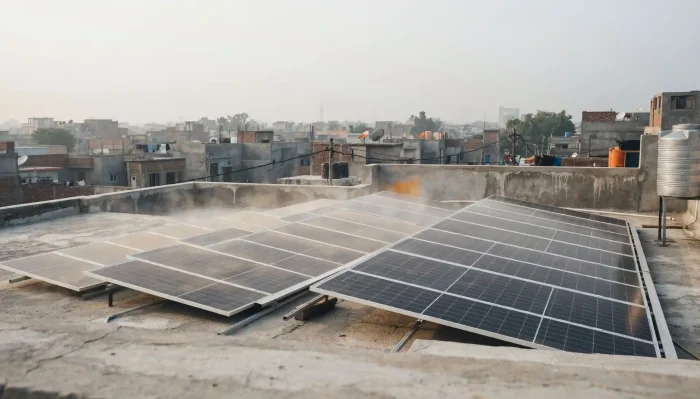
Keep this part to safe visual checks only. Do not measure live DC voltage yourself. DC from solar panels can cause serious shock and arc burns, even in low light.
You can safely look for:
- Shade from new walls, trees, or tanks
- Dirty panels
- Loose or hanging cables
- Burn marks or melted connectors
- Water in junction boxes
If you see anything odd, do not touch it. Call a technician. This kind of solar inverter troubleshooting is where safety matters most.
Common Solar Inverter Problems and Solutions
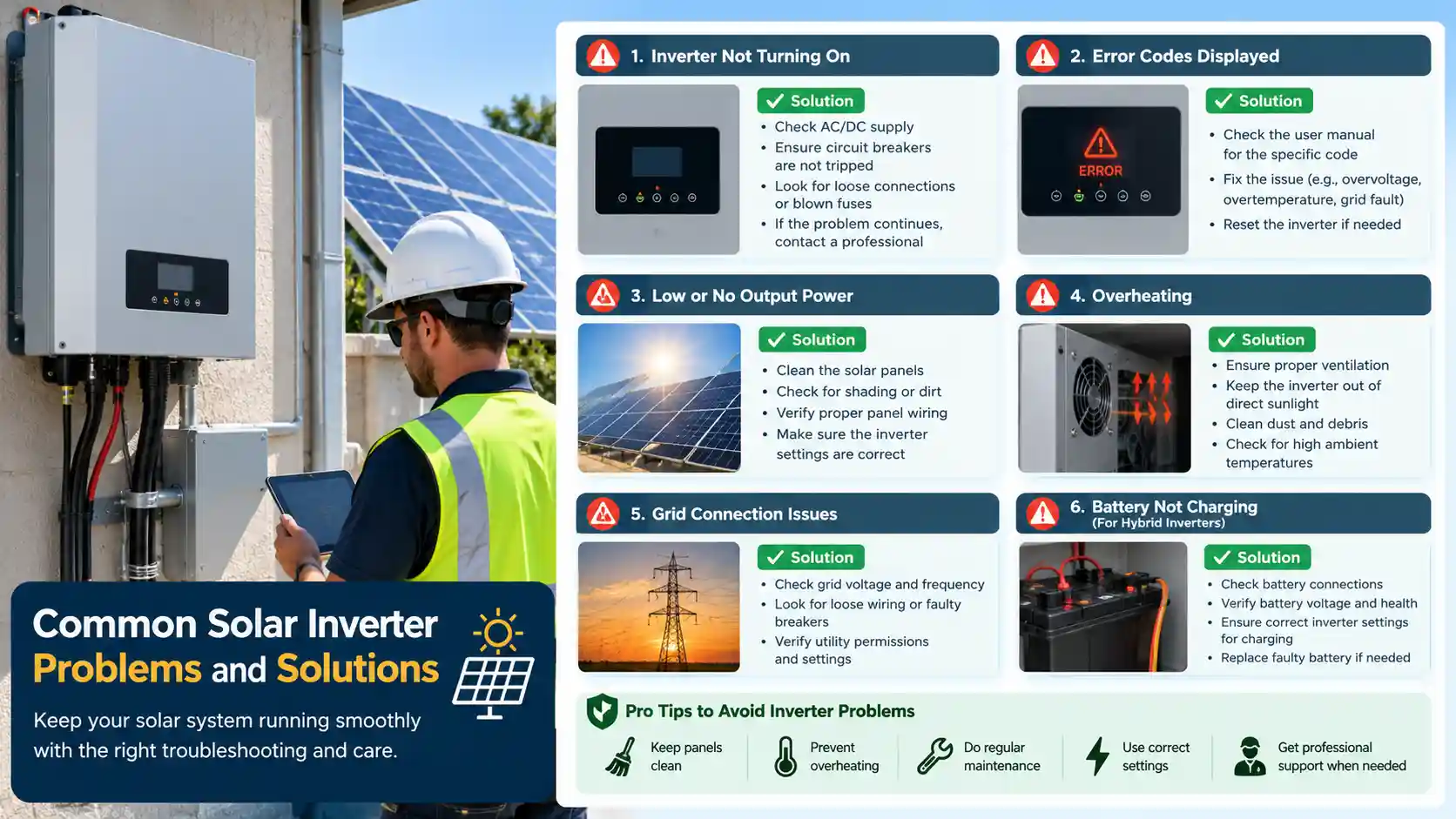
Here are common solar inverter problems and solutions, listed by symptom.
Inverter Is Not Turning On
Causes: Tripped breaker, dead battery, loose cable, or failed power board.
Fix: Check breakers and battery charge. Look at cable ends for looseness. If nothing helps, call a technician.
Inverter Keeps Shutting Down
Causes: Overload, overheating, low battery, or unstable grid.
Fix: Cut the load, check airflow, and check battery level. Note the time of each shutdown. A pattern points to the cause.
Inverter Shows Overload
Causes: Too many appliances, or motors with high start-up power.
Fix: Turn off heavy items. Start the AC and pump one at a time. If it keeps happening, your inverter may be too small.
Inverter Is Overheating
Causes: Blocked vents, dust, hot room, or a bad fan.
Fix: Clear space around it. Move it to shade if needed. Clean dust gently from the outside only.
Inverter Is Beeping Continuously
Causes: Warning for low battery, overload, or a grid problem.
Fix: Read the display code. Reduce the load first. Check battery level next.
Inverter Has No AC Output
Causes: Output breaker off, overload trip, or internal fault.
Fix: Check the output breaker and the display. If the fault stays after a proper reset, call a technician.
Solar Inverter Shows a Battery Fault
Causes: Low voltage, loose terminal, wrong settings, or BMS fault.
Fix: Check SOC, breaker, and the communication cable. A repeating BMS fault needs a technician.
Solar Inverter Shows a Grid Fault
Causes: High or low utility voltage, or a power cut.
Fix: Watch the grid reading. Wait for supply to settle. The inverter often restarts on its own.
Solar Inverter Monitoring/Wi-Fi Is Offline
Causes: Router issue, weak signal, or a dongle that lost its link.
Fix: Restart your router. Move the router closer. Reconnect the Wi-Fi module using your app steps. Your inverter keeps working even when the app is offline.
When Should You Reset a Solar Inverter?
Reset only when you have to, and follow your maker’s steps. Models differ, so there is no one sequence for all.
- Record the fault code first.
- Remove heavy loads before you restart.
- Do not restart again and again.
- If the same error returns, find the cause.
Repeated resets can hide a real fault and may stress parts. A reset clears a message. It does not fix the reason behind it.
When Should You Call a Solar Technician?
Call a qualified technician if you see any of these:
- Breakers that keep tripping
- Burning smell
- Cable damage
- Ground or isolation fault
- Internal hardware fault
- Battery or BMS fault that keeps returning
- Repeated overheating
- Damaged connectors
- Odd noise from the unit
- A fault that returns after reset
Isolation faults and internal faults are not DIY jobs. They involve live DC and risk of fire or shock.
Rough cost guide (estimates only, confirm with a local quote):
| Service | Estimated Range (PKR) |
| Inspection visit | 2,000 to 5,000 |
| Cooling fan replacement | 3,000 to 10,000 |
| Wi-Fi module replacement | 4,000 to 10,000 |
| Cable or connector repair | 3,000 to 15,000 |
Prices change by city, brand, and part supply. Check your warranty before you pay for any repair.
How to Prevent Solar Inverter Errors
A little care cuts most faults. Follow these steps:
- Right inverter size: Match it to your real load.
- Good PV string design: Wrong string voltage causes PV faults.
- Good airflow: Leave space around the unit.
- Regular cleaning: Keep vents and panels clean.
- Correct battery settings: Match the battery maker’s advice.
- Tight connections: Have a technician check terminals each year.
- Professional installation: Poor wiring causes many early faults.
- Regular monitoring: Watch your app for odd drops in output.
Get Expert Help With Your Solar System
Faults often come from poor design or rushed wiring. At Progressive Ventures, we design and fit systems that match your real load, with correct string layout, safe cabling, and good airflow. Quality Solar Energy Installation cuts faults from day one.
If your inverter keeps showing errors, do not guess. Contact Progressive Ventures today for an inspection and a clear fix. Also read our guide on How Long Do Solar Inverters Last? and What is a Solar Inverter System?
FAQs
What are the most common solar inverter error codes?
The most common are overload, low battery voltage, grid overvoltage, grid undervoltage, PV overvoltage, overheating, isolation fault, and BMS communication fault. Exact numbers vary by brand.
How do I troubleshoot a solar inverter error?
Record the code. Reduce the load. Check grid power, battery status, and heat. Do safe visual checks of the panels. Call a technician if the fault stays.
Why does my solar inverter keep shutting down?
Common causes are overload, heat, a low battery, or unstable grid voltage. Note when it shuts down. The time often shows the cause.
Why is my solar inverter showing an overload error?
Too many appliances are running, or a motor is pulling a big start-up load. Turn off heavy items and restart them one by one.
Why is my solar inverter showing a battery error?
The battery may be low, the breaker may be off, the data cable may be loose, or the settings may be wrong. A repeating fault points to a BMS issue.
Can I reset a solar inverter myself?
Yes, if you follow the maker’s steps and have removed heavy loads. Do not reset again and again.
When should I call a solar inverter technician?
Call one for burning smell, cable damage, isolation faults, repeated tripping, or any fault that returns after a reset.