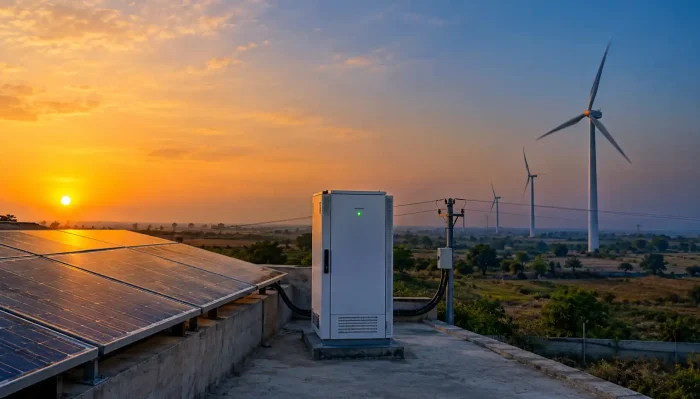
Solar panels only do half the job. The battery sitting behind them decides whether your lights stay on at 2 AM during load shedding or whether the whole system goes dark the moment the sun sets. That’s the part most people rush through — and it’s usually the part they regret rushing.
If you’re trying to figure out which battery is best for solar systems in Pakistan, the honest answer isn’t one-size-fits-all. It depends on how much you’re willing to spend upfront, how often your area loses grid power, and whether you’d rather deal with occasional water top-ups or pay more once and forget about maintenance for a decade. Lithium-ion batteries have taken over the premium end of the market for good reason, but tubular batteries still make sense for a huge number of households across Pakistan, and lead-acid hasn’t disappeared either.
This guide walks through every major battery type sold here, what they actually cost in 2026, how long they realistically last, and which one fits your situation – whether you’re powering a 5-marla home or running a small workshop.
What Does a Solar Battery Actually Do?
Table of Contents
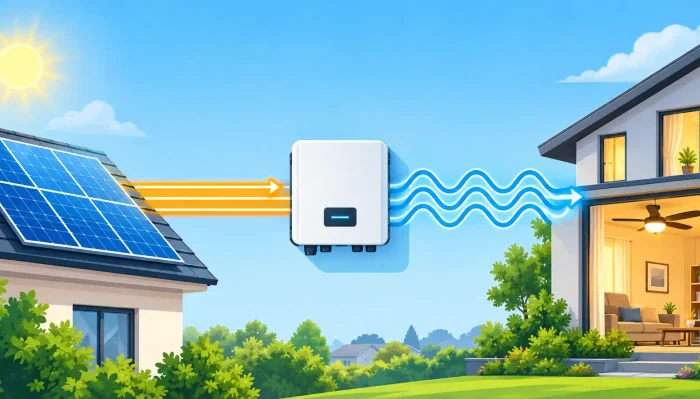
ToggleDuring the day, your panels generate more electricity than your house is using. A solar battery captures that surplus instead of letting it go to waste, then releases it back when the sun goes down or the grid drops. Without one, an off-grid setup is essentially useless after dark — and even grid-tied hybrid systems lean on batteries to cut your dependence on utility power.
In practical terms, a good battery lets you:
- Keep fans, lights, and the fridge running through load shedding
- Store daytime solar output instead of losing it
- Lower your monthly electricity bill
- Reduce wear on your inverter by smoothing out power delivery
- Move closer to true energy independence
Which Battery Is Best for Solar Systems in Pakistan?
Lithium-ion batteries are, in most cases, the best battery for solar in Pakistan right now — they last longest, waste the least energy, charge quickest, and need almost no upkeep once installed. But “best” isn’t the same as “right for everyone.” Tubular batteries remain a genuinely solid pick if the upfront budget is tight, and gel batteries earn their keep in specific situations like extreme heat or remote sites where maintenance visits aren’t practical.
|
Your Priority |
Battery to Consider |
|
Longest lifespan |
Lithium-ion |
|
Zero hassle, no maintenance |
Lithium-ion |
|
Lowest purchase price |
Lead-acid |
|
Heavy, frequent load shedding |
Lithium-ion |
|
Off-grid setup |
Lithium-ion |
|
Tight budget, still want durability |
Tubular |
|
Rural or farm installation |
Tubular |
|
Hot climate, minimal servicing |
Gel |
Why This Decision Matters More Now Than It Did Five Years Ago
Electricity tariffs in Pakistan keep climbing, peak-hour pricing punishes households that draw from the grid at the wrong time, and load shedding hasn’t gone anywhere in most cities and towns. NEPRA has been pushing renewable adoption harder each year as the country tries to ease pressure on conventional generation — but a solar system without a properly matched battery only solves half the problem.
A battery that’s correctly sized and installed does more than provide backup. It stretches your inverter’s lifespan, smooths out voltage swings, and — over five or six years — often ends up saving more money than the panels themselves, simply because you’re not buying grid electricity at peak rates.
The Main Battery Types Used in Pakistan
Lithium-Ion: The Premium Standard
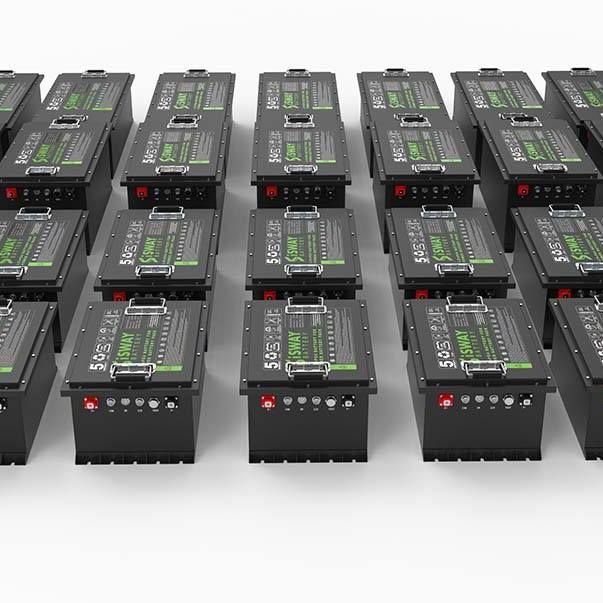
Ask any installer what they’d put in their own home, and lithium-ion usually wins. It’s become the default recommendation for residential and commercial solar in Pakistan over the last couple of years, and the reasons are straightforward:
- 10–15 year realistic lifespan
- 6,000–8,000 charge cycles before meaningful degradation
- 95–98% efficiency, so very little energy is wasted
- No water top-ups, no regular servicing
- Handles deep discharge without shortening its own life
- Compact — a lithium bank takes up a fraction of the space a tubular setup needs
The catch is cost. You’ll pay considerably more on day one, and you need an inverter with a compatible Battery Management System for it to work properly. For homeowners, hybrid systems, and businesses dealing with frequent outages, though, the math usually still favors lithium once you factor in how rarely you’ll be replacing it.
Lead-Acid: The Old Reliable
Lead-acid has been in solar systems for decades, and it’s stuck around mainly because of price. It’s the cheapest way to get backup power, parts and replacements are easy to find anywhere in the country, and the technology is well understood by nearly every local technician.
The trade-off is real, though — expect 3 to 5 years of usable life, efficiency in the 75–85% range, and regular maintenance if you want it to last that long. It’s a reasonable fit for small systems, short-term installations, or anyone who genuinely can’t stretch the budget further right now.
Tubular: Pakistan’s Budget Workhorse
Tubular batteries are essentially an upgraded lead-acid design, built specifically to handle the deep, repeated cycling that solar systems demand. This is arguably the most popular choice in the country outside of premium lithium installs, and for good reason.
What you get: longer life than standard lead-acid (typically 5–8 years), better performance under deep discharge, and a price point that most households can actually afford. What you give up: they still need periodic water top-ups, they’re bulky, and charging is noticeably slower than lithium. For homes, small shops, and rural setups running water pumps or basic appliances, tubular remains one of the best solar battery in Pakistan options when lithium simply isn’t in the budget.
Gel: The Niche Maintenance-Free Option
Gel batteries replace liquid electrolyte with a silica-based gel, which makes them sealed, spill-proof, and maintenance-free. They handle deep cycling reasonably well and tolerate temperature swings better than standard lead-acid — useful in parts of Pakistan where summer heat is brutal on batteries.
They cost more than lead-acid without matching lithium’s efficiency, and they’re sensitive to overcharging if your charge controller isn’t set up correctly. Gel tends to show up more in remote installations, marine use, or mid-sized systems where zero maintenance matters more than squeezing out every last percentage point of efficiency.
Quick Comparison
|
Feature |
Lithium-ion |
Tubular |
Gel |
Lead-acid |
|
Lifespan |
10–15 yrs |
5–8 yrs |
5–7 yrs |
3–5 yrs |
|
Efficiency |
95–98% |
80–90% |
85–90% |
75–85% |
|
Maintenance |
None |
Water top-ups |
None |
Regular |
|
Charging speed |
Fast |
Moderate |
Moderate |
Slow |
|
Charge cycles |
6,000–8,000 |
1,500–2,500 |
1,000–2,000 |
500–1,200 |
|
Relative cost |
High |
Medium |
Medium-high |
Low |
Which Battery Fits Which Kind of User?
Homeowners generally get the most value out of lithium-ion — the lower long-term cost, quiet operation, and near-zero maintenance tend to outweigh the higher sticker price, especially over a 10-year horizon. Small businesses often land in the same place, or go tubular if the upfront capital just isn’t there yet.
Farmers running irrigation pumps or off-grid setups usually do better with tubular batteries — they’re built for the kind of repeated deep discharge that farm equipment demands, and they’re easier to service locally. Larger commercial installations almost always default to lithium once the system scales up, since the maintenance savings and faster charging start to matter a lot more at that size.
Factors to Consider Before Buying a Solar Battery
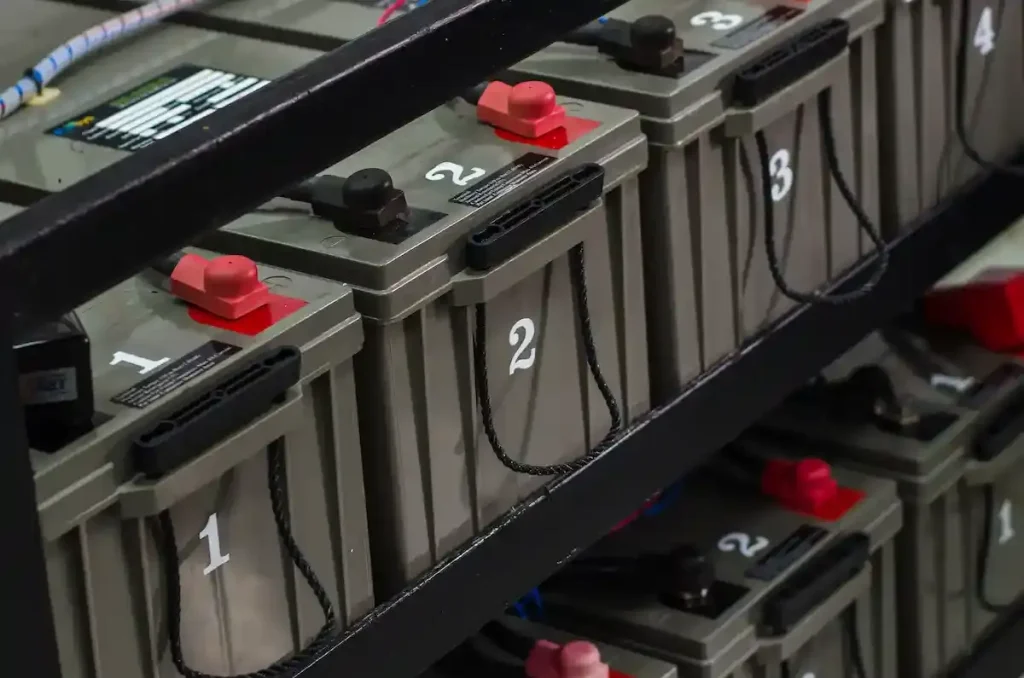
Battery capacity is measured in Ah for conventional batteries and kWh for lithium systems — a 100Ah battery might cover a small home, while a 5–10kWh lithium bank suits a hybrid setup running more appliances.
Efficiency determines how much of your panels’ output you actually get to use. Lithium sits at 95–98%, gel around 85–90%, tubular 80–90%, and lead-acid trails at 75–85%. Battery University’s research on this is worth noting — charging behavior, ambient temperature, and how deeply you discharge the battery each cycle affect lifespan more than almost any other factor, regardless of chemistry.
Best Solar Battery Brands in Pakistan
Brand matters less than people assume — proper sizing and correct installation usually determine performance more than the logo on the case — but it’s still worth knowing who’s active in the market.
|
Brand |
Type |
Best For |
Typical Warranty |
|
Pylontech |
Lithium-ion |
Hybrid systems |
7–10 years |
|
Narada |
Lithium-ion |
Residential & commercial |
5–10 years |
|
Dyness |
Lithium-ion |
Home energy storage |
5–10 years |
|
GoodWe / Saluna |
Lithium-ion |
Homes with strong after-sales needs |
Up to 10 years |
|
AGS |
Tubular / lead-acid |
Residential backup |
1–3 years |
|
Osaka |
Tubular / lead-acid |
Homes & shops |
1–3 years |
|
Phoenix |
Tubular / lead-acid |
Residential solar |
1–3 years |
|
Exide |
Tubular / lead-acid |
Commercial backup |
1–3 years |
Which Battery Is Best Based on Your Solar System Size?
Choosing the right battery size is just as important as choosing the right battery technology.
| Solar System Size | Recommended Battery |
|---|---|
| 3kW | 5kWh Lithium or 150Ah Tubular |
| 5kW | 10kWh Lithium or Two 200Ah Tubular Batteries |
| 6kW | 10–15kWh Lithium |
| 8kW | 15kWh Lithium |
| 10kW | 15–20kWh Lithium |
| 15kW+ | Modular Lithium Battery Bank |
Solar Battery Price Guide in Pakistan (2026)
Prices move constantly with exchange rates and import duties, so treat these as a starting range rather than a fixed quote.
|
Battery Type |
Estimated Price (PKR) |
|
100Ah lead-acid |
30,000 – 45,000 |
|
150Ah lead-acid |
40,000 – 60,000 |
|
200Ah tubular |
65,000 – 95,000 |
|
5kWh lithium-ion |
300,000 – 450,000 |
|
10kWh lithium-ion |
600,000 – 900,000 |
|
15kWh lithium-ion |
900,000 – 1,300,000 |
Get a current quote before committing — these figures shift more often than people expect.
Battery Capacity Explained
Battery capacity indicates how much electricity a battery can store. It is measured in Ampere-hours (Ah) for conventional batteries and kilowatt-hours (kWh) for lithium battery systems.
Example
A household consuming 10kWh of electricity overnight needs approximately a 10–12kWh lithium battery to provide reliable backup, depending on inverter efficiency and reserve capacity.
How Much Battery Backup Do You Need?
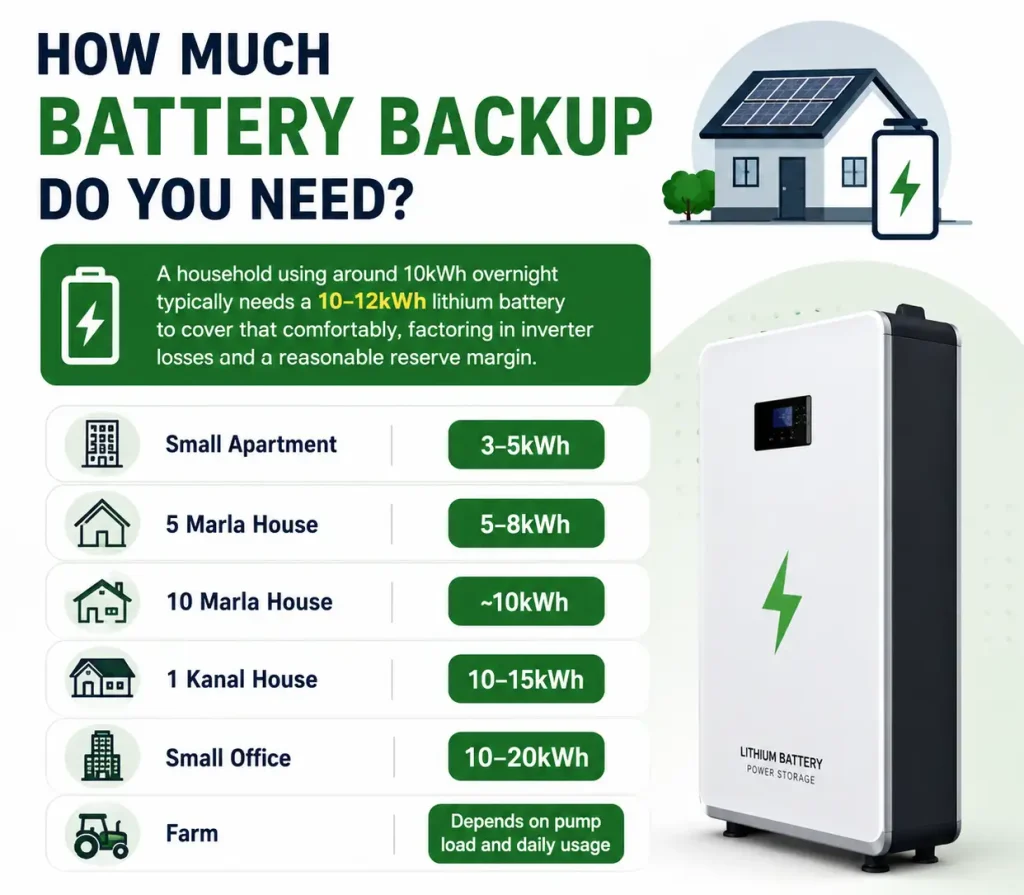
A household using around 10kWh overnight typically needs a 10–12kWh lithium battery to cover that comfortably, factoring in inverter losses and a reasonable reserve margin.
- Small apartment: 3–5kWh
- 5 Marla house: 5–8kWh
- 10 Marla house: ~10kWh
- 1 Kanal house: 10–15kWh
- Small office: 10–20kWh
- Farm: depends entirely on pump load and daily usage
Lithium-ion vs Tubular Battery: Which Should You Buy?
This is the comparison that actually matters for most people, because gel and standard lead-acid are increasingly niche choices.
|
Factor |
Lithium-ion |
Tubular |
|
Upfront cost |
Higher |
Lower |
|
Long-term savings |
Excellent |
Good |
|
Maintenance |
None |
Water top-ups needed |
|
Lifespan |
10–15 years |
5–8 years |
|
Charging speed |
Fast |
Moderate |
|
Space needed |
Compact |
Larger footprint |
If the budget stretches, lithium wins on almost every metric that matters over a decade. If it doesn’t, tubular still gets the job done — just plan on more hands-on maintenance and a replacement cycle roughly twice as often.
What Affects How Long Your Battery Actually Lasts
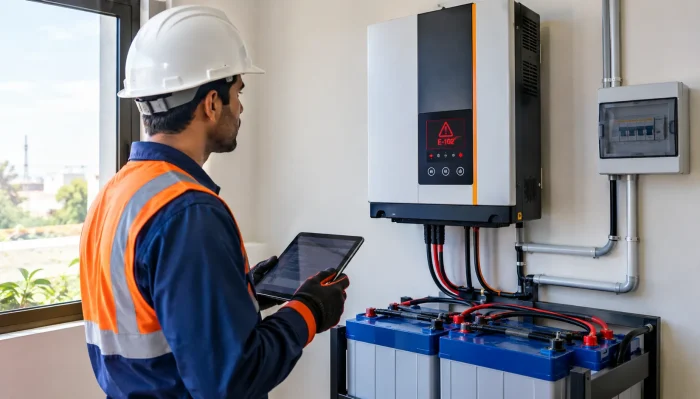
Even a good battery underperforms if it’s installed carelessly. Before buying, it’s worth understanding how much solar batteries typically cost in relation to your system size — oversizing or undersizing both hurt long-term value.
Key factors that shape real-world lifespan:
- Ambient temperature (Pakistani summers are genuinely hard on batteries)
- Charging voltage settings
- Inverter and BMS compatibility
- Depth of discharge on each cycle
- Installation quality and ventilation
- Daily consumption patterns
Battery Warranty: What Should You Look For?
A warranty tells you how confident the manufacturer is in their own product. Before buying, look past the number of years and check the cycle-life guarantee, capacity retention terms, replacement policy, and — just as important — whether there’s an authorized service center anywhere near you. A battery with a great warranty on paper isn’t worth much if the nearest service point is three cities away.
Keeping Your Battery Alive Longer
Lithium-ion needs almost nothing from you — decent ventilation, a compatible inverter, and avoiding prolonged heat exposure covers most of it. Tubular and lead-acid batteries ask for more attention: check electrolyte levels regularly, clean the terminals so corrosion doesn’t creep in, avoid letting them sit at a deep discharge for long, and inspect the cabling every few months.
Tubular and Lead-acid Batteries
- Check electrolyte levels regularly
- Clean terminals to prevent corrosion
- Keep batteries fully charged
- Avoid deep discharges
- Inspect cables and connections periodically
Mistakes We See Buyers Make Constantly
Most people focus entirely on price and skip everything else that actually determines whether a battery performs well for the next decade.
- Buying the cheapest option without checking specs
- Undersizing capacity relative to actual usage
- Skipping the fine print on warranty terms
- Mixing old batteries with new ones in the same bank
- Pairing an incompatible battery with the wrong inverter
- Not accounting for future load growth (a new AC, an EV charger, etc.)
- Skipping maintenance on tubular or lead-acid units
Myths vs Facts
| Myth | Fact |
|---|---|
| Expensive batteries are always better. | The best battery depends on your energy needs, not just the price. |
| All solar batteries last 15 years. | Lifespan varies significantly by battery chemistry and usage. |
| Lithium batteries require regular maintenance. | Most lithium batteries are virtually maintenance-free. |
| Bigger batteries charge faster. | Charging speed depends on battery chemistry and charger capacity. |
| Any battery works with any inverter. | Battery and inverter compatibility is essential for safe and efficient operation. |
Our Recommendations, Based on What We See in the Field
Best overall: Lithium-ion, for anyone who can stretch the budget and wants a decade-plus of reliable, low-maintenance backup.
Best budget pick: Tubular, for households that need dependable backup without the higher upfront cost of lithium.
Best for small business: A 10kWh lithium setup — the scalability and lower operating cost pay off quickly at that scale.
Best for off-grid farms: Either a high-capacity tubular bank or a lithium system, depending on daily pump load and available budget.
Conclusion
Choosing which battery is best for solar systems in Pakistan ultimately depends on your energy needs, budget, and long-term goals. While lithium-ion batteries stand out for their excellent efficiency, long lifespan, and minimal maintenance, tubular batteries remain a practical and cost-effective option for many households and small businesses.
Before making a purchase, compare battery capacity, charging cycles, warranty, inverter compatibility, and total ownership cost—not just the initial price. Investing in a high-quality solar battery can improve your system’s reliability, reduce dependence on the grid, and help you get the most value from your solar panels.
If you’re planning to install or upgrade a solar energy system, Progressive Ventures can help you select the right battery, design a system tailored to your energy requirements, and provide professional Solar Panel installation and after-sales support across Pakistan.
Frequently Asked Questions
1. Which battery is best for a solar system in Pakistan?
Lithium-ion batteries are generally the best option because they offer higher efficiency, longer lifespan, faster charging, and require little to no maintenance. Tubular batteries remain a reliable choice for buyers with a limited budget.
2. Which battery lasts the longest?
Lithium-ion batteries typically last 10–15 years with proper installation and usage, making them the longest-lasting option for residential solar systems.
3. Is a tubular battery better than a lead-acid battery?
Yes. Tubular batteries are designed for deep-cycle use, provide longer backup time, and usually last longer than conventional lead-acid batteries.
4. How long do solar batteries last?
The lifespan depends on the battery type:
- Lead-acid: 3–5 years
- Tubular: 5–8 years
- Gel: 5–7 years
- Lithium-ion: 10–15 years
5. How do I choose the right battery capacity?
Select a battery based on your daily electricity usage, desired backup time, solar system size, and future energy requirements. Oversizing slightly can provide additional flexibility.
6. Are lithium batteries worth the higher price?
Yes. Although lithium batteries have a higher initial cost, they generally deliver better efficiency, longer service life, lower maintenance, and reduced replacement costs over time.
7. Can I add a battery to my existing solar system?
In many cases, yes. However, compatibility depends on your inverter, system design, and available installation space. A qualified installer can confirm whether upgrades are possible.
8. Which battery requires the least maintenance?
Lithium-ion and gel batteries require very little maintenance. Traditional lead-acid and tubular batteries may need periodic inspection and, in some cases, water top-ups.
9. What affects a solar battery’s lifespan?
Several factors influence battery life, including temperature, charging habits, depth of discharge, maintenance, inverter compatibility, and installation quality.
10. Is investing in a solar battery worthwhile in Pakistan?
For many homeowners and businesses, a solar battery can improve energy independence, provide backup during load shedding, and maximize the use of solar-generated electricity.