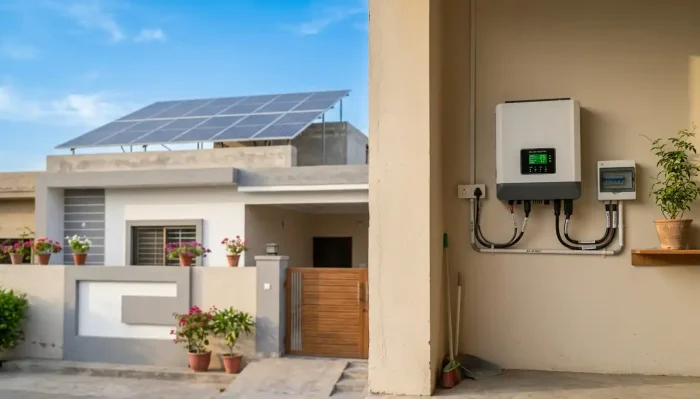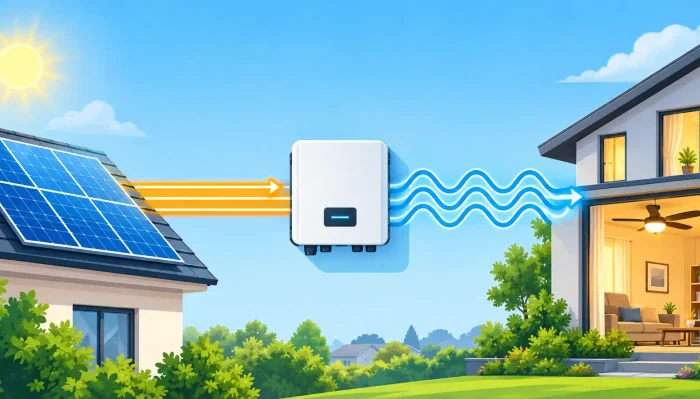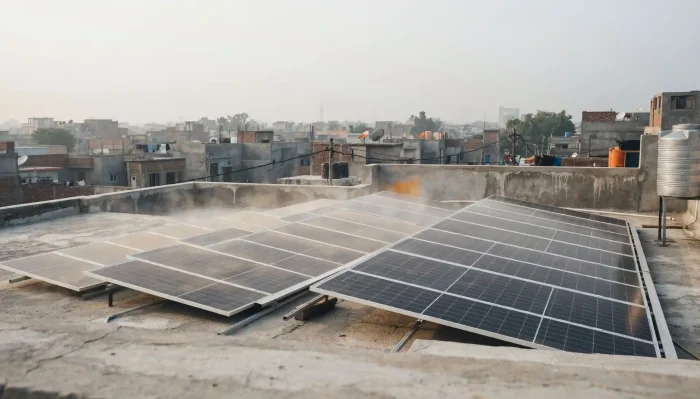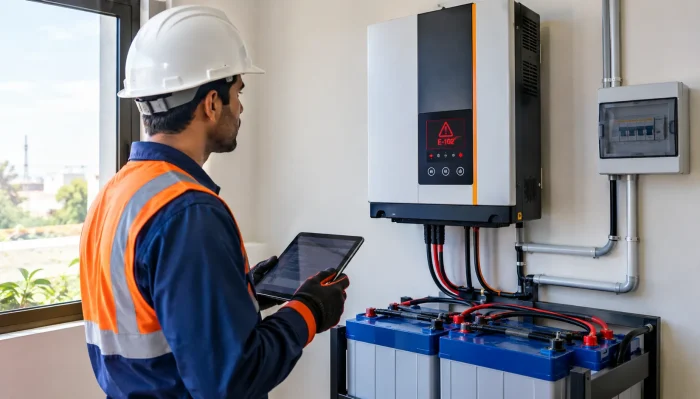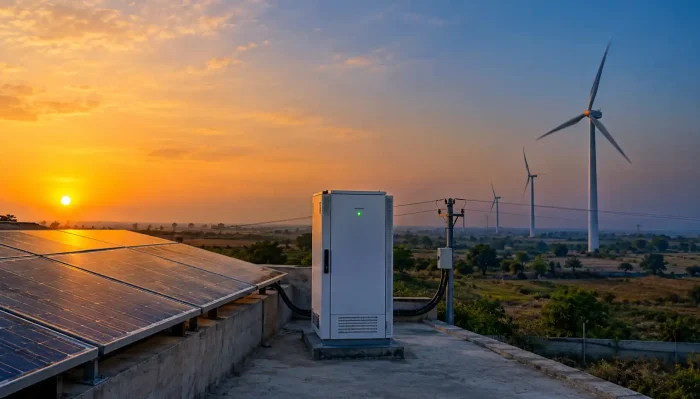
In 2026, a home solar battery costs roughly Rs. 140,000 to Rs. 360,000 per kWh, with full setups ranging from Rs. 25 Lakh to Rs. 50 Lakh. Locally, a premium 5 kWh Lithium (LiFePO4) battery costs Rs. 260,000 to Rs. 330,000 and lasts 10 to 15 years, while a tubular lead-acid bank costs Rs. 130,000 to Rs. 160,000 but must be replaced every 3 to 4 years.
Under NEPRA’s net billing regulations, storing your daytime solar power for evening use saves more money than selling it back to the grid. Though lithium requires a Battery Management System (BMS) to survive local summer heat, its 90% usable depth of discharge makes it the cheapest option over time.
What Factors Affect Solar Battery Prices?
Your final cost is influenced by a few factors, the most significant of which is capacity. Naturally, a larger battery costs more up front because it can store more power.
Chemistry is equally important. Over time, the math shifts since lithium iron phosphate batteries are more expensive than lead-acid batteries but have a far longer lifespan. Additionally, brand is important. Well-known brands with robust warranty support charge more than lesser-known regional alternatives.
Complexity of installation adds another level of expense. A simple swap-in installation will cost less than a property that requires new wiring, a panel upgrade, or additional permitting work. Because labour costs and import taxes differ from city to city and nation to nation, location further alters the situation.
The cost of batteries for solar panel systems is also influenced by round-trip efficiency and cycle life. A battery with an 8,000-cycle lifespan and a 95% efficiency rating costs more than a simple one, but it eventually saves money on maintenance and replacement.
Types of Solar Batteries and Their Costs
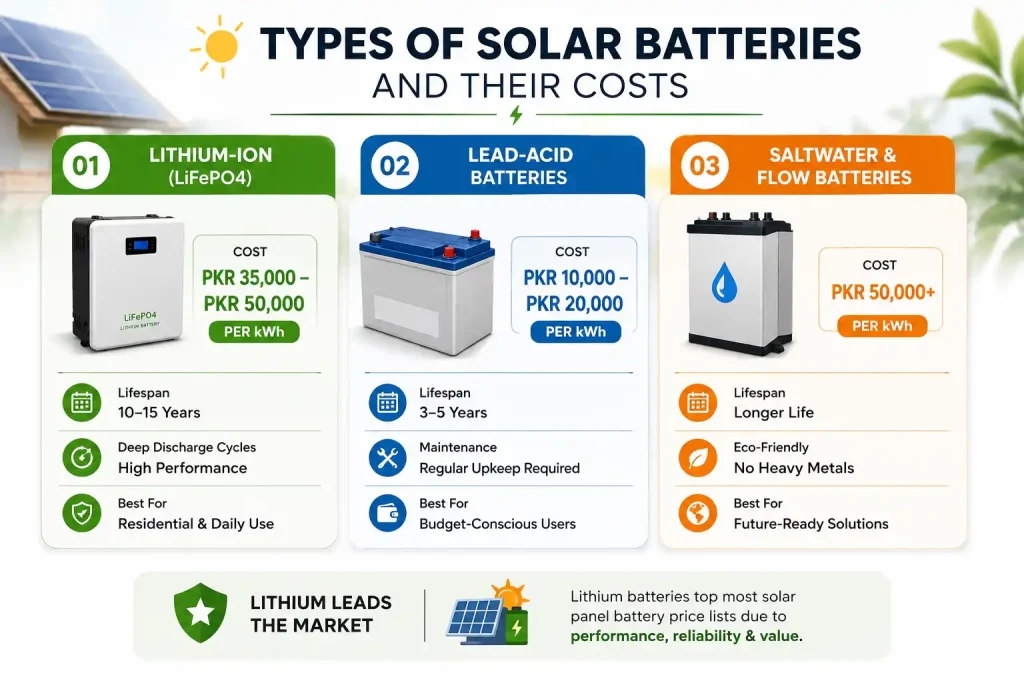
Three main battery types dominate the market right now.
Lithium-ion (LiFePO4)
Most residential solar installations today are a regular offering. The cost of installing internationally is around $700-$1,200 per kWh, which means around PKR 35,000 to PKR 50,000 per kWh locally. These batteries are long-lasting (10-15 years) and can take a lot of deep-discharge cycles without any deterioration.
Lead-acid batteries
The budget choice. You’re looking at about $200-$400 per kWh, but the cost is a shorter lifespan of 3-5 years and constant upkeep – water top-ups, terminal cleaning, the normal maintenance grind.
Saltwater and flow batteries
Still rare but getting traction. These cost more up front, frequently over $1,000 per kWh, and avoid heavy metals altogether and last a long time. Availability is still limited outside of a few markets at the moment.
If you search for any solar panel battery price list on the internet, lithium batteries will be at the top.
How Much Battery Capacity Do You Need?
10 to 20 kWh storage is needed for most houses to cover essential loads during an outage. A modest home with a fridge, a few lights and a Wi-Fi connection may get along happily on 5 kWh.
Load shedding and a bigger household operating air conditioning, a water heater and other appliances consume about 20 kWh or more. Your real beginning point for sizing correctly is your daily energy use, the number on your electricity bill.
And a qualified installation will do a load estimate before proposing any capacity. The biggest mistake homeowners make is guessing the size of battery they buy, and it is the most expensive error.
Solar Battery Cost by System Size
A rough breakdown by battery capacity, based on estimated 2026 pricing in Pakistan:
- 5 kWh system: PKR 1,120,000 to PKR 2,100,000 installed
- 10 kWh system: PKR 2,520,000 to PKR 3,920,000 installed
- 13.5 kWh system: PKR 3,080,000 to PKR 4,480,000 installed
- 20 kWh system: PKR 4,480,000 to PKR 6,720,000 installed
These figures include the battery itself plus inverter and labour. Bigger systems tend to be cheaper per kWh because fixed labour and permitting expenses are distributed over more overall capacity.
Lithium vs. Lead-Acid: Which Is More Cost-Effective?
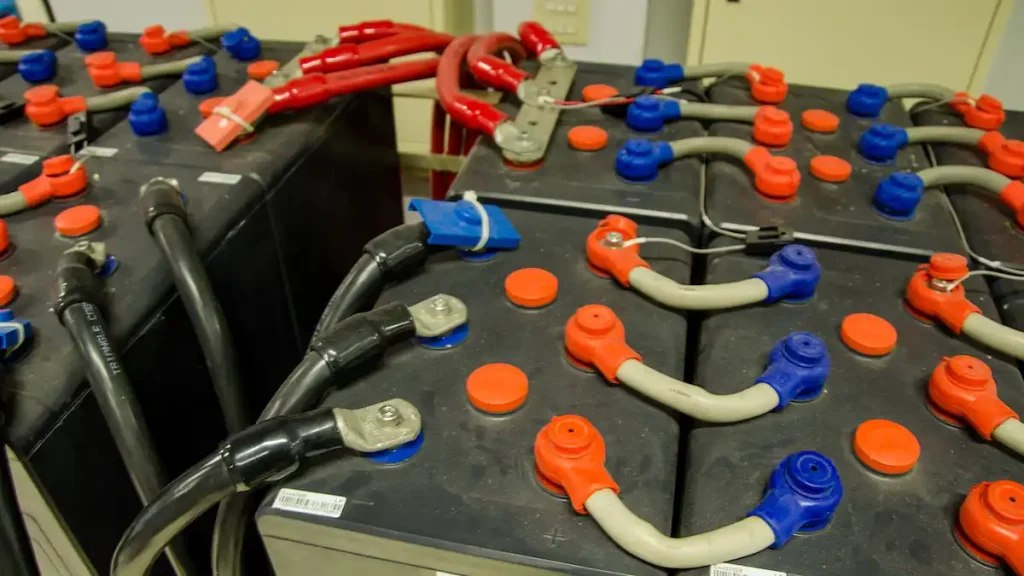
Lead-acid may look cheaper on the price tag, but the math changes when you consider time. Lead-acid batteries last 3 to 5 years and lose 15 to 20 percent of stored energy due to inefficiency along the way. So in 15 years you’re realistically going to replace it twice or three times.
Lithium costs more at purchase but lasts 10 to 15 years, with no maintenance. Even with the higher upfront cost, over that same 15-year time period, lithium is often cheaper per kWh delivered.
If you’re looking at batteries for solar panel choices on a budget, lead-acid still makes sense for small, short-term backup needs. Lithium wins on practically every front for daily solar cycle and long-term savings.
How Long Do Solar Batteries Last?
Most lithium batteries last 10-15 years or 3000-8000 charge cycles, depending on the brand and how deep you drain it each cycle. Lead acid batteries have a life of 3 to 5 years (around 1,000-1,500 cycles).
The warranty term is usually a good signal for the predicted lifespan. The best lithium batteries come with a 10-year warranty, but the cheapest batteries often have a 5- to 8-year warranty.
Heat kills battery life more than people know. A shady and well-ventilated area will help extend the life of your battery to near its rated life. This is really important in Pakistani summers.
Is a Solar Battery Worth the Cost in 2026?
Yes, for most homeowners, especially if grid power is unstable or expensive. A battery also allows you to store solar electricity generated throughout the day to use after dark, so you rely less on the grid.
For places with frequent load shedding or expensive electricity, a battery is a money-saving device by cutting expenses and avoiding outages. In areas where grid power is cheap, steady and with few outages, the payback periods are longer, sometimes over 10 years.
Crunch the statistics yourself before you make up your mind. Check your electric bill today and compare it to the cost of the battery, potential savings, and any local subsidies.
Additional Costs to Consider
The battery price tag isn’t the whole picture. A few extra costs tend to show up across most installations.
- Inverter upgrades: Older solar setups sometimes need a new hybrid inverter to work with a battery, adding roughly $1,500 to $3,000
- Permits and inspections: Local permitting fees typically run $200 to $500
- Electrical panel upgrades: Older homes occasionally need panel work, adding another $1,000 to $3,000
- Ongoing maintenance: Lithium needs little upkeep, but lead-acid requires regular servicing that adds to the long-term bill
These extras explain why two quotes for the exact same battery model can differ by a noticeable margin.
Battery for Solar Panel Price in Pakistan
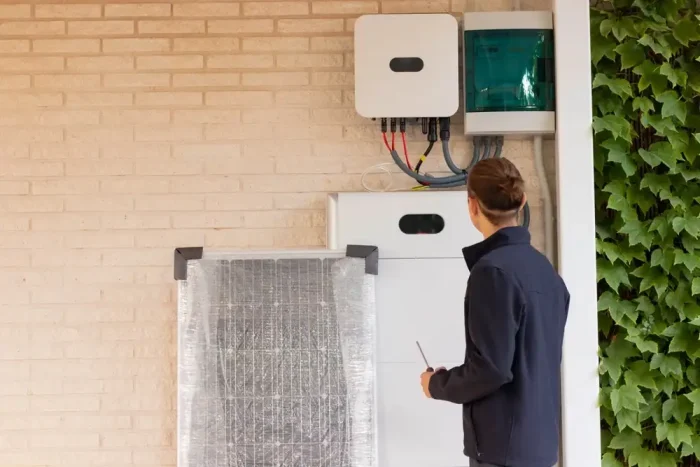
Pricing is a whole different animal if you leave the US market behind. The cost of solar panel batteries in Pakistan for lead-acid tubular batteries ranges from PKR 45,000 to PKR 150,000 depending on the capacity and brand.
The cost of lithium batteries in Pakistan is between PKR 220,000 to PKR 600,000 or more. Which is approximately PKR 35,000 to PKR 50,000 per kWh. There are medium brands like Pylontech and BYD and cheaper local brands that are cheaper to buy at first.
The import taxes and currency fluctuations affect the solar battery price in Pakistan more than in the US. If you’re scheduling a purchase, a lower rupee against the dollar tends to push up lithium battery costs in a couple of months, which is worth bearing in mind.
How to Choose the Right Solar Battery
Start with your daily energy use, not the battery’s price tag. Pull your last few utility bills to see your average kWh usage.
Match the battery’s capacity to your backup goals. Decide if you only need essentials covered, or if you want to run your whole home during an outage.
Check the warranty, cycle life, and round-trip efficiency before comparing prices. A cheaper battery with a short lifespan often costs more per kWh over time than a pricier one that lasts longer. For a closer look at which battery is best for your specific needs, compare capacity, chemistry, and warranty side by side before you buy.
Work with a licensed installer who can size your system correctly. If you’re planning a new setup or adding storage to an existing array, professional solar panel installation services from a company like Progressive Ventures can help you avoid an undersized or oversized system.
Conclusion
So, how much do solar panel batteries cost? By 2026, expect to see $500 to $1300 per kwh in the US market or PKR 35000 to 50000 per kwh of lithium here in Pakistan. It boils down to capacity, chemistry and how complex the installation turns out to be.
Lithium batteries tend to be more expensive, but they also last longer and are more efficient, so you often get more bang for your buck. If you require little, short-term backup power and you care more about cost than life expectancy, lead-acid is a reasonable option. Don’t guess. Make your decision based on actual energy use and backup needs. Get quotes from a few installers before you buy. Call us immediately for experienced solar battery advice and a solution tailored to your household’s actual needs.
FAQs
How much do batteries for solar panels cost on average?
Most homeowners pay $500 to $1,300 per installed kWh in 2026, with a full system running $9,000 to $18,000 before incentives.
What is the cheapest type of solar battery?
Lead-acid batteries are the cheapest upfront, usually $200 to $400 per kWh, but they last only 3 to 5 years.
Is the federal tax credit for solar batteries still available in 2026?
The federal Residential Clean Energy Credit expired for new purchases after December 31, 2025. Some state and utility rebates are still active.
How long does a solar battery last?
Lithium batteries last 10 to 15 years. Lead-acid batteries last 3 to 5 years with regular maintenance.
Do I need a solar battery if I already have solar panels?
Not always. If your grid is reliable and net metering pays well, you may not need one. If outages are common or rates are high, a battery adds real value.