A household consuming around 500 kilowatt-hours, or kWh, of electricity per month may need approximately 39 100-watt solar panels. This estimate assumes five peak sun hours per day and around 14% energy loss across the solar system.
However, the exact number will depend on your monthly electricity consumption, location, roof conditions, available sunlight and system efficiency. A small home may need fewer than 25 panels, while a house with air conditioners, electric heating or other high-power appliances may need 70 panels or more.
This guide explains How Many 100 Waat Solar Panels Do I Need for My House and how to calculate the number of 100-watt solar panels for a house using a simple formula. It also provides practical examples for different electricity bills and homeowners in Pakistan.
How Many 100W Solar Panels Are Needed to Run a House?
There is no single number that applies to every property. Your panel requirement should be based on how much electricity your house actually consumes.
Using five peak sun hours per day and allowing for approximately 14% system losses, the estimated requirements are:
- A home using 200 kWh per month may need 16 panels.
- A home using 300 kWh per month may need 24 panels.
- A home using 500 kWh per month may need 39 panels.
- A home using 700 kWh per month may need 55 panels.
- A home using 1,000 kWh per month may need 78 panels.
These figures are starting estimates. Roof shade, dust, panel angle, high temperatures, and seasonal weather can increase the final number.
The National Renewable Energy Laboratory’s PVWatts calculator uses location and weather information to estimate solar production. Its calculator currently shows 14% as an estimated default for system losses, although the actual percentage can be adjusted for a specific installation.
How Much Power Can a 100-Watt Solar Panel Generate Per Day?
A 100-watt panel does not generate 100 watts continuously throughout the day. Its rated output represents the power it can produce under specified testing conditions when sunlight is strong enough.
To estimate the daily power generation of a 100W solar panel, use this formula:
Daily output = Panel size in kW × peak sun hours × system efficiency
A 100-watt panel is equal to 0.1 kW. If we allow for 14% system losses, the remaining system efficiency is approximately 86%.
Here are three examples:
- Four peak sun hours: 0.1 × 4 × 0.86 = 0.344 kWh daily
- Five peak sun hours: 0.1 × 5 × 0.86 = 0.43 kWh daily
- Six peak sun hours: 0.1 × 6 × 0.86 = 0.516 kWh daily
Therefore, the realistic 100W solar panel output per day could be between 0.34 and 0.52 kWh under these example conditions.
Actual production may be lower when the panel is shaded, dirty, poorly positioned, or exposed to very high temperatures. Solar output also changes throughout the year.
How to Calculate the Number of 100-Watt Solar Panels for a House
You can estimate your solar-panel requirement in four simple steps.
1. Check Your Monthly Electricity Usage
Look at your latest electricity bill and find the total electricity consumed in kWh. In Pakistan, one electricity unit generally represents one kWh.
Do not rely on only one low-usage month. Check your bills from the past 12 months and calculate an average. This gives you a more realistic picture of your annual electricity needs.
Pay particular attention to summer consumption if you regularly use air conditioners.
2. Find Your Local Peak Sun Hours
Peak sun hours do not mean the total number of daylight hours. They represent the amount of strong sunlight that is equivalent to receiving 1,000 watts of solar energy per square metre.
Your location may receive daylight for 10 or 12 hours, but the equivalent peak sunlight may be much lower.
Use a location-based tool such as PVWatts or the Global Solar Atlas instead of applying the same sunlight assumption to every city. NREL’s PVWatts estimates grid-connected solar production using location and long-term weather information.
3. Estimate the Monthly Output of One Panel
Use the following formula:
Monthly panel output = 0.1 kW × peak sun hours × 30 days × system efficiency
For example, using five peak sun hours and 86% efficiency:
0.1 × 5 × 30 × 0.86 = 12.9 kWh per month
Under these assumptions, one 100-watt panel may generate approximately 12.9 kWh in a month.
4. Divide Your Monthly Usage by Panel Output
Use this final formula:
Number of panels = Monthly electricity use ÷ monthly output of one panel
For a house consuming 500 kWh monthly:
500 ÷ 12.9 = 38.76
Because you cannot install part of a panel, round the result up to 39 panels.
A professional installer may recommend additional capacity after considering shade, seasonal changes, panel degradation, and expected increases in household electricity consumption.
How Many 100W Solar Panels Do I Need Based on Monthly Electricity Usage?
The following table assumes five peak sun hours per day and approximately 14% total system losses.
| Monthly Electricity Use | Estimated 100W Panels | Total Rated Capacity |
| 200 kWh | 16 panels | 1.6 kW |
| 300 kWh | 24 panels | 2.4 kW |
| 400 kWh | 32 panels | 3.2 kW |
| 500 kWh | 39 panels | 3.9 kW |
| 600 kWh | 47 panels | 4.7 kW |
| 700 kWh | 55 panels | 5.5 kW |
| 800 kWh | 63 panels | 6.3 kW |
| 900 kWh | 70 panels | 7.0 kW |
| 1,000 kWh | 78 panels | 7.8 kW |
These estimates show why the answer to “How many 100-watt solar panels power an average home?” depends on the household’s actual electricity bill. Two similarly sized houses can have completely different electricity needs.
One home may use gas for cooking and heating, while another may depend on electricity for air conditioning, water heating, cooking and vehicle charging.
How Many 100-Watt Solar Panels Do I Need in Pakistan?
The number of panels required in Pakistan depends on your city, monthly units, roof orientation, seasonal weather and local shading.
Pakistan has significant solar potential, but production is not identical across the country. The Global Solar Atlas and World Bank provide Pakistan-specific maps covering solar irradiation, photovoltaic output, optimum panel tilt and other solar-resource measurements.
Consider a Pakistani household using 500 electricity units per month.
Using the same 14% estimated system-loss allowance:
- At four peak sun hours, it may need approximately 49 panels.
- At five peak sun hours, it may need approximately 39 panels.
- At six peak sun hours, it may need approximately 33 panels.
These examples demonstrate why local sunlight information is important. A homeowner in Lahore should not automatically copy a system designed for Karachi, Quetta or Islamabad.
Anyone planning a grid-connected system should also check the latest requirements for connecting rooftop solar to the electricity network. NEPRA currently lists the National Electric Power Regulatory Authority Prosumer Regulations, 2026, along with information related to distributed generation and net metering.
Also Read: What are the 33 rules for solar panels
What Affects the Output of a 100-Watt Solar Panel?
Several factors can change the amount of electricity your panels generate.
Roof Direction and Panel Angle
Panels should be installed where they receive maximum sunlight throughout the day. The ideal direction and tilt depend on your location and roof design. Proper solar installation is equally important, as correct panel placement, tilt, and wiring maximize energy production and help your 1.5-ton AC run efficiently
Shade
Trees, water tanks, nearby buildings, walls and rooftop structures can cast shadows on panels. Even partial shade may reduce production during important sunlight hours.
Dust and Dirt
Dust can block sunlight from reaching the solar cells. This is particularly important in dry and dusty areas where panels may require regular inspection and appropriate cleaning.
High Temperatures
Bright sunlight supports solar production, but excessive panel temperature can reduce operating efficiency. That is why rated output and real-world production are not always identical.
Wiring and Inverter Losses
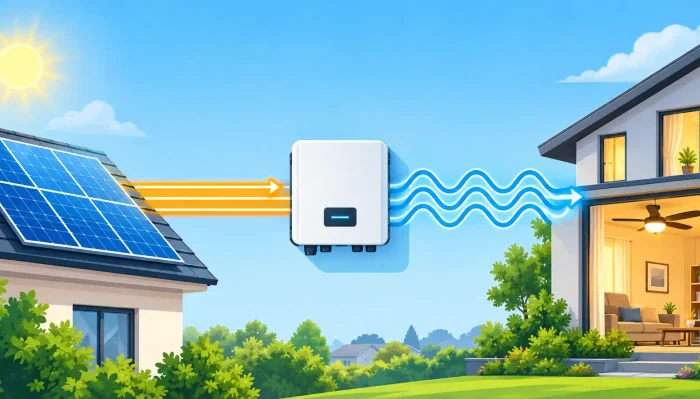
Solar panels generate direct-current electricity. An inverter converts it into the alternating-current electricity used by most household appliances. Energy can be lost through the inverter, wiring, connections, dirt, shading, and differences between panels.
The U.S. Department of Energy explains that residential photovoltaic systems include more than panels. Mounting equipment, inverters, and other components are needed to convert and deliver usable household electricity.
Is a 100-Watt Solar Panel Practical for Home Use?
A 100-watt solar panel for home use can be useful for small loads, but powering an entire house with these panels may require a large number of modules.
For example, four 100-watt panels provide 400 watts of rated capacity. One modern 400-watt panel offers the same rated capacity using a single module.
Installing dozens of smaller panels can require:
- More mounting hardware
- More wiring and connectors
- Additional roof space
- More installation labour
- More points that require inspection
A 100-watt panel may still be suitable for garden lights, security systems, sheds, caravans, fans, device charging or small backup systems. For a complete residential installation, higher-wattage panels are often more practical when roof space is limited.
Grid-Tied and Off-Grid Systems Need Different Calculations
The calculations above are mainly useful for estimating the energy production of a grid-tied solar system.
With a grid-tied system, your home can receive electricity from the grid when solar production is insufficient. The main goal is often to offset part or all of the electricity consumed over a month or year.
An off-grid system requires a more detailed calculation. You must consider:
- Electricity used at night
- Battery storage capacity
- Battery discharge limits
- Inverter size
- Appliance-starting surges
- Cloudy-weather backup
- The number of backup days required
Solar panels alone cannot provide normal night-time electricity unless the energy is stored in batteries or another power source is available. Battery-supported systems also need suitable equipment that can manage generation, storage and household loads.
Common Solar-Panel Sizing Mistakes
Avoid these common mistakes when calculating your system:
- Assuming a 100-watt panel generates 100 watts all day
- Using daylight hours instead of peak sun hours
- Checking only one month’s electricity bill
- Ignoring dust, shade and system losses
- Forgetting about night-time battery requirements
- Rounding the required number of panels down
- Copying another house’s solar setup
- Ignoring future air conditioners or appliances
Online calculations are useful for initial planning, but they cannot replace an on-site inspection by a qualified professional.
Final Answer
So, How Many 100 Waat Solar Panels Do I Need for My House?
At five peak sun hours per day and approximately 14% system losses, one 100-watt panel may generate around 12.9 kWh per month. A household using 500 kWh monthly would therefore need approximately 39 panels.
Your final requirement could be higher or lower depending on location, shade, roof direction, temperature, and seasonal conditions. Check your average annual electricity consumption and obtain a professional roof and electrical-load assessment before purchasing a complete system.
Frequently Asked Questions
How many 100-watt solar panels are needed for an average home?
There is no universal average because household electricity consumption varies. At five peak sun hours and 14% system losses, a home using 300 kWh monthly may need 24 panels, while a home using 900 kWh may need around 70.
Can ten 100-watt solar panels power a house?
Ten 100-watt panels create a 1 kW rated array. This may cover selected appliances or part of a small household’s consumption, but it is unlikely to power an appliance-heavy home completely.
How many 100-watt panels are needed for 500 kWh per month?
You may need approximately 39 panels when each panel produces around 12.9 kWh per month. The estimate assumes five peak sun hours daily and 14% system losses.
Can a 100-watt solar panel run a refrigerator?
It depends on the refrigerator’s daily electricity consumption, compressor-starting surge, battery and inverter. One 100-watt panel is usually not enough to operate a standard refrigerator reliably throughout the day and night.
Does a 100-watt solar panel produce 100 watts every hour?
No. Its production changes with sunlight strength, panel angle, temperature, dust, clouds and shade. The 100-watt figure is its rated output under specified test conditions.
Do I need batteries with 100-watt solar panels?
Batteries are usually required when you need off-grid electricity, night-time power or backup during outages. A basic grid-tied system may operate without batteries, depending on its design and local connection rules.
How many 100-watt solar panels do I need in Pakistan?
Divide your monthly electricity units by the estimated monthly output of one panel in your city. A household using 500 units may need approximately 33 to 49 panels under illustrative conditions of four to six peak sun hours and 14% system losses.
How much electricity does a 100-watt panel produce monthly?
At five peak sun hours per day and approximately 86% system efficiency, a 100-watt panel may produce around 12.9 kWh per month. Actual output will vary by location and installation conditions.