So, is hydro power DC or AC? It is AC. A hydroelectric generator spins inside a magnetic field, and that motion makes alternating current. Large plants send this AC straight into the grid. Some small off-grid systems change it to DC so batteries can store it.
The full answer depends on the size and type of system. Below, you will learn how a plant makes power, why AC dominates, and when DC shows up. You will also see how to choose for your own site.
The Short Answer
Large hydroelectric plants use synchronous generators. These make AC at a fixed frequency. In Pakistan, that frequency is 50 Hz.
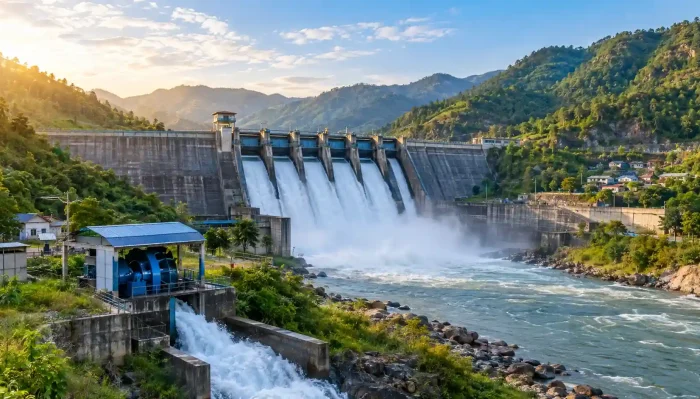
People often ask about dams like Tarbela and Mangla. The answer for both is AC. The same goes for almost every grid-connected hydel plant.
Small systems are more mixed. A micro-hydro unit can send AC directly to your appliances. Or it can make AC, convert it to DC, and store it in a battery bank. Does a hydroelectric generator produce AC or DC? Almost always AC. What happens next depends on the design.
| Feature | Large hydel plant | Micro-hydro system |
| Generator output | AC (synchronous generator) | AC (alternator), or a small DC unit |
| Voltage at the generator | Thousands of volts, then stepped up | 230 V AC direct, or 12 V, 24 V, 48 V DC at the battery |
| Typical size | Tens to thousands of MW | Under 100 kW. Most Pakistani village schemes are 3 to 50 kW |
| Typical use | National grid | Homes, farms, small villages off the grid |
| Conversion gear | Step-up transformer | Rectifier, charge controller, inverter (battery systems) |
How a Hydropower Plant Generates Electricity
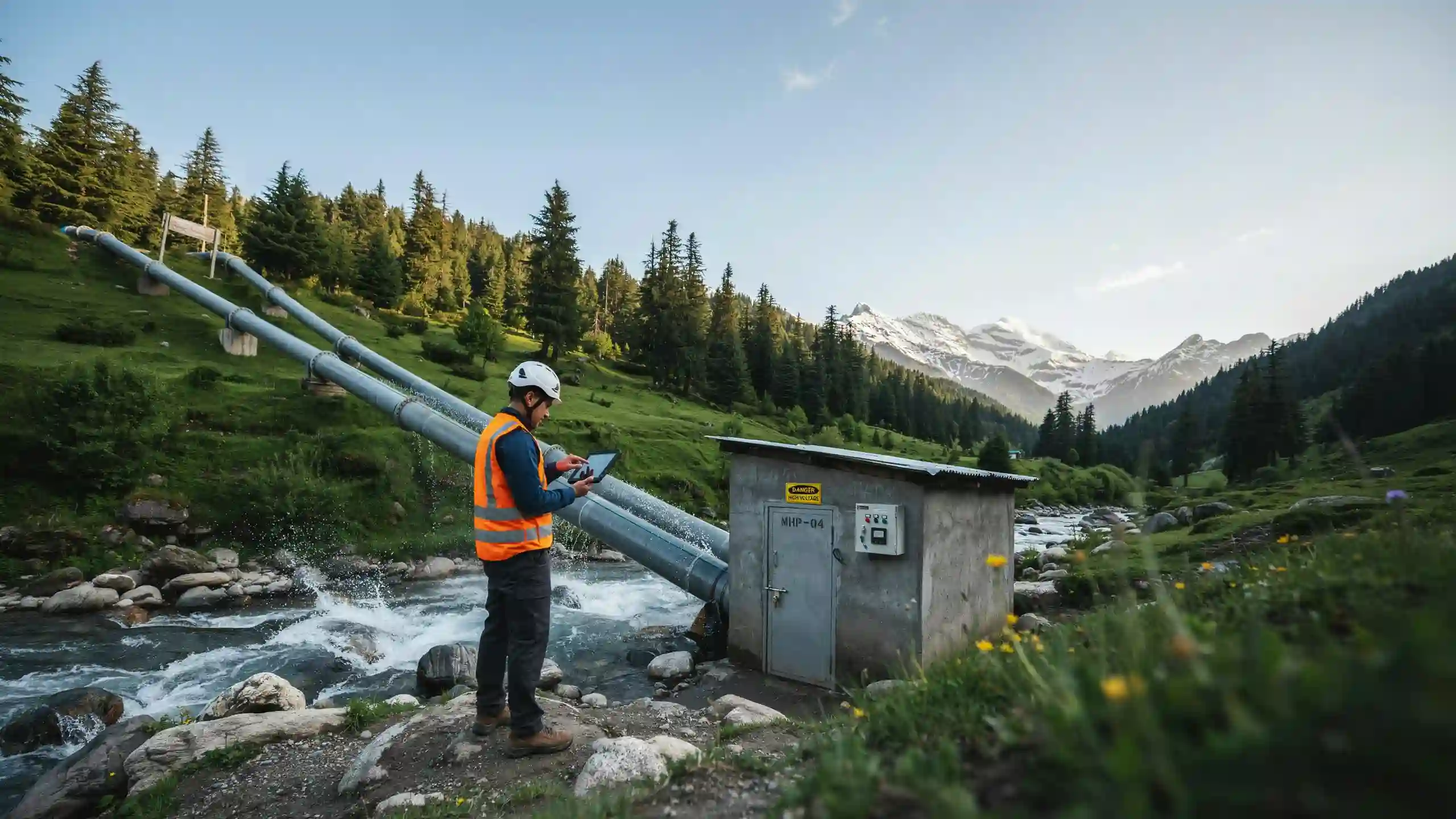
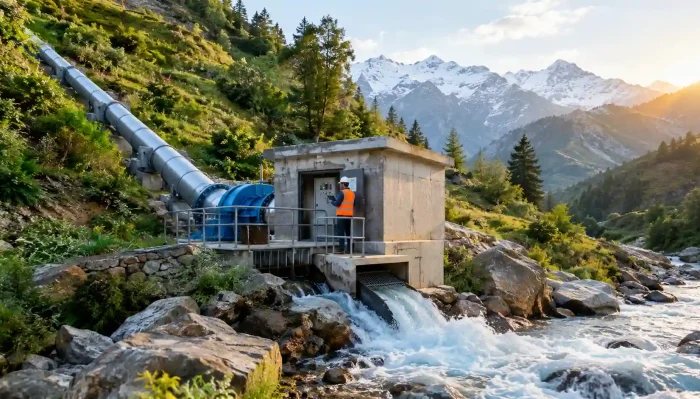
Every hydro plant follows the same basic path. Water gets collected at a dam, canal or stream intake. It then flows down a large pipe called the penstock.
The falling water hits a turbine and spins it. The turbine shaft is connected to a generator. Inside the generator, a spinning rotor creates a moving magnetic field around copper windings. That motion pushes electrons through the wires. This is electricity.
The turbine type depends on the site:
- Pelton wheels suit high head and low flow, common in mountain streams.
- Francis turbines suit medium head and medium flow.
- Kaplan turbines suit low head and high flow, such as canals and wide rivers.
- Crossflow turbines are popular in small hydel projects because they are simple to build and fix.
After the generator, the output is either stepped up for transmission or conditioned for local use. A big plant raises the voltage with a transformer. A small off-grid system may send it to a controller or a battery.
Want the full process? Read our guide: How Does Hydropower Work?
Why Large Hydropower Plants Use AC
AC wins at large scale for four reasons.
- Transformers make AC easy to adjust. A transformer raises or lowers AC voltage with no moving parts. It is cheap, tough and very efficient.
- High-voltage AC cuts losses over distance. Power lost in a wire grows with the square of the current. Raise the voltage ten times and the current falls ten times. The loss in the wire drops by 100 times. That is why power lines run at high voltage.
- The grid runs on AC. Every plant feeding the grid must match its frequency. In Pakistan, that is 50 Hz. A generator’s speed is tied to this number. A 20-pole machine, for example, must spin at exactly 300 rpm to give 50 Hz. The formula is 120 times frequency, divided by the number of poles.
- Your appliances expect AC. Fans, fridges, pumps and motors in Pakistani homes are built for 230 V AC.
AC vs DC History in Hydropower
The early story is a good example of AC vs DC electricity in hydropower. In 1882, the Vulcan Street plant in Appleton, Wisconsin, began running on water power. It made DC, and the DC could only travel a short distance. Edison’s DC systems had the same limit. Each neighbourhood needed its own power station.
Then Nikola Tesla’s AC designs, backed by George Westinghouse, changed things. Transformers let AC travel far. In 1896, the hydro plants at Niagara Falls began sending AC power to Buffalo, New York. That success helped make national grids practical.
One more fact: today, some very long hydro links use high-voltage DC. Brazil’s Itaipu project is one example. Converter stations at each end change AC to DC and back. So AC still does the generating and the final delivery.
When Hydropower Ends Up as DC
Can hydropower produce DC electricity? Yes, in two ways. A small turbine can drive a DC generator. Or a standard AC alternator can feed a rectifier that changes AC to DC. The second method is far more common.
DC appears mostly in off-grid homes and remote sites. These use battery banks at 12 V, 24 V or 48 V. A 48 V bank is popular for larger systems. Higher voltage means lower current, so you can use thinner, cheaper wire.
The usual chain looks like this:
Water → Penstock → Turbine → Generator (makes AC)
↓
Rectifier (AC to DC)
↓
Charge controller ──→ Dump load
↓ (burns extra power)
Battery bank (12 / 24 / 48 V DC)
↓
Inverter (DC to AC)
↓
Home appliances (230 V AC)
The dump load matters. When batteries are full, the controller sends spare power to a heater or similar load. This keeps the turbine from running unloaded and speeding up.
So is hydro power DC or AC in a battery system? The generator still makes AC. The battery stores DC. The inverter makes AC again for your home. Each conversion loses a little power, so fewer steps usually means better efficiency.
Common Myth: “A Transformer Converts DC to AC”
Some websites get this wrong. Pages that try to answer “is hydro power DC or AC” often say a transformer converts DC to AC. It does not.
Here is what each device really does:
- Transformer: changes AC voltage up or down. It does not work on steady DC.
- Rectifier: converts AC to DC.
- Inverter: converts DC to AC.
Think of the transformer as a gear box. It changes the “gear” of the voltage. It cannot change the type of current. If a plan for your site leaves out the rectifier or inverter, ask why.
AC or DC Micro-Hydro: Which Suits Your Site?
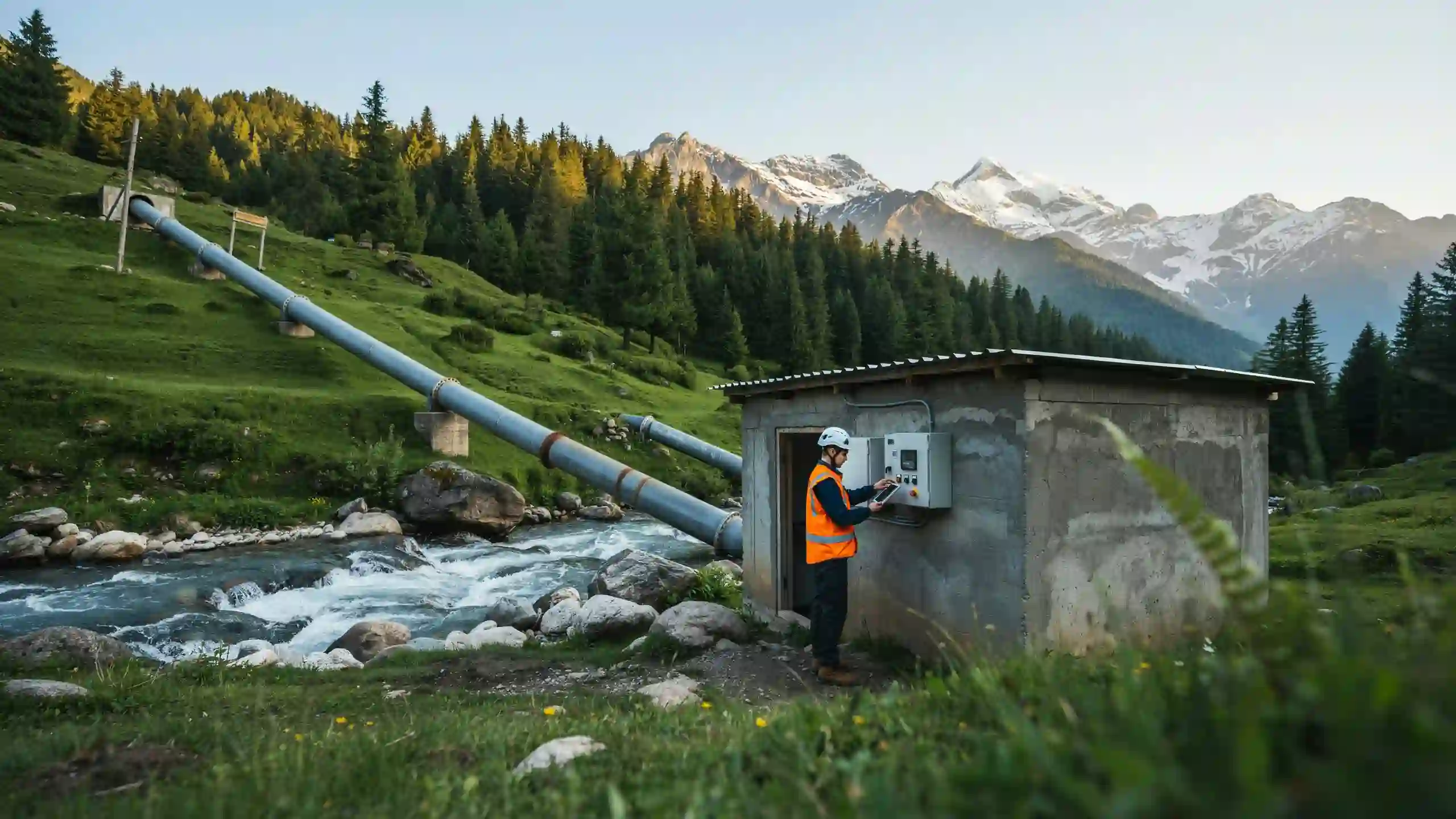
Two numbers set your power: head and flow rate. Head is the vertical drop of the water, in metres. Flow is the water volume per second.
The basic formula is:
Power (kW) = 9.81 × flow (m³/s) × head (m)
This gives water power before losses.
Worked example. Your stream drops 10 m, and 53 litres per second pass through the pipe. That is 0.053 m³/s.
9.81 × 0.053 × 10 = about 5.2 kW of water power.
Turbines, pipes and generators lose some of this. A common planning assumption is about 50% overall efficiency for small systems. That leaves roughly 2.6 kW of real output. Run all day, that is around 62 kWh. Check your own meter or load list to see how far that goes.
One more tip. Size your system for the dry-season flow, not the monsoon flow. Many people measure in July and regret it in February.
When AC Direct Makes Sense
Pick AC direct when your resource is strong and steady. It also works when your demand is high and constant, such as a workshop, a mill or a small village grid. You skip the batteries and the extra conversions. You do need an electronic load controller to keep voltage and frequency steady.
When a Battery-Based DC System Makes Sense
Pick batteries when power is low, flow changes with the seasons, or the site is remote. Batteries cover evening peaks, when the demand is higher than your turbine output. They also give you power if the stream drops for a few days.
| Your situation | Better choice |
| Strong, steady flow and high daily demand | AC direct |
| Low power (under 2 kW) or variable flow | Battery-based DC |
| Remote home with evening-only demand | Battery-based DC |
| Village mini-grid | AC direct, with a controller |
What Does It Cost?
These are foreign prices. Your cost in Pakistan depends on pipe length, civil work, turbine type and the batteries you choose. Batteries and inverters add to the total, but a grid connection to a remote site can cost more.
Need ideas for your own site? Read: What Are 5 Examples of Hydro Energy?
Hydropower in Pakistan
Pakistan has huge hydel potential. One academic review puts the total at about 60,000 MW. It notes that only around 11% had been developed. The north holds the biggest share. Khyber Pakhtunkhwa has about 14,000 MW and Gilgit-Baltistan about 11,700 MW.
Small streams matter too. Dawn has reported that the Pakistan Council of Renewable Energy Technologies built 290 micro-hydro schemes in the north. Each was between 3 and 50 kW. The Aga Khan Rural Support Programme built 171 micro-hydel units serving about 17,000 households. These figures come from older reporting, so check current numbers before you quote them.
Remote villages in the north often sit far from the national grid. Running a line up a mountain costs a lot. A stream next door can be a better answer. Winter flow can drop as water freezes, so a battery bank or a smaller turbine often helps.
For design, installation and testing, you can rely on professional Hydel Energy Installation services. Progressive Ventures studies your head, flow and demand. The team then picks the right turbine, generator and AC or DC setup for your site.
Conclusion
Large grid-connected plants use AC. Small systems use AC or DC, depending on how they store and deliver power. For anyone asking is hydro power DC or AC, the generator side is AC. DC only appears when batteries enter the picture.
Choosing the right setup starts with measuring your head, flow and daily demand. Contact Progressive Ventures for a site assessment and hydel installation built around your stream.
FAQs
Does hydropower produce AC or DC?
Hydropower generators produce AC. Large plants send it to the grid as AC. Some small off-grid systems convert it to DC to charge batteries.
Can household appliances run directly from a micro-hydro turbine?
Yes, if the system makes 230 V AC at a steady frequency and has a load controller. Without a controller, voltage can swing and damage appliances. Many homes use a battery and inverter for safer power.
Do I need an inverter with a hydro system?
You need one if you store power in batteries and want to run normal AC appliances. An AC-direct system with a controller does not need an inverter.
What is the difference between hydel and hydro energy?
“Hydel” is a common South Asian short form of “hydroelectric.” Both mean electricity made from moving water. Read more: Hydel vs Hydro Energy
Is hydropower renewable?
Yes. Rain and snowmelt refill rivers, so the water source renews itself.