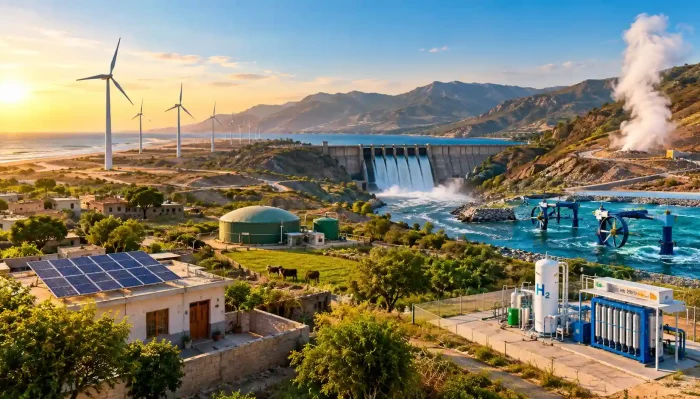
Here is the short answer. There is no real difference. What is the difference between hydel and hydro energy comes down to one thing: word choice, not science. “Hydel” is a short form of “hydraulic-electric,” and people in Pakistan use it the same way the rest of the world uses “hydro” or “hydroelectric.” Same dams, same turbines, same electricity.
If you grew up reading Pakistani news or WAPDA notices, you have seen “hydel” a hundred times. If you read international energy reports, you have only ever seen “hydro.” Both point to the exact same source of power: moving water.
Quick Answer: Hydel vs Hydro vs Hydraulic Energy
Most people searching for hydel energy vs hydropower explained just want one clear table, not three pages of theory. Here it is.
| Term | What It Means | Where It’s Used |
| Hydel energy | Short form of “hydraulic-electric.” Refers to electricity made from water. | Pakistan and other South Asian countries |
| Hydro / hydroelectric energy | Electricity generated from the kinetic and potential energy of moving water. | Used worldwide, including in Pakistan’s own technical reports |
| Hydraulic energy | The broader physical force of water in motion, whether or not it makes electricity. | Used in engineering and mechanical contexts globally |
So hydel and hydro sit in the same box. Hydraulic energy is the bigger box that holds them both, because water can do mechanical work (like running an old flour mill) without ever producing a single watt of electricity.
What Does “Hydel” Actually Mean? (Terminology and Origin)
The word “hydel” first showed up in print in the Times of back in 1934. It was built by joining “hydr” (from the Greek word for water) with “el,” a short form of “electric.” Over time it became standard shorthand across South Asian English.
Two of the most respected dictionaries in the world confirm this. The Oxford English Dictionary lists “hydel” as an adjective used mainly in n English, meaning “of or relating to hydroelectric power.” The Cambridge Dictionary defines it even more plainly: “n English for hydroelectric.”
In Pakistan, the word is not just casual slang. It shows up in official government language too. WAPDA (Water and Power Development Authority) uses “hydel” in its own documents, project names, and public notices. You will also hear it in the term “Net Hydel Profit,” which is real money the federal government pays to provincial governments, mainly Khyber Pakhtunkhwa, based on how much power a hydel station in that province generates. This is a genuine part of Pakistan’s power sector, not a made-up example.
So when you read “hydel power station” in a Pakistani newspaper and “hydroelectric plant” in a BBC report, both stories are talking about the same kind of facility.
What Is Hydro or Hydroelectric Energy? (The Technical Definition)

Now let’s get into how the actual engineering works, because this is where the real substance sits.
Hydro or hydroelectric energy is electricity made from the movement of water. A river’s water has two kinds of energy sitting inside it: kinetic energy from flowing, and potential energy from height. A hydro plant captures both.
Here is the basic setup at most plants. Water is held back by a dam or diverted from a river. It builds up behind a reservoir. Engineers call the height difference between the water surface and the turbine the “head.” A bigger head usually means more power.
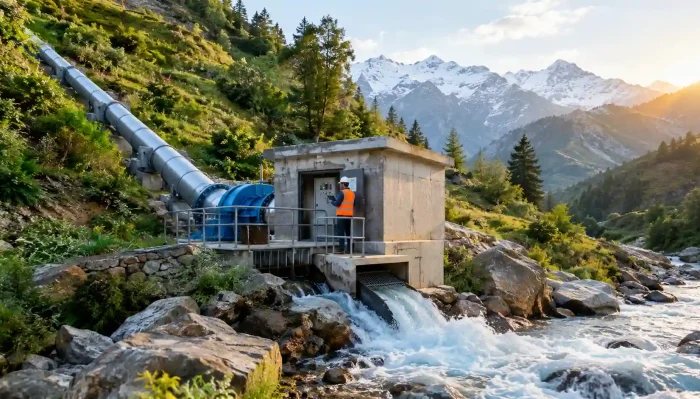
The water then drops through a large pipe called a penstock. Gravity pulls it down with real force. At the bottom, the water hits the blades of a turbine and spins it hard. That turbine is connected by a shaft to a generator, which turns the spinning motion into electricity. From there, the power travels out through transmission lines into the national grid, and eventually into homes and factories.
Some plants use large dams and reservoirs. Others use “run-of-river” designs, where the river’s natural flow spins the turbine without a big reservoir behind it. Both count as hydro energy. Both count as hydel energy too, if you are speaking in a Pakistani or n context.
Is Hydel Energy the Same as Hydroelectric Power?
Yes. Is hydel energy the same as hydroelectric power? Completely, in every technical sense. There is no separate turbine design for “hydel,” no separate physics, no separate grid connection process. A hydel power plant and a hydroelectric power plant are built the same way and run on the same principle.
The only difference is which word your source uses. A WAPDA report will say “hydel.” An International Energy Agency report will say “hydro” or “hydroelectric.” Both are describing identical technology. Think of it the way you’d think about “petrol” and “gasoline.” Different words, same fuel.
This matters for anyone doing research, writing a school assignment, or comparing project reports from different countries. Don’t assume a “hydel” plant and a “hydro” plant are different categories of infrastructure. They aren’t. They are the same industry using two labels shaped by regional English.
How a Hydel or Hydro Power Plant Works
Here is the process broken down into four simple steps.
- Water collection. A dam or intake structure gathers water from a river, either storing it in a reservoir or letting it flow through directly.
- The fall. Water drops through the penstock, gaining speed and force as it moves downward due to gravity.
- Turbine spin. The rushing water strikes the turbine blades and spins them at high speed.
- Electricity generation. The spinning turbine drives a generator, which produces electricity that flows into transmission lines and out to the grid.
This cycle repeats nonstop, day and night, as long as water keeps flowing. That’s part of why hydro and hydel plants can run for decades without needing new fuel, unlike a coal or gas plant that burns through supply constantly.
Types of Hydel and Hydro Power Plants in Pakistan
Understanding the types of hydel and hydro power plants in Pakistan helps explain why this energy source matters so much to the national grid.
Storage or reservoir plants. These use a large dam to hold back water and release it through turbines on demand. Pakistan’s two biggest examples are Tarbela Dam on the Indus River and Mangla Dam on the Jhelum River. Tarbela alone produces roughly 4,800 to 6,400 megawatts depending on which expansion phase is counted, making it one of the largest earth-filled dams in the world. Mangla adds close to 1,000 to 1,150 megawatts.
Run-of-river plants. These don’t rely on a massive reservoir. Instead they use the river’s natural flow and a smaller drop in elevation. Ghazi Barotha, downstream of Tarbela, and the Neelum-Jhelum Hydropower Project in Azad Jammu & Kashmir are strong Pakistani examples, each contributing close to 1,000 megawatts to the grid.
Pumped-storage plants. Globally, these work like a giant battery. Extra electricity pumps water uphill to a reservoir, then that water runs back down through turbines when demand spikes. Pakistan has very limited pumped-storage capacity right now, unlike countries such as China or the US, though it has been discussed in future WAPDA planning studies.
Small and mini hydel schemes. Smaller rivers and streams in Khyber Pakhtunkhwa, Gilgit-Baltistan, and parts of Azad Jammu & Kashmir host mini hydel stations that power off-grid villages. These schemes rarely make national headlines, but they matter enormously to remote communities with no other steady power source.
Newer additions built under the China-Pakistan Economic Corridor (CPEC) have also expanded capacity, including the Karot Hydropower Project on the Jhelum River and the Suki Kinari Hydropower Project in Khyber Pakhtunkhwa.
If your organization is exploring where hydel power fits into a broader renewable strategy, that’s exactly the kind of planning Progressive Ventures works on with clients across Pakistan. Our team handles feasibility studies and full Hydel Energy Installation projects, from site assessment through to grid connection. If you’re considering a hydel project for your site or community, get in touch with Progressive Ventures today to talk through what’s realistic for your location and budget.
Hydel Energy in Pakistan: Why the Term Matters Locally
Hydel power is not a side topic in Pakistan. It has historically supplied somewhere around a quarter to a third of the country’s total electricity, though the exact share shifts year to year based on rainfall, glacial melt, and how much thermal or renewable capacity comes online. WAPDA operates most of the country’s major hydel stations, while NEPRA (National Electric Power Regulatory Authority) regulates tariffs and oversees how that power gets priced and distributed.
The Net Hydel Profit arrangement is one of the clearest examples of why the word “hydel” carries real weight in Pakistan. It is a constitutional mechanism where the federal government pays provinces, mainly Khyber Pakhtunkhwa, a share of profit generated from hydel stations located within their territory.
This has been a genuine point of negotiation between provincial and federal governments for years, and it’s a detail almost no international energy website ever mentions, simply because the term “hydel” doesn’t exist outside South Asian English.
For Pakistan’s energy mix, hydel power offers something thermal plants can’t: low running cost once built, no imported fuel bill, and a direct role in managing water for irrigation alongside electricity. That combination is exactly why WAPDA and provincial governments keep expanding hydel capacity, from Diamer-Bhasha to smaller provincial schemes.
Is Hydel or Hydro Energy Renewable?
Yes, hydel and hydro energy are both renewable. They run on the water cycle, where rain and snowmelt refill rivers and reservoirs naturally, over and over, without ever running out the way fossil fuel reserves do.
That said, it’s not free of environmental cost. Large dams can affect river ecosystems, block fish migration, and cause sedimentation to build up behind the reservoir wall over time. Building a large hydel or hydro plant also takes years and heavy upfront investment. None of that changes its renewable classification, but it’s worth knowing before treating hydropower as a perfect, impact-free energy source.
FAQs
What is the difference between hydel and hydro energy?
There isn’t one in any technical sense. “Hydel” is a regional English term used in Pakistan and for hydroelectric power. “Hydro” and “hydroelectric” are the same thing, just used internationally.
Is hydel energy the same as hydroelectric power?
Yes. Both describe electricity generated from moving water using turbines and generators. The difference is only in wording, not in engineering.
What does “hydel” mean in Pakistan?
It means hydroelectric power. Pakistani government bodies like WAPDA and Pakistani media use “hydel” as standard shorthand, including in official terms like Net Hydel Profit.
What are the main types of hydel power plants in Pakistan?
Pakistan mainly uses storage plants like Tarbela and Mangla, run-of-river plants like Ghazi Barotha and Neelum-Jhelum, and smaller mini hydel schemes in Khyber Pakhtunkhwa and Gilgit-Baltistan.
Is hydel or hydro energy renewable?
Yes. Both rely on the water cycle, which refills naturally through rain and snowmelt, unlike coal, oil, or gas.