If you have a 3kW power system in your house, it should be enough for some very critical things you need in your house. But what specifically is the maximum number of things you can use at once if your household system has 3kW power capacity? Well, it depends on individual electrical appliances. If you want to know what you can connect to 3KW at the same time, do give it a look prior to going for a solar system, generator, or some other power system.
So, how many appliances can run on 3kw system at a time? This can produce around 3,000 watts of electricity to power whatever is connected to your household or commercial setup. However, in actuality, not everything you plug into it can run at the same time if it reaches up to precisely 3,000 watts, and you have to know about your system because solar generation varies day by day based on sunny days, whether a battery is fully charged, or even how powerful the inverter is used to deliver energy to your electrical gadgets.
Understanding the Capacity of a 3kW System
Think of your solar panel system’s capacity (how many kW it is) as its peak output potential (how much power it can generate at one time). Each item in your home requires a specific wattage to run; all you have to do to see if you can run several devices at once is sum up their requirements.
If, for example, your refrigerator uses 200 watts, your TV requires 100 watts, and some of the many LED lights in your house use 100 watts, all of those would be using roughly 400 watts combined.
That means that for the rest of the day, your system can take on more—as long as you don’t exceed 3000 watts at any one moment!
A 3kw Solar System: Will It Suit Your Needs?
People often ask what a 3kw solar system will power to ensure it can keep their most needed day-to-day necessities running. Under the right design, a 3 kW solar system can typically power things like
- Fans
- Refrigerators
- Computers
- Other common household appliances
Ideally, a 3 kW solar system would work best in medium- to small-sized homes with a low to medium usage of electricity per day. Essentially, if you rely more on energy-efficient appliances and are able to make do with running only a handful of high-powered appliances simultaneously, then a 3kw solar system would be ideal for you!
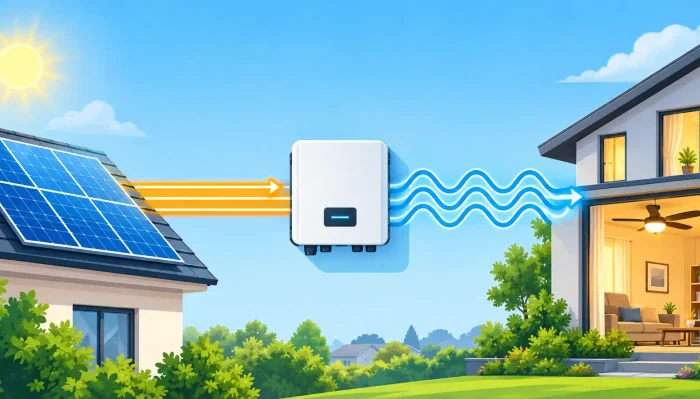
The performance capabilities of a solar system are also affected by whether your solar system is a grid-tied, hybrid, or off-grid system. Off-grid solutions (i.e., battery-based systems) can run without being connected to the grid and so could function as your primary electricity source after dark, whereas for an interconnected system (grid-tied), you may be more reliant on sunlight exposure and connection to the grid.
Appliances Commonly Suitable for a 3kW Solar System
A well-designed system may support appliances such as
- LED televisions
- Ceiling and pedestal fans
- LED lighting
- Mobile phone chargers
- Small kitchen appliances
- Water pumps with suitable capacity
Appliances That Can Quickly Increase Power Consumption
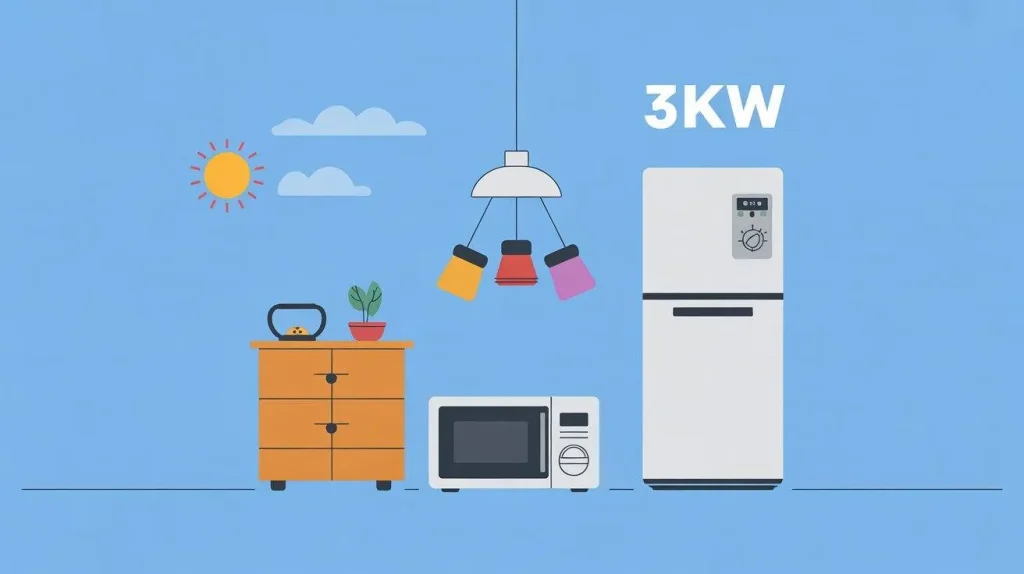
Different appliances consume different amounts of energy. While the capacity of your system is about 3 kW, it makes a lot of sense to think judiciously about the appliances that you want to operate, since many of the appliances mentioned below will drain all your energy.
Electric appliances with high heating functionality are often the most powerful electricity consumers: electric ovens, electric heaters, electric stoves, water heaters, and irons can individually consume 1,000 to 3,000 watts (or sometimes much higher), depending on the unit
Air conditioners and other cooling systems are another category to consider: these appliances can have substantial power demands. While newer-style, inverter-type air conditioners use less power once the desired temperature has been met, startup power and continuous use need to be included in a system’s total load calculation.
High-Power Appliances to Manage Carefully
The following appliances may require special load planning:
- Water heater
- Room heater
- Large air conditioner
- Electric oven
- Hair dryer
- High-capacity water pump
Things like kettles or irons that are power-hungry might not be a problem on a 3 kW even system, but if you turn these on when other items like ovens or toasters are running, you will very quickly flatten a battery or tax an inverter.
How to Calculate Your Household Appliance Load
If you are curious what wattage you need, then that is the simplest. All you have to do is look at the wattage rating on each device, appliance, and even thing that consumes power and is expected to run at the same time. Those can generally be found on a label affixed to the device itself, or it will be on or in your manual that comes with your new equipment, and sometimes will be found on the web at your manufacturer’s website.
Add up all of the wattages of the appliances that might run simultaneously, and viola!
You have an idea of what simultaneous load you have when you are running appliances simultaneously.
Total estimated load: 790 watts
This load is way lower than the 3,000-watt appliance that you could have; although, adding to the equation, you would have to include a 2,000-watt electric iron too, so appliance scheduling becomes necessary for it to run normally.
How Many Appliances Can Run on a 3kW Solar System?
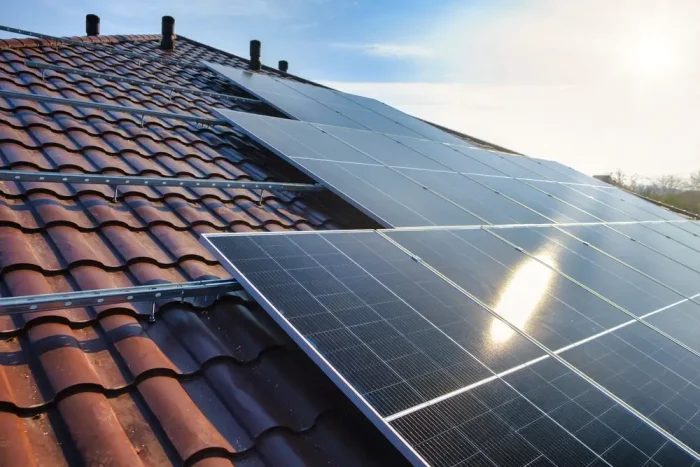
It is not the number of appliances that matters most—it’s total power consumption. For example, 15 different, low-wattage appliances could easily be used on a 3kW system, whilst just a single appliance or two in excess of 1kW may use up the majority of its capacity.
When it comes to determining the number of appliances that a 3 kW solar system can cater to, the best method for you to decide is by making a list of the appliances you frequently use. The total amperage consumption will give you a much better picture than simply stating how many appliances your solar array would be powering.
As well as your maximum solar system load, remember to consider daily energy consumption also.
Is a 3kW Solar System Enough for an Average Pakistani Home?
A 3kW system fits well for:
- Small to medium homes with two to four rooms
- Households running one AC unit at most
- Families focused mainly on fans, lights, a fridge, and basic electronics
It is not the right fit if your home regularly runs two or more air conditioners, an electric geyser, and multiple heavy appliances together. In that case, jumping to 5kW or 6kW avoids constant load management and gives more room to grow.
The Importance of Battery Capacity in a 3kW System
One of the most important factors of a 3 kW solar system is the battery storage capacity. It’s crucial to understand that solar panel capacity and battery capacity aren’t the same things. 3 kW denotes the maximum rated power that can be supplied by your panels. The battery is where the energy your panels produce is stored and used when solar production is low (nighttime and during cloud cover).
Your energy needs will play a huge role in determining whether you need a larger battery capacity. In many cases, those with a larger battery are capable of running the high-energy-consuming appliances in their home during the nighttime and outages for much longer, as opposed to a smaller system that may require managing usage of certain devices even when you have a 3kW system.
It is also vital not to forget that the type and quality of your inverter have a crucial role here, making sure the inverter is correctly rated or sized for your expected usage and surge during startup.
Factors That Affect 3kW Solar System Performance
As previously mentioned, the output of any solar system can vary significantly between homes. You simply cannot assume your 3 kW solar panels will ever work at full maximum capacity for all of the available daylight—especially during overcast weather or at times such as sunrise and sunset.
Shade, temperature, orientation, and location of your panels, as well as regular maintenance, are additional factors and variables that influence your electricity production, such as dust and dirt accumulated on the panels.
Professional installation can improve 3kW solar system performance through proper panel placement, wiring, and setup. Progressive Ventures provides professional solar installation services in Pakistan.
As such, you should never assume your 3 kW solar system will give you a full 3,000 watts during the day and instead rely on a properly designed system around your household usage with realistic predictions on output.
Tips for Running More Appliances Efficiently
Homeowners will need to start considering investing in an inverter air Conditioner/heating appliances—or a solar pump that uses DC instead of AC if they expect a higher amount of usage out of their current solar production—there are even new LED filament light bulb options to extend run times.
Using these types of appliances in conjunction with having them scheduled around the peak sun hours will make it significantly more comfortable and effective for most users on even lower-rated solar arrays—for smarter management and better return on investment through reducing the time when most solar is used when it is at the peak capacity on average of your solar day.
Instead of opting to invest in a potentially oversized setup, homeowners can consider utilizing and developing the right appliances and smart load management devices.
Final Thoughts
If you are living with energy-efficient appliances and are mindful of the high-consumption appliances running, a 3kW solar system can be powerful enough to run many important household appliances. Instead of looking for a 3kw solar system suitable for how many appliances can run on 3kw, the number to look for is how many high-consumption appliances run at the same time.
The actual number depends heavily upon your usage of individual appliances: do you have a smart refrigerator, energy-saving fans, and LED lights at your place, or do you have separate air conditioning units, a large oven for your kitchen, and maybe much more? Taking your time to note all these aspects, along with your actual hourly power consumption, will help you determine whether 3 kW of solar is sufficient for your household or not.
A 3kW solar system is suitable for powering essential home appliances. Contact Progressive Ventures for expert solar solutions tailored to your needs.
FAQs
How many appliances can run on a 3kW solar system?
A 3kW solar system can run multiple fans, LED lights, a refrigerator, a television, laptops, and other essential household appliances as long as the total load stays within 3,000 watts.
How many appliances can run on 3kW power system
A 3kW solar system can run fans, lights, refrigerators, TVs, laptops, Wi-Fi routers, washing machines, and an inverter air conditioner under favorable conditions.
What is the 3kW solar system load capacity?
The load capacity is approximately 3,000 watts, although operating below this limit is recommended for optimal performance.
Can a 3kW solar system run an AC?
Yes, a 3kW solar system can usually run one 1-ton inverter air conditioner along with several other household appliances during daylight hours.
How much electricity does a 3kW solar system generate daily?
Most 3kW solar systems in Pakistan generate between 12 and 15 kWh of electricity per day, depending on location, weather, and system efficiency.
Is a 3kW solar system enough for a house?
A 3kW solar system is generally sufficient for small and medium-sized homes with moderate electricity consumption and limited use of high-power appliances.
Will 3kW run a refrigerator?
A typical refrigerator may well work on 3kW in addition to other low-powered devices, depending on the start-up requirement and running wattage.
How many fans can I run from a 3kW setup?
It is normally quite easy to run multiple fans from a 3kW setup, as normal fans are relatively low-energy devices. High-efficiency fans will simply permit many more appliances to be run.
Can I run a washing machine on 3kW?
Yes, the system described previously should have the capacity to run most washing machines; the important thing is to ensure that you don’t try to run multiple high-powered devices simultaneously.
Should I put a battery in my 3kW setup?
Yes, if you want to continue to power your high-power appliances and lights during the night when you don’t generate any of your own solar.