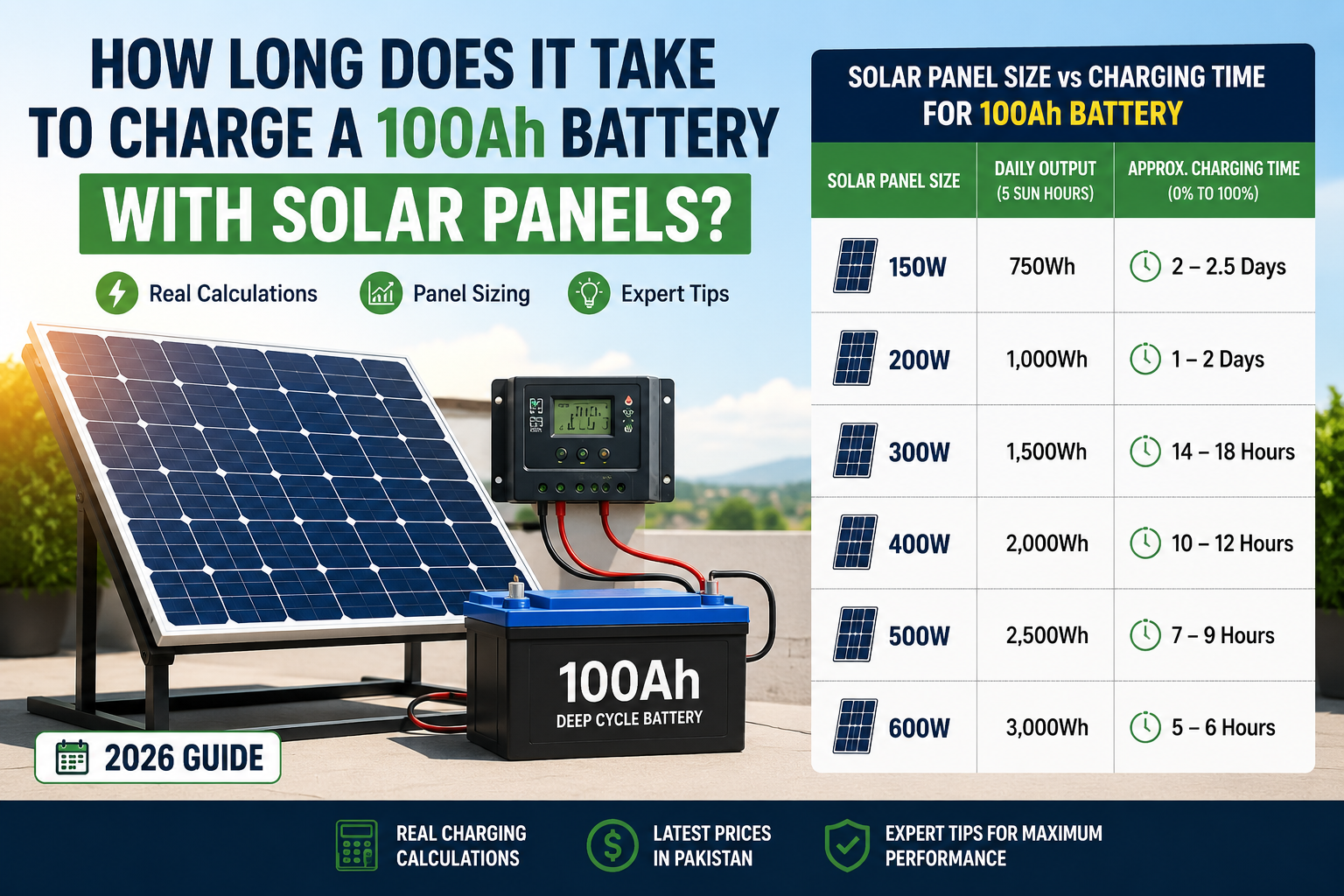
100Ah Battery Charge Time by Solar Panel Size
These figures assume a 12V 100Ah battery (1,200Wh), charging from empty, with 75% real-world system efficiency.
| Solar panel | Peak sun hours needed | Days at 5 sun hours | Suggested 12V MPPT controller |
|---|---|---|---|
| 100W | about 16 hours | about 3.2 days | 10A |
| 150W | about 10.7 hours | about 2.1 days | 20A |
| 200W | about 8 hours | about 1.6 days | 20A |
| 250W | about 6.4 hours | about 1.3 days | 30A |
| 300W | about 5.3 hours | about 1.1 days | 30A |
| 400W | about 4 hours | about 0.8 days | 40A |
| 500W | about 3.2 hours | about 0.6 days | 50A |
| 600W | about 2.7 hours | about 0.5 days | 60A, or move to 24V |
“Peak sun hours” are not clock hours of daylight. One peak sun hour is one hour of full-strength sunlight, so a day with 10 hours of daylight may only give 5 or 6 peak sun hours.
Understanding this energy value is important before calculating charging time because solar panels generate energy in watts, not amp-hours. Proper solar installation is also essential to ensure the system works efficiently and delivers accurate performance.
Real Usable Energy
| Battery Type | Usable Capacity |
|---|---|
| Lead Acid | 50%–70% (600–800Wh) |
| Lithium | 85%–95% (1000–1150Wh) |
This is important because real charging time depends on usable capacity, not just total capacity.
The Simple Formula for Solar Charge Time
You only need three numbers: your battery’s energy, your panel’s wattage, and an efficiency factor.
Charge time (peak sun hours) = Battery Wh ÷ (Panel watts × 0.75)
The 0.75 accounts for real losses from heat, wiring, dust, the charge controller and panel angle. In practice you receive about 75% of the panel’s rated output.
Worked example: 300W panel, 100Ah 12V battery
- Battery energy: 12V × 100Ah = 1,200Wh
- Ideal time: 1,200 ÷ 300 = 4 hours
- Real-world time: 4 ÷ 0.75 = 5.3 peak sun hours
So a 300W panel fills a 100Ah battery in about 5–6 hours of strong sun. In a place with 5 peak sun hours, that is just over one day.
PWM vs MPPT Controller
| Type | Efficiency | Use Case |
|---|---|---|
| PWM | 70–80% | Small systems |
| MPPT | 90–98% | Modern solar systems |
MPPT controllers are strongly recommended because they can improve charging speed by up to 30%.
Why a 100Ah Battery Holds 1,200Wh (and What You Can Actually Use)
A 100Ah battery can supply 100 amps for one hour or 10 amps for ten hours. Solar panels are rated in watts, so convert amp-hours to watt-hours before comparing:
12V × 100Ah = 1,200Wh (1.2kWh)
You cannot use all of that. Usable capacity depends on battery chemistry:
| Battery type | Usable capacity | Usable energy |
|---|---|---|
| Lead-acid (flooded, AGM, gel) | 50–70% | 600–840Wh |
| Lithium (LiFePO4) | 85–95% | 1,020–1,140Wh |
This matters for charge time. If your lead-acid battery is only drawn down to 50% each night, it needs about 600Wh to refill, so a 300W panel needs roughly 2.7 peak sun hours, not 5.3.
Charge Time by Panel Size, Explained
100W solar panel
About 16 peak sun hours, or 3 days or more. A 100W panel produces roughly 5–7 amps at 12V in good sun, which is enough to keep a battery topped up against a small load but too slow for real recharging.
150W solar panel
About 10.7 peak sun hours, or roughly 2 days at 5 sun hours. Fine for lights, a fan and phone charging on a backup battery, but too slow if you drain the battery daily.
200W solar panel
About 8 peak sun hours, or 1.5–2 days. A 200W panel does work with a 100Ah battery, but it only fully recharges it if you use less than about half the battery each day.
250W solar panel
About 6.4 peak sun hours. In strong sun this completes a charge in roughly one day with a little margin.
300W solar panel (the most common choice)
About 5.3 peak sun hours. Here is how a typical day looks in a sunny region:
- 9:00–11:00: the battery takes the most current and reaches roughly 40–50%.
- 11:00–14:00: the controller delivers near-full output and the battery reaches about 80–90%.
- 14:00–16:00: charging tapers off as the battery approaches full.
That means a 300W panel can fill a 100Ah battery in a single good day, but with little spare time for a late start or clouds. If you also run loads during the day, it will take longer.
400W solar panel (or panels)
About 4 peak sun hours. This is the best balance for most households because it leaves room for dust, haze and a slightly depleted battery.
500W solar panel (or panels)
About 3.2 peak sun hours. Useful when you want to run loads while charging. You will need at least a 50A controller at 12V.
600W solar panel (or panels)
About 2.7 peak sun hours on paper, but see the charge-rate limits below. A single 100Ah battery cannot always accept this much power, so a 600W array is better paired with a bigger battery bank or used to run appliances while charging.
For a deeper understanding of solar radiation and peak sun hours, you can read this global energy report:
International Energy Agency – Solar PV Systems
Peak Sun Hours in Pakistan: Use Your Own City
Pakistan receives plenty of sun, but the number you should use depends on your city and season. Typical annual averages:
| City | Average peak sun hours per day |
|---|---|
| Karachi | 5.5–6.5 |
| Lahore | 4.5–5.5 |
| Islamabad | 4.0–5.5 |
| Quetta | 6.0–7.0 |
| Peshawar | 5.0–6.0 |
| Multan | 5.5–6.5 |
| Faisalabad | 4.5–5.5 |
Winter values and hazy days are lower, so plan around the lower end of your range. For a precise figure for your exact location, use a solar estimation tool such as NREL’s PVWatts calculator.
Example for Quetta (6.5 peak sun hours, 300W panel):
- Daily output: 300W × 6.5 = 1,950Wh
- After 75% efficiency: about 1,462Wh
- Battery needs 1,200Wh, so it fills in 1,200 ÷ 1,462 ≈ 0.82 of a day
How to Calculate Your Own Charge Time (4 Steps)
- Battery energy: voltage × amp-hours. Example: 12V × 100Ah = 1,200Wh.
- Daily solar production: panel watts × peak sun hours. Example: 300W × 5 = 1,500Wh.
- Real-world output: multiply by 0.75. Example: 1,500 × 0.75 = 1,125Wh.
- Days to charge: battery Wh ÷ real-world output. Example: 1,200 ÷ 1,125 ≈ 1.07 days.
If your battery is not empty, replace 1,200Wh in step 4 with the energy you actually need to refill.
Choosing a certified solar company is just as important as selecting the right panel size, because installation quality directly affects system performance and long-term reliability
The Three Charging Stages (Why 100% Takes Longer)
Batteries do not charge at one steady speed.
1. Bulk (about 0–80%). The controller sends all the current the panels can provide, so this is the fastest stage. It usually takes 2–4 hours with a 300W panel.
2. Absorption (about 80–95%). Voltage is held steady while current falls. This protects the battery and typically adds 1–2 hours.
3. Float (about 95–100%). Only a small trickle flows to top off the battery. It can last from 30 minutes to several hours.
That is why a calculated 5.3 hours can become 6–7 hours in real life. For daily use, many people stop at 80–90%, and many lithium systems are set to do exactly that to extend battery life.
MPPT vs PWM Charge Controllers
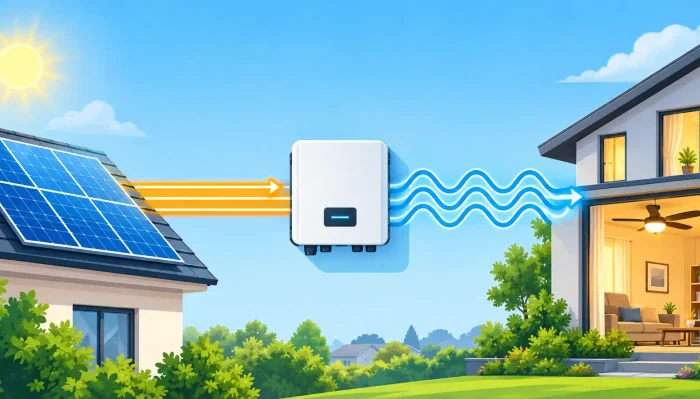
A solar panel cannot charge a battery directly. The charge controller regulates voltage and current. There are two main types.
| Controller | How it works | Typical gain | Best for |
|---|---|---|---|
| PWM | Connects the panel to the battery at battery voltage | Baseline | Small panels of 100W or less |
| MPPT | Converts the panel’s higher voltage into extra charging current | Often 10–30% more energy | Anything above 150W |
In practice, MPPT matters most in cold weather, with a partly depleted battery, and with higher-voltage panels. Over a full day it can cut your charge time noticeably, which is why we recommend MPPT for any system over 150W.
Lithium vs Lead-Acid: Charge Speed and Charge Limits
Lithium (LiFePO4) batteries accept charge faster and more evenly. Lead-acid batteries slow down sooner and have a lower maximum charge current.
- Lead-acid: most manufacturers recommend charging at about 10–20% of capacity, so 10–20A for a 100Ah battery.
- Lithium (LiFePO4): many 100Ah batteries accept 50A or more, but check your battery’s datasheet.
This changes what panel size makes sense:
- A 100Ah lead-acid battery cannot usefully absorb the output of a 600W array. Extra panels just push the battery against its charge limit.
- A 100Ah lithium battery can take a lot more, so 400–600W will genuinely charge it faster, as long as the controller and wiring are rated for the current.
Always check the battery’s maximum charge current before choosing your panels.
Why Real Charging Takes Longer Than the Math
- Weather: clouds, haze and rain can cut output by 30–60%.
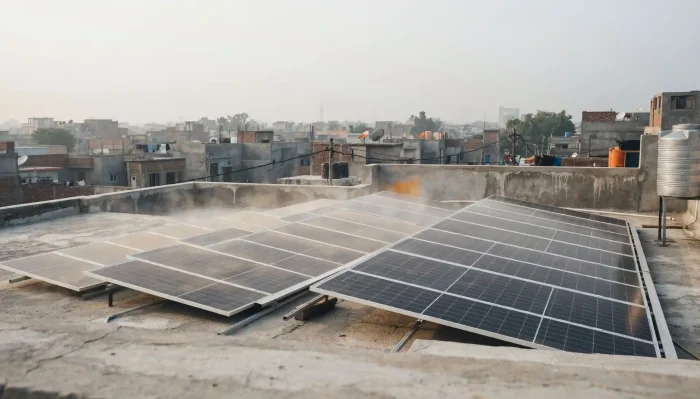
- Dust: common in Pakistan and a steady drag on output if panels are not cleaned.
- Angle and direction: panels should face south in Pakistan, tilted close to your latitude.
- Cables: thin or long wires waste energy as heat.
- Battery health: older batteries accept less charge and hold less energy.
- Starting charge level: a battery at 50% charges much sooner than one at 0%.
- Daytime loads: every watt you run while charging is a watt that does not reach the battery.
Good maintenance keeps performance up. If you are unsure how to care for your system, see our guide on whether solar panels need maintenance.
If you’re unsure how to maintain your system properly, you can get guidance on whether solar panels need maintenance and how to keep them working at peak efficiency.
What Size Solar Panel Do You Need for a 100Ah Battery?
| Goal | Recommended panel size |
|---|---|
| Minimum for a daily-use backup battery | 200W |
| Best balance of price and performance | 300–400W |
| Fast charging and running loads at the same time | 500–600W (lithium recommended) |
In dusty regions like Pakistan, a slightly oversized array makes up for efficiency loss.
How many panels is that?
- 300W: one 300W panel, or 2 × 150W
- 400W: one 400W panel, or 2 × 200W
- 600W: 3 × 200W, or 2 × 300W
More panels also help on cloudy days, when each panel produces less.
Example Setup: Backup Power During Load-Shedding
Suppose you want to run two fans, a few LED lights and a Wi-Fi router, about 150W in total, through an inverter during load-shedding.
- A 100Ah lithium battery gives about 1,000–1,150Wh of usable energy.
- After inverter losses, that powers the 150W load for roughly 6 hours.
- A 300W panel in good sun can refill most of that in one day, but only if the loads are off during peak sunlight.
If load-shedding happens daily, 400W is the safer choice because it leaves room for cloudy days.
Common Mistakes to Avoid
- Using an undersized panel and expecting daily full charges
- Ignoring efficiency losses and dust
- Using a PWM controller on a large array
- Choosing panels that exceed the battery’s maximum charge current
- Forgetting to clean the panels
- Expecting a fixed charge time instead of a range
Choosing a certified solar installer matters as much as choosing the right panel size, because installation quality directly affects performance and lifespan.
What Does a 100Ah Solar Setup Cost in Pakistan?
Costs vary widely with brand, battery type and installation. As a rough guide, a basic 200–300W system with a 100Ah battery sits at the lower end, while a 500–600W system with a lithium battery costs considerably more. Prices change often, so confirm current rates with a supplier.