If you already own a 100W solar panel and want to increase your system’s power, buying a 200W panel may seem like the easiest upgrade. But before connecting them, you might wonder: Can you connect 100W and 200W solar panels together?
The short answer is yes. You can connect a 100W and a 200W solar panel together, provided they have compatible electrical characteristics—especially similar voltage ratings. The way you connect them, whether in series or parallel, affects how efficiently they work and how much electricity they produce.
Many homeowners, RV owners, campers, and off-grid users expand their solar systems over time instead of replacing everything at once. Mixing different panel sizes is a practical and cost-effective solution, but it requires careful planning to avoid reduced performance or unnecessary energy loss.
In this guide, you’ll learn whether a 100W and 200W solar panel will work together, whether it is safe to connect 100W and 200W solar panels, the differences between series and parallel wiring, and the best practices for getting the highest performance from a mixed solar panel system.
Can You Connect 100W and 200W Solar Panels?
Table of Contents
ToggleYes, you can connect 100W and 200W solar panels, and many solar installers do this when expanding an existing system. However, simply connecting two different-wattage panels does not guarantee the best performance.
The most important factor is voltage compatibility, not wattage. If both panels have similar operating voltages (often around 18V for 12V nominal panels), they can generally be connected safely.
When connecting 100W and 200W solar panels, keep these points in mind:
- Match the voltage ratings as closely as possible.
- Use the appropriate connection method (series or parallel).
- Install a compatible MPPT charge controller.
- Use correctly sized cables and fuse protection.
- Follow the manufacturer’s installation recommendations.
If these guidelines are followed, a mixed solar panel setup can provide reliable energy while allowing you to expand your solar system without replacing your existing equipment.
How Solar Panel Wattage Works
Before deciding how to connect different solar panels, it’s important to understand what a panel’s wattage actually means.
A solar panel’s watt rating represents its maximum power output under Standard Test Conditions (STC). These laboratory conditions include:
- Sunlight intensity of 1,000 W/m²
- Cell temperature of 25°C
- Clear weather conditions
In real-world conditions, solar panels usually produce less than their rated power due to temperature, dust, shading, and weather.
What Does a 100W Solar Panel Mean?
A 100W solar panel can generate up to 100 watts of electricity under ideal conditions. It is commonly used for:
- RVs
- Camping
- Small battery charging systems
- Outdoor lighting
- Portable power stations
Typical electrical specifications include:
- Maximum Power: 100W
- Operating Voltage (Vmp): 18V
- Operating Current (Imp): 5.5A
Although compact, a 100W panel can generate approximately 400–600Wh of electricity per day depending on available sunlight.
What Does a 200W Solar Panel Mean?
A 200W solar panel produces roughly twice the maximum power of a 100W panel under the same conditions.
These panels are often used for:
- Home backup systems
- Cabins
- Larger battery banks
- RVs with higher energy demands
- Small off-grid solar systems
Typical specifications are:
- Maximum Power: 200W
- Operating Voltage (Vmp): 18V
- Operating Current (Imp): 11A
Notice that although the wattage doubles, the voltage often remains nearly the same. Instead, the panel delivers more current.
This is why matching voltage is much more important than matching wattage.
Typical Comparison
| Specification | 100W Panel | 200W Panel |
|---|---|---|
| Maximum Power | 100W | 200W |
| Operating Voltage (Vmp) | 18V | 18V |
| Operating Current (Imp) | 5.5A | 11A |
| Daily Energy (Average) | 0.4–0.6 kWh | 0.8–1.2 kWh |
As shown above, both panels can often operate at the same voltage, making them suitable candidates for a mixed solar setup.
Is It Safe to Connect 100W and 200W Solar Panels?
One of the most common questions people ask is “Is it safe to connect 100W and 200W solar panels?”
The answer is yes, provided the installation follows proper electrical design principles.
A mixed-wattage solar array is safe when:
- Both panels have similar operating voltages.
- Quality MC4 connectors are used.
- Proper fuse protection is installed.
- Cable sizes are appropriate for the expected current.
- A compatible MPPT charge controller manages the system.
- All wiring complies with the manufacturer’s recommendations.
Problems typically occur when users connect panels with very different voltage ratings or use undersized wiring that cannot safely handle the current.
Why an MPPT Charge Controller Matters
An MPPT (Maximum Power Point Tracking) charge controller is highly recommended when combining different wattage panels.
An MPPT controller can:
- Maximize energy harvest
- Improve charging efficiency
- Handle varying power levels more effectively
- Reduce energy losses compared to PWM controllers
Although PWM controllers can work in some systems, MPPT controllers usually deliver significantly better performance with mixed panel sizes.
How to Connect 100W and 200W Solar Panels in Series
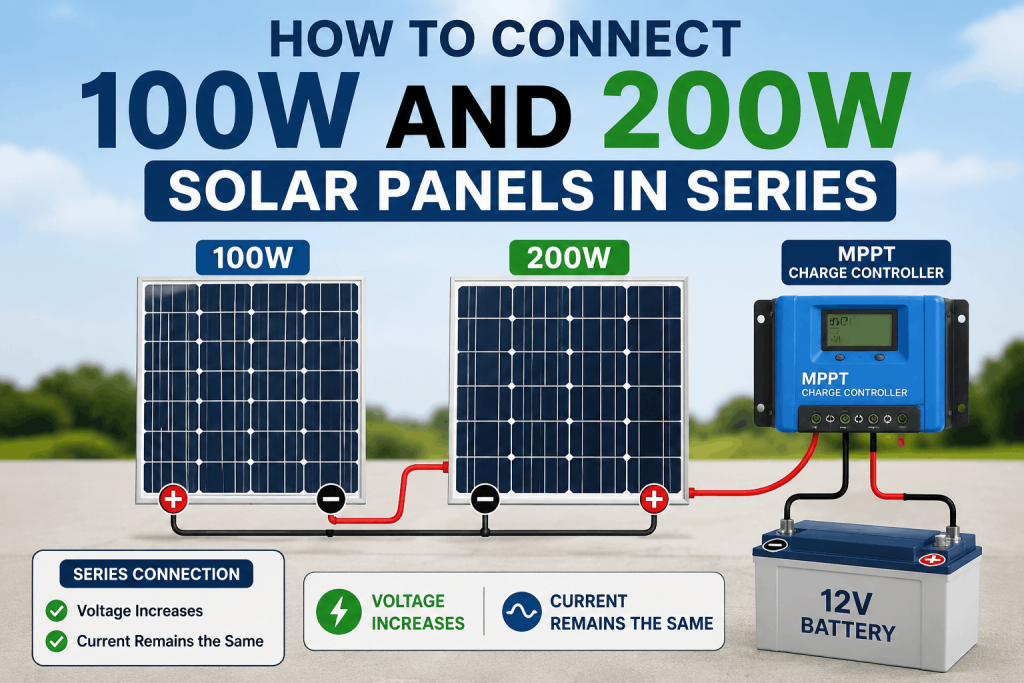
If your system requires a higher operating voltage, a series connection may be the right choice.
In a series connection:
- Connect the positive (+) terminal of the first panel to the negative (-) terminal of the second panel.
- The remaining positive and negative terminals connect to the charge controller.
How a Series Connection Works
When panels are connected in series:
- Voltage increases
- Current remains limited by the lower-current panel
For example:
100W Panel
- Voltage: 18V
- Current: 5.5A
200W Panel
- Voltage: 18V
- Current: 11A
Series Output
| Measurement | Result |
|---|---|
| Voltage | Approximately 36V |
| Current | Approximately 5.5A |
| Total Power | Around 198W |
Even though the second panel can produce more current, the entire series circuit is limited by the lower-current (100W) panel. This mismatch can reduce the total available power compared with the combined rated output.
Advantages of Connecting Solar Panels in Series
Connecting different-wattage panels in series offers several benefits:
- Higher system voltage
- Lower transmission losses over long cable runs
- Improved efficiency with MPPT charge controllers
- Reduced voltage drop in larger installations
- Suitable for higher-voltage battery systems
Limitations of Series Wiring
Before choosing this method, consider its drawbacks:
- The lower-current panel limits the total current.
- Shading on one panel reduces the output of the entire string.
- Significant electrical mismatches can decrease overall efficiency.
For these reasons, series wiring works best when the panels have matching voltage ratings and similar electrical characteristics, even if their wattages differ.
How to Connect 100W and 200W Solar Panels in Parallel
If your goal is to increase the available current while keeping the voltage the same, a parallel connection is often the better option. This method is commonly used in 12V solar systems for RVs, boats, cabins, and residential battery banks.
When learning how to connect 100W and 200W solar panels in parallel, the process is straightforward:
- Connect the positive (+) terminal of the 100W panel to the positive (+) terminal of the 200W panel.
- Connect the negative (-) terminal of the 100W panel to the negative (-) terminal of the 200W panel.
- Run the combined positive and negative cables to your charge controller using appropriately rated wiring and connectors.
How a Parallel Connection Works
In a parallel configuration:
- Voltage stays the same
- Current adds together
Using the same example:
100W Solar Panel
- Voltage: 18V
- Current: 5.5A
200W Solar Panel
- Voltage: 18V
- Current: 11A
Parallel Output
| Measurement | Result |
|---|---|
| Voltage | Approximately 18V |
| Current | Approximately 16.5A |
| Total Power | Around 300W |
Because the voltage remains constant while the current increases, parallel wiring allows both panels to contribute more effectively, making it one of the most efficient ways to combine panels with different wattages while maintaining matching voltages.
Advantages of Parallel Wiring
Parallel wiring offers several benefits:
- Better performance when one panel is partially shaded.
- Easier to expand your solar system over time.
- Maintains a stable voltage for 12V battery systems.
- Allows each panel to contribute its available current independently.
- Ideal for most residential and portable solar installations.
Limitations of Parallel Wiring
While parallel connections have many advantages, there are a few considerations:
- Higher current requires thicker cables to reduce voltage drop.
- Larger systems may need combiner boxes and additional fuse protection.
- Cable lengths should be kept as equal as possible for balanced performance.
Series vs. Parallel: Which Connection Is Better?
If you’re unsure which wiring method to choose, the answer depends on your solar system design, battery voltage, and charge controller.
| Feature | Series Connection | Parallel Connection |
|---|---|---|
| Voltage | Increases | Stays the same |
| Current | Limited by the lowest-current panel | Adds together |
| Performance in Shade | Lower | Better |
| Cable Losses | Lower | Slightly higher |
| Best For | High-voltage systems | 12V battery systems |
| Expansion | Moderate | Easier |
Which One Should You Choose?
For most homeowners and off-grid users, parallel wiring is the preferred choice when connecting 100W and 200W solar panels, especially if both panels have the same operating voltage. It allows each panel to contribute more effectively and performs better when sunlight conditions vary. If you’re upgrading your system, solar panel installation services can help ensure a safe and efficient installation.
A series connection can still be an excellent option if you’re using an MPPT charge controller and need a higher system voltage for improved efficiency over longer cable runs.
Can You Mix Solar Panel Sizes?
A common question among solar users is, “Can you mix solar panel sizes?”
Yes, you can mix solar panels of different wattages, and it’s a common practice when expanding an existing system. However, the panels should be compatible in terms of voltage and electrical characteristics.
Examples include:
- 100W + 200W
- 150W + 300W
- 200W + 400W
These combinations can work well when designed correctly.
However, avoid mixing panels that have:
- Significantly different operating voltages
- Different battery system voltages (such as 12V and 24V nominal panels)
- Different solar technologies without confirming compatibility
- Old, degraded panels with brand-new high-efficiency panels, as this may reduce overall performance
Planning your system carefully ensures that all panels work together efficiently and safely. If you need professional guidance on how to install solar panels, it can help you design and install a reliable, high-performance solar system tailored to your energy needs.
Best Way to Connect Different Solar Panels
If you’re connecting solar panels with different wattages, follow these best practices for safe and efficient performance.Before installing or expanding a solar system, it’s helpful to review the Homeowner’s Guide to Going Solar from the U.S. Department of Energy for best practices and planning considerations.
Match the Voltage
Ensure all panels have similar operating voltages (Vmp). Matching voltages improves efficiency and reduces power loss.
Use an MPPT Charge Controller
An MPPT charge controller maximizes energy production and is the best choice for mixed-wattage solar panels.
Install Circuit Protection
Protect your system with:
- DC-rated fuses
- Circuit breakers
- Surge protection (if required)
These components help prevent electrical damage.
Choose the Right Cable Size
Use cables rated for the total current to minimize voltage drop and improve efficiency. If you’re unsure about the correct cable size, our professional assessment can help ensure your system is designed safely and performs at its best.
Install Panels Correctly
For maximum output:
- Face all panels in the same direction.
- Use the same tilt angle.
- Keep panels free from shade.
Practical Example of a Mixed Solar Panel System
Suppose you already have a 100W solar panel and add a 200W panel to increase power output.
A typical setup includes:
- One 100W solar panel
- One 200W solar panel
- 30A MPPT charge controller
- 12V 200Ah lithium battery
- 1,000W pure sine wave inverter
With about 5 peak sun hours per day, this system can generate approximately 1.2–1.5 kWh of electricity daily.
It can comfortably power:
- LED lights
- Fans
- Wi-Fi router
- Laptop
- Television
- Small energy-efficient refrigerator
- Mobile device chargers
For higher energy needs, additional solar panels and battery storage may be required.
Conclusion
So, can you connect 100W and 200W solar panels? Absolutely. As long as both panels have compatible voltage ratings and are installed correctly, they can work together safely and efficiently.
Whether you choose a series or parallel connection depends on your energy goals and system design. Parallel wiring is generally the preferred option for most 12V battery systems because it allows both panels to contribute their available current while maintaining a consistent voltage. Series wiring can also be effective, particularly when paired with an MPPT charge controller and higher-voltage systems.
If you’re planning to expand your solar setup, taking the time to match panel specifications, use quality components, and follow proper installation practices will maximize energy production and protect your investment.
At Progressive Ventures, we help homeowners and businesses across Pakistan design and install efficient solar energy systems tailored to their power needs. Whether you’re upgrading an existing setup or planning a new installation, our experienced team can help you choose the right components for reliable, long-term performance.
Frequently Asked Questions (FAQs)
1. Can you connect a 100W and 200W solar panel together?
Yes. You can connect them if they have compatible voltage ratings and are wired correctly using either a series or parallel configuration.
2. Will a 100W and 200W solar panel work together?
Yes. Different wattage panels can work together, but the overall performance depends on their electrical compatibility and the connection method used.
3. Is it safe to connect 100W and 200W solar panels?
Yes. It is safe when proper wiring, compatible voltage ratings, correctly sized cables, fuse protection, and an MPPT charge controller are used.
4. Which is better: series or parallel?
For most 12V battery systems, a parallel connection is generally the better choice because it increases current while maintaining a stable voltage. Series connections are often preferred for higher-voltage systems with MPPT charge controllers.
5. Can you mix solar panel sizes?
Yes. Mixing different panel sizes is common and practical, provided the panels have similar operating voltages and compatible electrical characteristics.
6. Do I need an MPPT charge controller?
While not always required, an MPPT charge controller is strongly recommended because it maximizes energy production and improves efficiency when using different wattage solar panels.
7. Can I connect solar panels from different brands?
Yes. Solar panels from different manufacturers can often be connected together if their voltage and electrical specifications are compatible.
8. What happens if the voltages don’t match?
Panels with significantly different operating voltages may experience reduced performance, energy losses, and charging issues. Always verify electrical compatibility before connecting different solar panels.