One of the heavy duty home appliances that keeps us cool during the hot summers is an air conditioning unit. It also happens to be the most expensive device that consumes high amounts of electricity in a household. Whether you are buying an air conditioner, calculating the bill or using solar power, wattage matters.
If you’re wondering, “How many watts does an air conditioner use”, there is no definitive answer without knowing the AC’s capacity, type, efficiency, temperature, and your conditions. A small window AC could draw anywhere from 500 to 1,500 watts, and larger ones will be much higher. An inverter will fluctuate the watts instead of running at max power constantly.
What Does Wattage Mean in an Air Conditioner?
Watts (W) measure the electrical power an appliance uses while operating. A higher wattage generally means more electrical power is being used at that moment.
The more watts an appliance has the more electricity it’s consuming.
But, however, the thing is, your utility bills are normally calculated by kWh, not.
1,000 watts = 1 kilowatt (kW)
- AC watts are the power used by the AC while it is running.
- Initial power in the case of a conventional compressor starting.
- Actual consumption changes as cooling demand changes.
Understanding the wattage of your AC allows you to estimate your power consumption and see if it is supported by your electrical or solar system.
How Many Watts Does an Air Conditioner Use?
A residential air conditioner could be anywhere from a few hundred watts up to a few thousand watts.
For a rough estimate, the initial calculations for this article suggested these general ranges for running consumption:
| AC Capacity | Estimated Running Watts |
| 0.75 Ton | 500–700 W |
| 1 Ton | 800–1,200 W |
| 1.5 Ton | 1,200–1,800 W |
| 2 Ton | 1,800–2,500 W |
| 3 Ton | 3,000–4,000 W |
These are estimates rather than fixed specifications. Your actual AC may use more or less depending on its model, efficiency rating, outdoor temperature, thermostat setting, and cooling load. Current Progressive Ventures guidance, for example, gives a typical 1.5-ton inverter AC running range of around 1,200–1,500 watts for efficient models, while older non-inverter units can be higher.
How Much Does a 1.5 Ton AC Use?
Among the most asked question is regarding how many watts AC 1.5 ton are used for run.
A 1.5 Ton AC has an 18000 BTU/hr cooling capacity, then it doesn’t mean that it requires 1.5 kW of power to run. You’ll need an approximated power rating depending on the compressor, efficiency, conditions, and inverter type.
As a general estimate:
- Power consumption of 1.5 ton inverter AC approximately 1,200 to 1,500 watts or during operation.
- Some 1.5-ton ACs: around 1,500-1,800 watts
- Short startup demand: can be higher on some conventional units
The most accurate figure can always be found on the nameplate or by specification from the manufacturer.
1.5 Ton AC How Many Watts Does It Need?
If you are asking 1.5 ton AC how many watts is required for a solar or electrical system, then do not size the system based on just one ton.
Say for instance your inverter AC consumes 1500W or 1.5kW at its highest capacity and we use an inverter AC with capacity of 1.5 Tons and its.
1,500 W ÷ 1,000 = 1.5 kW
If it runs at that average power for 8 hours:
1.5 kW × 8 hours = 12 kWh
But, it is not that the inverter AC will consume the rated power for 8 hours. Inverter Compressor can switch off when the set temperature is achieved.
Window AC Power Consumption
Do Window Air Conditioners Use a Lot of Power? Window AC power use is determined by how efficient the unit is and the cooling capacity.
Typical estimates include:
| Window AC Size | Estimated Power |
| 0.75 Ton | 600-700 W |
| 1 Ton | 900-1,200 W |
| 1.5 Ton | 1,400-1,800 W |
The U.S. Department of Energy reference material shows that the small window units consume about 500 watts of power, and about 1,440 watts for some of its largest window units in their example data. Real-world consumption depends on model.
If you use a window AC with a power rating of 1,200 watts for 8 hours, it would theoretically take:
1.2 × 8 = 9.6 kWh per day
The actual number can be reduced depending on the compressor cycling off or the unit actually running below the rated load.
Inverter AC Watts: How Much Power Do They Use?
A basic fixed-speed AC has a constant compressor speed and switches on/off. A variable speed inverter AC can cut back the compressor speed once the room reaches the goal temperature.
Benefits of Inverter AC Technology
- Variable compressor speed
- More consistent temperature
- Potentially lower electricity consumption
- Quieter operation in many models
- Less frequent full-power cycling
Efficiency Levels can be radically different depending on the model, so comparing the manufacturer efficiency ratings as well as actual power figures are a better way to compare against an inverter AC than to assume each one will give you the same percentage of savings.
How Much Electricity Does an AC Use Per Month?
Use this simple formula:
Watts × Hours Used ÷ 1,000 = kWh
1,500 × 8 ÷ 1,000 = 12 kWh per day
For 30 days:
12 × 30 = 360 kWh per month
What Factors Affect AC Power Consumption?
Here’s the thing that might alter the power consumption of your AC:
AC Capacity
More capacity systems tend to have higher power requirements, though efficiency still comes into it.
Inverter Technology
Inverter systems can vary the compressor speed according to cooling requirements. This avoids running the compressor at full power when it is not necessary.
Outdoor Temperature
On extremely hot days, the AC must work harder.
Thermostat Setting
Extremes in temperature – the low setting on your water heater – can also add to the amount of hot water you use. A moderate setting will also help you reduce your electricity consumption.
Room Insulation
Rooms without insulation lose cool air faster.
Maintenance
Filters become dirty, airflow is restricted, and other components are not clean and maintained.
However, this is not a fixed number. Factors like sunlight availability, panel efficiency, battery backup (if used), and system design can slightly increase or decrease the total requirement, and how much solar panels can save on your electricity bills also depends on these conditions. That’s why proper system sizing is very important before installation.
However, factors like sunlight hours, hybrid inverter efficiency, and system losses can affect the final number. That’s why a proper solar system for AC load calculation is important before installation.
How to Calculate Your AC’s Exact Electricity Usage
Your best bet for calculating the actual amount you consume is to use the AC specifications.
Step 1: Check the AC Label
Look for information such as:
- Rated input power
- Current in amps
- Voltage
- Cooling capacity
- Efficiency rating
Step 2: Estimate Operating Hours
Determine approximately how many hours the AC operates each day.
Step 3: Convert Watts to kWh
Use:
Watts × Hours ÷ 1,000 = Daily kWh
Step 4: Calculate Monthly Consumption
You multiply your daily level for your AC use by the number of days you operate the AC.
Step 5: Estimate the Cost
Multiply your monthly kWh consumption by your electric rate.
This is a much more useful estimate than on the AC itself.
How Can You Reduce Air Conditioner Electricity Consumption?
You don’t necessarily need to stop using your AC to reduce electricity costs. A few practical changes can help.
Choose an Efficient AC
Consider the efficiency ratings and power ratings of the new model against the old when replacing an old unit. Energy efficiency standards and ratings are available to compare the energy efficiency of various models.
Keep Filters Clean
Dirty filters can restrict airflow and make the system work harder.
Keep Doors and Windows Closed
Preventing cooled air from escaping reduces unnecessary AC runtime.
Improve Insulation
Installation of good insulation helps to keep the temperatures down and reduces the cooling load.
Maintain the AC Regularly
Clearing drain filters and the exterior device can help the system work well.
Can Solar Panels Run a 1.5 Ton AC?
Yes, the correct size solar system can power the 1.5 Ton AC. The capacity of the solar system required will be based on the actual power drawn by the air conditioner, panel wattage, sunshine hours, inverter efficiency, other loads in the house and the presence of battery backup.
As an instance, a present Progressive Ventures steerage says that a properly designed 1.5-ton inverter ac is likely to draw 1,200-1,500 watts throughout operation, and may use around four 550-watt panels (slightly lower for a based mostly system, relying on real-world circumstances and losses). A battery backup requires increased capability.
The reason being the size of a solar system should be done on the basis of the real AC load and total load of the house and not a panel based on the AC’s tonnage.
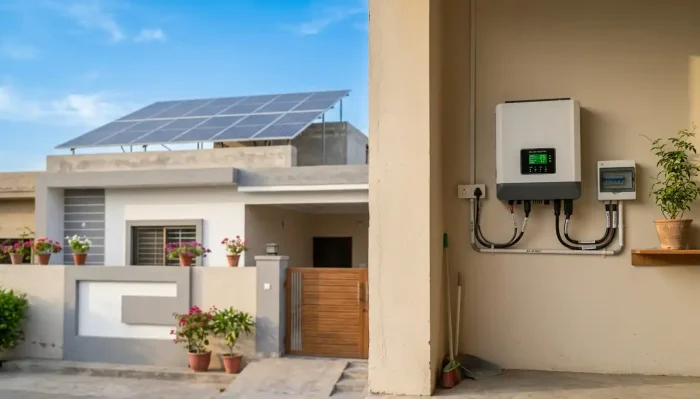
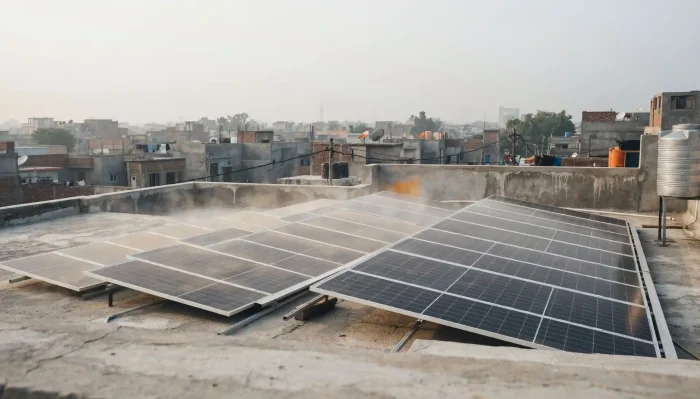
However, the most effective long-term solution is switching to solar. By installing a solar system, you can run your air conditioner using free energy from the sun, drastically reducing your monthly electricity costs. Certified Companies offers professional solar installation services in Islamabad, helping you power high-consumption appliances like air conditioners efficiently. With the right system design, you can cut your electricity bills by 50% or more while enjoying uninterrupted comfort.
What Size Solar System Is Needed for an AC?
No one size fits all so the optimal size for one AC won’t be appropriate for your others.
For example, one efficient 1.5-ton inverter AC might generate a running AC load of around 1.2-1.5 kW, and have to give space for other appliances as well.
You should consider:
- AC running wattage
- Maximum AC power demand
- Number of ACs
- Other appliances running simultaneously
- Solar panel wattage
- Peak sunlight hours
- Inverter capacity
- Battery requirements
- System losses
A professional load assessment can be used to identify the correct size prior to installation.
Smart Ways to Lower Your AC Electricity Bill
There isn’t a single solar-system size that fits all of your ACs.
As an illustration, one 1.5 ton efficient inverter AC system that was built, will have a requirement of around 1.2-1.5 kW of running AC load, and still remaining to support other appliances. You should consider:
- AC running wattage
- Maximum AC power demand
- Number of ACs
- Other appliances running simultaneously
- Solar panel wattage
- Peak sunlight hours
- Inverter capacity
- Battery requirements
- System losses
- Prior to installing a system, a professional load calculation can be used to determine system size.
Conclusion
Knowing How Many Watts An Air Conditioner Use can help you to Estimate Electricity Usage, evaluate the electricity requirements of different air conditioning models and options and determine the size of the electrical or solar system you need.
Power consumption varies by AC load, compressor, efficiency, temperature, room condition, and hours of operation. While 1.5 ton air conditioners typically consume around 1200-1800 W, their consumption can vary significantly from model to model. Inverter and more efficient models will consume less power as the cooling load reduces.
For running an AC with solar power don’t go by the tonnage. Go for electrical specs, maximum demand of the AC, other load of the house, sunlight available and inverter capacity. Contact us correctly sized solar system can take care of high cooling loads.
FAQs
How many watts does an air conditioner use?
Residential ACs can use several hundred watts to several thousand watts depending on their size, type, and efficiency. A 1.5-ton AC may commonly fall around 1,200–1,800 watts while running, although the exact figure depends on the model.
1.5 ton AC how many watts does it use?
A 1.5-ton AC does not have one fixed wattage. Many units operate around 1,200–1,800 watts, while efficient inverter models may commonly run around 1,200–1,500 watts under typical conditions.
How much 1.5 ton AC watts are needed for solar?
The answer depends on the AC’s actual power consumption. An efficient 1.5-ton inverter AC drawing around 1,500 watts requires enough solar generation and inverter capacity to support that load, with additional allowance for system losses and other appliances.
How many watts does an inverter AC use?
AC Power consumption in Inverters The power consumption of an inverter AC is less because the compressor speed varies. When the inverter air-conditioner is cooling a hot room, it uses more power, then less when it reaches the required temperature.
Does a window AC use more electricity?
Certain window air conditioners may draw more power than more efficient split or inverter units with similar cooling capacities-though this is true of some systems, not all, so check the specs.
How much electricity does an AC use in 8 hours?
If an AC averages 1,500 watts for 8 hours, the theoretical consumption is:
1,500 × 8 ÷ 1,000 = 12 kWh
Actual consumption can be lower if the compressor does not operate continuously at that power level.
Can a 1.5 ton AC run on solar panels?
Yes. You can run 1.5 ton AC using a solar system as if it is correctly installed. How many panels and the inverter capacity required will depend on the watt consumption of the AC the Watt PV panel has generated, sun hours, losses, other appliances, etc.
Does an inverter AC always use less electricity?
Not. Inverters are quite simply a way of controlling the compressor speed and in doing so, the inverter can often enhance the efficiency of your system. Your savings will however depend on the model, efficiency rating, how you use it, room conditions and climate.